As risk aversion intensifies and US Treasury yields decline, the US dollar index remains volatile at high levels.
2026-10-23 13:50:22
On Friday during the Asian session, the US dollar index traded around 101.60, with a significantly narrowed trading range, continuing its consolidation pattern after falling from its highs. The core contradiction currently lies in the fact that the cooling of the AI narrative and the slowdown in tech stock earnings have weakened the dollar's offensive power, while the Middle East geopolitical premium and strong short-term US Treasury yields have preserved a defensive floor. This combination results in a tug-of-war pattern where the index is "unable to fall deeply or rise significantly."  From the perspective of suppressing factors, a shift in risk appetite is altering capital flows. As several of the largest tech companies reported quarterly earnings that fell short of expectations, market doubts about the sustainability of AI trading deepened, weakening investor confidence. This pullback driven by "failed earnings validation" is fundamentally different from previous fluctuations solely driven by interest rate expectations—it simultaneously impacts both the dollar's risk premium and growth premium, depriving the index of tailwinds from asset rotation. When funds withdraw from tech stocks, theoretically, this should benefit safe-haven government bonds and lower yields, thus putting pressure on the dollar; however, at the same time, risk aversion also pushes up defensive currencies like the yen and Swiss franc, which in turn suppress the dollar index through weighted channels. This is the fundamental reason why this round of dollar pullback is more persistent than previous ones. Geopolitical uncertainties provide support from another angle. Escalating conflicts in the Middle East have triggered broader market risk aversion, with reports that the US and Israel are preparing additional military strikes against Iran after the midterm elections, further strengthening safe-haven demand and boosting the yen and Swiss franc against the dollar. This intermediate state of "leaving the door open for negotiations while holding military options" is precisely the scenario most difficult for the market to price: it is neither sufficient to disprove the risk of supply disruptions nor to provide a clear path to easing tensions, leading to a simultaneous rise in safe-haven demand and inflation concerns. For the US dollar index, this means that any deep correction is more likely to encounter buying support at relatively high levels; however, since safe-haven funds are flowing more towards the yen and Swiss franc rather than the dollar itself, the index's rebound also lacks smoothness. In terms of monetary policy, there are no signs of a shift in the tightening path, but the pace has been significantly prolonged. Recent statements from Federal Reserve officials indicate that there is almost no need to rush to accelerate policy tightening. While Fed Chairman Warsh expressed optimism about the potential resilience of the US economy, he avoided the question of whether further interest rate hikes are needed. Despite cautious wording, according to the CME FedWatch tool, market participants are currently pricing in a 92.8% probability of a pause in rate hikes at the October 27-28 policy meeting. This combination of "uncertain direction and delayed timing" has put the US dollar in an awkward position: a lack of hawkish catalysts to attract buying in the short term, while the medium-term tightening logic remains unproven to avoid a full-blown sell-off. For the US dollar index, this is an environment of "lack of short-term catalysts and unbroken medium-term logic": as long as the year-end rate hike path is not substantially disproven by data, the current pullback is closer to a technical correction than a trend reversal. Looking at the relative performance across currencies, institutional views further confirm the current divergence. ING analysts point out that the current macroeconomic background "may be more favorable for defensive currencies to slightly outperform commodity currencies," reflecting a market preference shifting away from high-risk foreign exchange assets. However, the bank also warns that "it's difficult to say the dollar needs a full-blown decline before the rock-solid short-term yield curve in the US begins to loosen," suggesting that the strength of US front-end yields remains a key anchor for overall dollar support. In other words, the current weakness of the US dollar is more reflected in the rebalancing of relative strength among G10 currencies than in a collapse of absolute value. The strengthening of the Japanese yen and Swiss franc has diverted some safe-haven funds, while commodity currencies are under pressure due to declining risk appetite, and the US dollar itself is firmly anchored to short-term interest rates. This assessment has important implications for investors: in the current environment, the success rate of going long or short on a single currency pair often depends on choosing the right "counterpart," rather than simply betting on the direction of the US dollar. Ignoring this structural characteristic makes it easy to suffer from sharp fluctuations in cross-currency pairs while the index moves sideways. In addition, the high volatility of oil prices is also indirectly shaping the index's fluctuation path. Rising energy costs reinforce the central bank's rationale for maintaining high interest rates through inflation, raising the central level of real interest rates, which corroborates ING's emphasis on the logic of "short-term yields anchored to the US dollar." However, at the same time, it also amplifies concerns about a global slowdown, creating an asymmetric impact on commodity currencies and Asian export-oriented economies' currencies. Therefore, the current weakness of the US dollar index is not a one-way decline, but rather the result of three intertwined factors: first, a proactive pullback triggered by the cooling of the AI narrative; second, the diversion effect of geopolitical premiums driving safe-haven funds to the Japanese yen and Swiss franc; and third, the bottom support provided by short-term US Treasury yields. This combination suggests that the index is more likely to digest divergences within a range rather than embark on a smooth one-way trend. On the 4-hour chart, the US dollar index is holding above the 200-period simple moving average, indicating a mildly bullish bias in the short term, and showing initial signs of bottoming out above this moving average; however, the price is constrained by the 23.6% Fibonacci retracement level at 101.92, which constitutes direct resistance to any rebound. Only a successful recovery above this level can confirm the end of the consolidation and open up space for an upward attack on higher retracement levels. The upside resistance levels to watch are 101.92, the previous support level at 102.40, and the psychological level of 103.00. On the downside, the first support level to watch is the 38.2% Fibonacci retracement at around 101.28, followed by the 200-period moving average at around 101.00. A clear break below this moving average on the daily chart would weaken the emerging bullish bias and expose a deeper risk of a pullback. Further downside targets are the psychological levels of 100.80 and 100.00. On the daily chart, the index has been consolidating slowly along the short-term moving average after falling from its high. The MACD histogram is close to the zero axis, with the fast and slow lines repeatedly intertwined, indicating neutral momentum. Currently, the price is fluctuating narrowly between 101.50 and 101.75. If it retraces to 101.50-101.60 and finds support, there is still a chance for a short-term upward move towards 101.92-102.00. However, if it breaks below 101.40 with high volume, it may seek support at 101.28 or even 101.00.
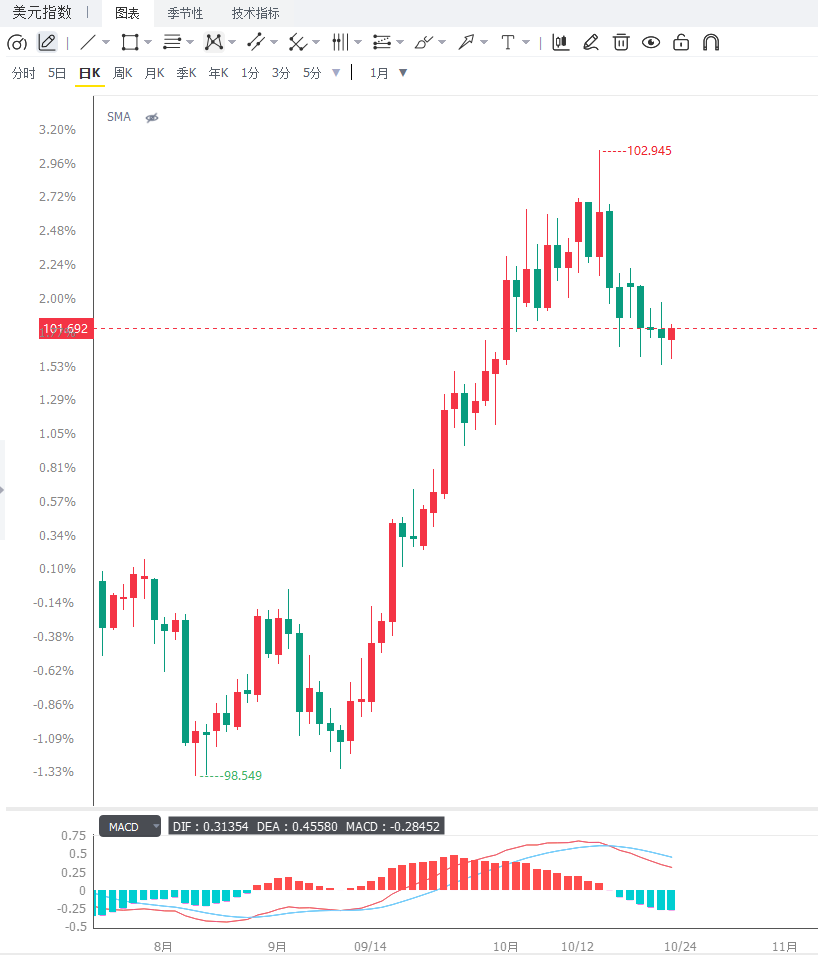 Editor's Summary: The core contradiction for the US dollar index in the short term lies in the skepticism surrounding AI trading and the slowdown in tech company earnings reports, which are suppressing bullish sentiment. Meanwhile, geopolitical premiums and short-term US Treasury yields maintain a floor, creating a two-way driving force that makes the index more likely to consolidate within the 101.28-101.92 range, awaiting a breakthrough in key events. Three variables need to be closely monitored going forward: first, the outcome and wording of the FOMC meeting on October 27-28, which will be the most crucial directional catalyst in the near term; second, the progress of the US-Israel plan against Iran and the status of passage through the Strait of Hormuz, any substantial escalation could potentially revitalize the dollar through safe-haven flows; and third, the stability of the US short-term yield curve, which ING emphasizes as the overall support anchor for the dollar, and any weakening of this curve would open up room for a comprehensive decline. In the medium term, before a significant breakout from the 101.00-101.92 range, the index will maintain a consolidation pattern, and confirmation of a trend direction still requires waiting for the recovery of tech stock earnings and the final clarity of the Fed's year-end policy path.
From the perspective of suppressing factors, a shift in risk appetite is altering capital flows. As several of the largest tech companies reported quarterly earnings that fell short of expectations, market doubts about the sustainability of AI trading deepened, weakening investor confidence. This pullback driven by "failed earnings validation" is fundamentally different from previous fluctuations solely driven by interest rate expectations—it simultaneously impacts both the dollar's risk premium and growth premium, depriving the index of tailwinds from asset rotation. When funds withdraw from tech stocks, theoretically, this should benefit safe-haven government bonds and lower yields, thus putting pressure on the dollar; however, at the same time, risk aversion also pushes up defensive currencies like the yen and Swiss franc, which in turn suppress the dollar index through weighted channels. This is the fundamental reason why this round of dollar pullback is more persistent than previous ones. Geopolitical uncertainties provide support from another angle. Escalating conflicts in the Middle East have triggered broader market risk aversion, with reports that the US and Israel are preparing additional military strikes against Iran after the midterm elections, further strengthening safe-haven demand and boosting the yen and Swiss franc against the dollar. This intermediate state of "leaving the door open for negotiations while holding military options" is precisely the scenario most difficult for the market to price: it is neither sufficient to disprove the risk of supply disruptions nor to provide a clear path to easing tensions, leading to a simultaneous rise in safe-haven demand and inflation concerns. For the US dollar index, this means that any deep correction is more likely to encounter buying support at relatively high levels; however, since safe-haven funds are flowing more towards the yen and Swiss franc rather than the dollar itself, the index's rebound also lacks smoothness. In terms of monetary policy, there are no signs of a shift in the tightening path, but the pace has been significantly prolonged. Recent statements from Federal Reserve officials indicate that there is almost no need to rush to accelerate policy tightening. While Fed Chairman Warsh expressed optimism about the potential resilience of the US economy, he avoided the question of whether further interest rate hikes are needed. Despite cautious wording, according to the CME FedWatch tool, market participants are currently pricing in a 92.8% probability of a pause in rate hikes at the October 27-28 policy meeting. This combination of "uncertain direction and delayed timing" has put the US dollar in an awkward position: a lack of hawkish catalysts to attract buying in the short term, while the medium-term tightening logic remains unproven to avoid a full-blown sell-off. For the US dollar index, this is an environment of "lack of short-term catalysts and unbroken medium-term logic": as long as the year-end rate hike path is not substantially disproven by data, the current pullback is closer to a technical correction than a trend reversal. Looking at the relative performance across currencies, institutional views further confirm the current divergence. ING analysts point out that the current macroeconomic background "may be more favorable for defensive currencies to slightly outperform commodity currencies," reflecting a market preference shifting away from high-risk foreign exchange assets. However, the bank also warns that "it's difficult to say the dollar needs a full-blown decline before the rock-solid short-term yield curve in the US begins to loosen," suggesting that the strength of US front-end yields remains a key anchor for overall dollar support. In other words, the current weakness of the US dollar is more reflected in the rebalancing of relative strength among G10 currencies than in a collapse of absolute value. The strengthening of the Japanese yen and Swiss franc has diverted some safe-haven funds, while commodity currencies are under pressure due to declining risk appetite, and the US dollar itself is firmly anchored to short-term interest rates. This assessment has important implications for investors: in the current environment, the success rate of going long or short on a single currency pair often depends on choosing the right "counterpart," rather than simply betting on the direction of the US dollar. Ignoring this structural characteristic makes it easy to suffer from sharp fluctuations in cross-currency pairs while the index moves sideways. In addition, the high volatility of oil prices is also indirectly shaping the index's fluctuation path. Rising energy costs reinforce the central bank's rationale for maintaining high interest rates through inflation, raising the central level of real interest rates, which corroborates ING's emphasis on the logic of "short-term yields anchored to the US dollar." However, at the same time, it also amplifies concerns about a global slowdown, creating an asymmetric impact on commodity currencies and Asian export-oriented economies' currencies. Therefore, the current weakness of the US dollar index is not a one-way decline, but rather the result of three intertwined factors: first, a proactive pullback triggered by the cooling of the AI narrative; second, the diversion effect of geopolitical premiums driving safe-haven funds to the Japanese yen and Swiss franc; and third, the bottom support provided by short-term US Treasury yields. This combination suggests that the index is more likely to digest divergences within a range rather than embark on a smooth one-way trend. On the 4-hour chart, the US dollar index is holding above the 200-period simple moving average, indicating a mildly bullish bias in the short term, and showing initial signs of bottoming out above this moving average; however, the price is constrained by the 23.6% Fibonacci retracement level at 101.92, which constitutes direct resistance to any rebound. Only a successful recovery above this level can confirm the end of the consolidation and open up space for an upward attack on higher retracement levels. The upside resistance levels to watch are 101.92, the previous support level at 102.40, and the psychological level of 103.00. On the downside, the first support level to watch is the 38.2% Fibonacci retracement at around 101.28, followed by the 200-period moving average at around 101.00. A clear break below this moving average on the daily chart would weaken the emerging bullish bias and expose a deeper risk of a pullback. Further downside targets are the psychological levels of 100.80 and 100.00. On the daily chart, the index has been consolidating slowly along the short-term moving average after falling from its high. The MACD histogram is close to the zero axis, with the fast and slow lines repeatedly intertwined, indicating neutral momentum. Currently, the price is fluctuating narrowly between 101.50 and 101.75. If it retraces to 101.50-101.60 and finds support, there is still a chance for a short-term upward move towards 101.92-102.00. However, if it breaks below 101.40 with high volume, it may seek support at 101.28 or even 101.00. Editor's Summary: The core contradiction for the US dollar index in the short term lies in the skepticism surrounding AI trading and the slowdown in tech company earnings reports, which are suppressing bullish sentiment. Meanwhile, geopolitical premiums and short-term US Treasury yields maintain a floor, creating a two-way driving force that makes the index more likely to consolidate within the 101.28-101.92 range, awaiting a breakthrough in key events. Three variables need to be closely monitored going forward: first, the outcome and wording of the FOMC meeting on October 27-28, which will be the most crucial directional catalyst in the near term; second, the progress of the US-Israel plan against Iran and the status of passage through the Strait of Hormuz, any substantial escalation could potentially revitalize the dollar through safe-haven flows; and third, the stability of the US short-term yield curve, which ING emphasizes as the overall support anchor for the dollar, and any weakening of this curve would open up room for a comprehensive decline. In the medium term, before a significant breakout from the 101.00-101.92 range, the index will maintain a consolidation pattern, and confirmation of a trend direction still requires waiting for the recovery of tech stock earnings and the final clarity of the Fed's year-end policy path.
- Risk Warning and Disclaimer
- The market involves risk, and trading may not be suitable for all investors. This article is for reference only and does not constitute personal investment advice, nor does it take into account certain users’ specific investment objectives, financial situation, or other needs. Any investment decisions made based on this information are at your own risk.