Weak PMI data failed to weigh on the Australian dollar, while rising bets on a Reserve Bank of Australia rate hike created a tug-of-war with a rebounding US dollar.
2026-10-23 15:58:24
The Australian dollar held steady against the US dollar after a slight decline the previous day, trading around 0.7020 in early European trading on Friday (October 23). Australia's S&P Global Composite PMI fell to 47.7 in October, down from 51.3 in September, marking its lowest level since March and the first contraction in private sector activity since May. The manufacturing PMI rose slightly to 49.7, contracting for the second consecutive month, while the services PMI fell to 47.8, contracting for the first time since May. Traders increased bets on a Reserve Bank of Australia (RBA) rate hike after Policy Committee member Andrew Hauser warned of a "significantly deteriorating" inflation outlook in the coming months, raising the probability of a November rate hike from 30% to 45%. However, a rebound in US Treasury yields supported the US dollar, potentially limiting the Australian dollar's upside potential. 
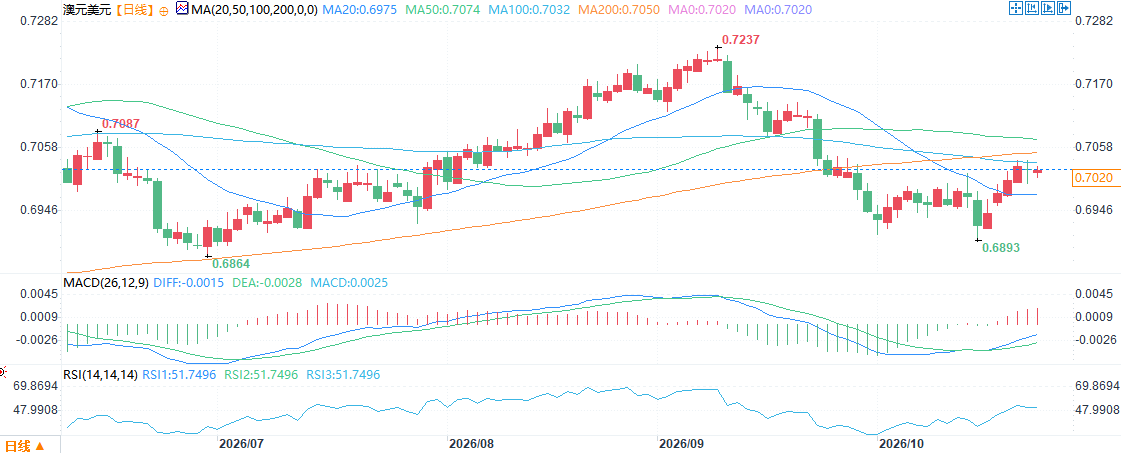 (Australian dollar to US dollar daily chart, source: EasyForex) At 15:52 Beijing time, the Australian dollar to US dollar exchange rate was 0.7020/21.
Australian PMI: Private sector activity contracts for the first time since May
The Australian dollar held steady against the US dollar after a slight decline the previous day, trading around 0.7020 in early European trading on Friday. The dollar remained stable following the release of the preliminary S&P Global Purchasing Managers' Index (PMI) for Australia. Specifically, the composite PMI fell to 47.7 in October from 51.3 in September, the lowest reading since March and the first contraction in private sector activity since May. The manufacturing PMI rose slightly to 49.7 from a 21-month low of 49.6 in September, remaining in contraction territory for the second consecutive month. The services PMI fell to 47.8 in September from 51.9, the first contraction since May and the lowest reading since March, although new business growth slowed significantly but remained in expansion territory.Bets on a Reserve Bank of Australia rate hike are heating up.
Traders significantly increased their bets on an RBA interest rate hike following comments from Reserve Bank of Australia (RBA) Monetary Policy Committee member and Deputy Governor Andrew Hauser. Speaking at a Citigroup investment conference on Wednesday, Hauser warned that the inflation outlook for the coming months had "significantly deteriorated," more severe than the RBA's August forecast. He cited high oil prices, rising AI-related costs, and continued domestic production pressures as reasons for businesses to view inflation around 3.5% as the "new normal." He emphasized that the central bank faces a "difficult choice," needing to balance curbing inflation expectations with protecting the labor market. Media reports indicate that the probability of a rate hike at the November policy meeting jumped from about 30% before Hauser's speech to 45%-50%. If the rate hike occurs, it will be the fifth this year, raising the official cash rate target from the current 4.60% to 4.85%, the highest level since the global financial crisis. Institutions such as Goldman Sachs have already included a November rate hike in their baseline scenario.A rebound in the US dollar may limit the upside potential of the Australian dollar.
However, the upside potential of the Australian dollar against the US dollar may be limited by a stronger dollar. The yield on the 10-year US Treasury note rebounded to around 4.98% on Friday, after falling sharply by more than 10 basis points the previous day due to a deeper sell-off in tech and artificial intelligence stocks, briefly hitting a one-month low. US bonds had previously been pressured by safe-haven inflows, mainly due to heightened market concerns about the sustainability of investment in artificial intelligence—AI is considered a core engine of current US economic growth, and a sharp correction in related stocks triggered a cooling of risk appetite. Investors flocked to US Treasuries for safety, pushing down yields, but a technical rebound followed. Meanwhile, financial markets lowered their expectations for further rate hikes by the Federal Reserve, with the October meeting almost certain to remain unchanged and the probability of a December rate hike also easing. The US dollar strengthened slightly, supported by rising yields, thus limiting further appreciation of the Australian dollar.Market impact
Australian October PMI data showed private sector activity contracted for the first time since May, with the service sector dragging down significantly and manufacturing also under pressure. However, the Australian dollar remained generally stable after the data release, indicating that the market is more focused on the policy outlook than on short-term soft economic data. Reserve Bank of Australia (RBA) Deputy Governor Hauser's inflation warning pushed the probability of a November rate hike to over 45%, which, if implemented, would be the fifth rate hike this year, raising the cash rate to 4.85%, providing potential support for the Australian dollar. However, the short-term Australian dollar/US dollar exchange rate remains constrained by the rebound in US Treasury yields and the recovery of the US dollar. Concerns about AI investments have cooled expectations of a Fed rate hike, creating a mixed picture of bullish and bearish factors. The exchange rate may maintain a volatile pattern in the short term. Close attention should be paid to next week's US GDP, PCE data, and Australian Q3 CPI results to determine whether the divergence in interest rate paths will widen further. (Australian dollar to US dollar daily chart, source: EasyForex) At 15:52 Beijing time, the Australian dollar to US dollar exchange rate was 0.7020/21.
- Risk Warning and Disclaimer
- The market involves risk, and trading may not be suitable for all investors. This article is for reference only and does not constitute personal investment advice, nor does it take into account certain users’ specific investment objectives, financial situation, or other needs. Any investment decisions made based on this information are at your own risk.