Rising oil prices have supported the Canadian dollar, while the USD/CAD pair has fallen for the seventh consecutive day; caution is advised against a potential acceleration of the downward trend.
2026-10-23 13:52:22
On Friday during the Asian session, the USD/CAD pair traded around 1.4000, continuing its downward trend from the previous trading day's close and approaching the psychologically important psychological level. The core contradiction in the current exchange rate lies in the fact that the US dollar has lost its offensive momentum due to the cooling of the AI narrative, while the Canadian dollar has received passive support due to high oil prices. This combined pressure has resulted in the rare seven-day losing streak. However, as key support levels approach and the oil price premium diminishes, the momentum for short selling is clearly weakening.  From the perspective of the US dollar, a shift in risk appetite constitutes the main theme of this round of decline. As several of the largest tech companies reported quarterly earnings that fell short of expectations, market doubts about the sustainability of AI trading deepened, weakening investor confidence. This correction, driven by "failed earnings validation," is fundamentally different from previous fluctuations solely driven by interest rate expectations—it simultaneously impacts both the dollar's risk premium and growth premium, depriving the index of tailwinds from asset rotation. When funds withdraw from tech stocks, theoretically, this should benefit safe-haven government bonds and lower yields, thus putting pressure on the dollar; simultaneously, risk aversion will also push up defensive currencies such as the yen and Swiss franc, indirectly disrupting cross-currency rhythms through the dollar index. This is the fundamental reason why the current pullback in USD/CAD is more persistent than previous rounds. In terms of monetary policy, there are no signs of a shift in the tightening path, but the pace has been significantly prolonged. Recent statements from Federal Reserve officials indicate that there is almost no need to rush to accelerate policy tightening. While Fed Chairman Warsh expressed optimism about the potential resilience of the US economy, he avoided the question of whether further interest rate hikes are needed. Despite cautious wording, according to the CME FedWatch tool, market participants are currently pricing in a 92.8% probability of a pause in rate hikes at the October 27-28 policy meeting. This combination of "uncertain direction and delayed timing" puts the US dollar in an awkward position: a lack of hawkish catalysts to attract buying in the short term, while the medium-term tightening logic has not been disproven to avoid a full-blown sell-off. For USD/CAD, this means the current decline is more of a technical correction than a trend reversal—as long as the year-end rate hike path is not substantially disproven by data, the exchange rate is still likely to find buying support after a deep correction. Support for the Canadian dollar is more direct and concrete. The Houthi rebels claimed responsibility for an attack on Saudi Arabia's Yanbu port on the Red Sea and carried out deadly strikes against an oil field and an airport in the world's largest crude oil exporter; meanwhile, Ukraine intensified its attacks on Russian refineries this week, clearly aiming to block Moscow's ability to expand diesel exports under the recently reached agreement. As a result, WTI crude oil held near a five-week high, while Brent crude remained in the five-month high range of around $110. As a typical commodity currency, the Canadian dollar is generally more elastic to oil prices than the US dollar. During periods of rapid oil price increases, the USD/CAD exchange rate tends to be more pressured downwards. This is a key driver behind the recent seven-day losing streak. However, it's important to be wary that this premium driven by "disruption expectations" could be quickly reversed if logistical data improves. Export flows from the Middle East have largely recovered to about 80% of pre-war levels. Saudi Arabia's crude oil exports in August increased by 7.9% month-on-month, the highest since March, and Russia is expected to ship its first diesel cargo as planned. This pattern of "conflict escalation and flow recovery coexisting" constitutes the core pricing contradiction in the current exchange rate: the attack brings a pulse-like premium, while export data reflects structural supply capacity. For the Canadian dollar, this is both immediate support and a potential reversal risk—once the geopolitical premium systematically subsides, the exchange rate is likely to quickly return to a track dominated by interest rate differentials. From the perspective of relative cross-currency performance, the current environment is more favorable for defensive currencies to outperform commodity currencies, reflecting a market preference for withdrawing from high-risk foreign exchange assets. This judgment has a dual meaning for USD/CAD: On the one hand, as a commodity currency, the Canadian dollar is already relatively weak in this round of preference switching, and its strength depends more on the passive driving of oil prices than on the active allocation of funds; on the other hand, the weakness of the US dollar is more reflected in the relative rebalancing of the strength and weakness of G10 currencies, rather than the collapse of absolute value. In other words, the decline in the exchange rate this time is not caused by the collapse of the US dollar's fundamentals, but is the result of the resonance of "US dollar deceleration superimposed with oil price pulse" - such combinations can often produce smooth one-sided market trends, but it is difficult to form a lasting trend. On the daily chart, USD/CAD is running below the 50-day exponential moving average (about 1.4075) and the 9-day EMA (about 1.4140). The short-term moving averages are arranged in a bearish pattern, and the rebound is continuously suppressed by the above resistance levels. The medium-term bearish structure has not yet been repaired; the RSI (14) is around 40, below the 50 neutral line and gradually approaching the oversold zone, indicating that the upward momentum is weakening, but the downside space may be limited by the excessive extension of the indicator. It is a typical "weak consolidation, approaching support" pattern. The upside resistance levels to watch are the 50-day EMA around 1.4075, the 9-day EMA around 1.4140, and the psychological level of 1.4200. Only a decisive break above 1.4075 on the daily chart can alleviate the current bearish bias. A further key resistance level is the horizontal resistance line at 1.4794. On the downside, the first support level to watch is the previous support at 1.3980, followed by 1.3920 and 1.3850. 1.3980 is a key support level in the near term; a break below this level could open up further downside potential. On the 4-hour chart, the price has been consolidating slowly along the short-term moving averages after falling from around 1.4040. The MACD histogram is close to the zero line, with the fast and slow lines repeatedly intertwined, indicating weak momentum. A break below 1.3980 with significant volume could lead to further support at 1.3920 or even 1.3850.
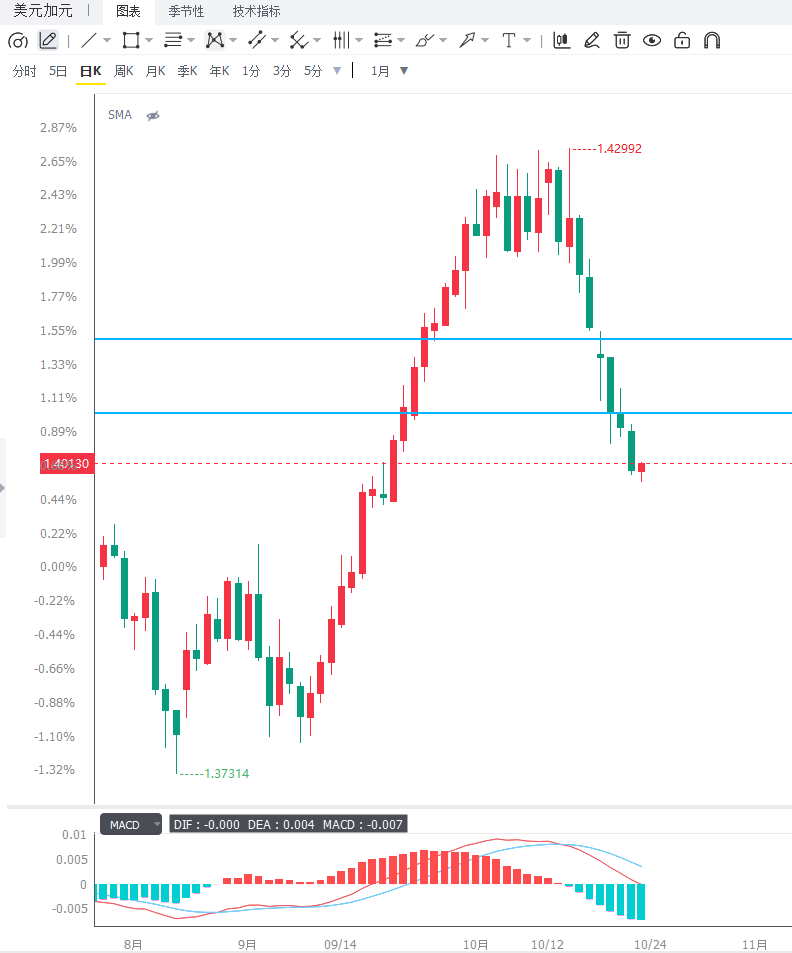 Editor's Summary: The core contradiction in the short-term USD/CAD exchange rate lies in the cooling of the AI narrative and the Fed's reluctance to raise interest rates, which suppresses the dollar. This, coupled with high oil prices boosting the Canadian dollar, makes the exchange rate more likely to consolidate within the 1.3980-1.4075 range, awaiting a breakthrough in the current situation. Three key variables need to be monitored: first, the extent of damage to the Shebay oil field and the progress of the evacuation from the Dhahran headquarters, as well as the port conditions of Yanbu and the Strait of Hormuz, which directly determine the duration of the oil price premium and the Canadian dollar's elasticity; second, the progress of the US-Israel plan against Iran and Iran's statements, any substantial escalation or de-escalation could repric the exchange rate through inflation; and third, the results and wording of the FOMC meeting on October 27-28, along with the preliminary Q3 GDP figures and the PCE price index, will be crucial in determining the year-end interest rate hike path. In the medium term, until 1.4075 is effectively recovered, the exchange rate will maintain a weak and volatile pattern. Confirmation of the trend direction still depends on the geopolitical situation and the final clarity of the policy paths of the US and Canadian central banks.
From the perspective of the US dollar, a shift in risk appetite constitutes the main theme of this round of decline. As several of the largest tech companies reported quarterly earnings that fell short of expectations, market doubts about the sustainability of AI trading deepened, weakening investor confidence. This correction, driven by "failed earnings validation," is fundamentally different from previous fluctuations solely driven by interest rate expectations—it simultaneously impacts both the dollar's risk premium and growth premium, depriving the index of tailwinds from asset rotation. When funds withdraw from tech stocks, theoretically, this should benefit safe-haven government bonds and lower yields, thus putting pressure on the dollar; simultaneously, risk aversion will also push up defensive currencies such as the yen and Swiss franc, indirectly disrupting cross-currency rhythms through the dollar index. This is the fundamental reason why the current pullback in USD/CAD is more persistent than previous rounds. In terms of monetary policy, there are no signs of a shift in the tightening path, but the pace has been significantly prolonged. Recent statements from Federal Reserve officials indicate that there is almost no need to rush to accelerate policy tightening. While Fed Chairman Warsh expressed optimism about the potential resilience of the US economy, he avoided the question of whether further interest rate hikes are needed. Despite cautious wording, according to the CME FedWatch tool, market participants are currently pricing in a 92.8% probability of a pause in rate hikes at the October 27-28 policy meeting. This combination of "uncertain direction and delayed timing" puts the US dollar in an awkward position: a lack of hawkish catalysts to attract buying in the short term, while the medium-term tightening logic has not been disproven to avoid a full-blown sell-off. For USD/CAD, this means the current decline is more of a technical correction than a trend reversal—as long as the year-end rate hike path is not substantially disproven by data, the exchange rate is still likely to find buying support after a deep correction. Support for the Canadian dollar is more direct and concrete. The Houthi rebels claimed responsibility for an attack on Saudi Arabia's Yanbu port on the Red Sea and carried out deadly strikes against an oil field and an airport in the world's largest crude oil exporter; meanwhile, Ukraine intensified its attacks on Russian refineries this week, clearly aiming to block Moscow's ability to expand diesel exports under the recently reached agreement. As a result, WTI crude oil held near a five-week high, while Brent crude remained in the five-month high range of around $110. As a typical commodity currency, the Canadian dollar is generally more elastic to oil prices than the US dollar. During periods of rapid oil price increases, the USD/CAD exchange rate tends to be more pressured downwards. This is a key driver behind the recent seven-day losing streak. However, it's important to be wary that this premium driven by "disruption expectations" could be quickly reversed if logistical data improves. Export flows from the Middle East have largely recovered to about 80% of pre-war levels. Saudi Arabia's crude oil exports in August increased by 7.9% month-on-month, the highest since March, and Russia is expected to ship its first diesel cargo as planned. This pattern of "conflict escalation and flow recovery coexisting" constitutes the core pricing contradiction in the current exchange rate: the attack brings a pulse-like premium, while export data reflects structural supply capacity. For the Canadian dollar, this is both immediate support and a potential reversal risk—once the geopolitical premium systematically subsides, the exchange rate is likely to quickly return to a track dominated by interest rate differentials. From the perspective of relative cross-currency performance, the current environment is more favorable for defensive currencies to outperform commodity currencies, reflecting a market preference for withdrawing from high-risk foreign exchange assets. This judgment has a dual meaning for USD/CAD: On the one hand, as a commodity currency, the Canadian dollar is already relatively weak in this round of preference switching, and its strength depends more on the passive driving of oil prices than on the active allocation of funds; on the other hand, the weakness of the US dollar is more reflected in the relative rebalancing of the strength and weakness of G10 currencies, rather than the collapse of absolute value. In other words, the decline in the exchange rate this time is not caused by the collapse of the US dollar's fundamentals, but is the result of the resonance of "US dollar deceleration superimposed with oil price pulse" - such combinations can often produce smooth one-sided market trends, but it is difficult to form a lasting trend. On the daily chart, USD/CAD is running below the 50-day exponential moving average (about 1.4075) and the 9-day EMA (about 1.4140). The short-term moving averages are arranged in a bearish pattern, and the rebound is continuously suppressed by the above resistance levels. The medium-term bearish structure has not yet been repaired; the RSI (14) is around 40, below the 50 neutral line and gradually approaching the oversold zone, indicating that the upward momentum is weakening, but the downside space may be limited by the excessive extension of the indicator. It is a typical "weak consolidation, approaching support" pattern. The upside resistance levels to watch are the 50-day EMA around 1.4075, the 9-day EMA around 1.4140, and the psychological level of 1.4200. Only a decisive break above 1.4075 on the daily chart can alleviate the current bearish bias. A further key resistance level is the horizontal resistance line at 1.4794. On the downside, the first support level to watch is the previous support at 1.3980, followed by 1.3920 and 1.3850. 1.3980 is a key support level in the near term; a break below this level could open up further downside potential. On the 4-hour chart, the price has been consolidating slowly along the short-term moving averages after falling from around 1.4040. The MACD histogram is close to the zero line, with the fast and slow lines repeatedly intertwined, indicating weak momentum. A break below 1.3980 with significant volume could lead to further support at 1.3920 or even 1.3850. Editor's Summary: The core contradiction in the short-term USD/CAD exchange rate lies in the cooling of the AI narrative and the Fed's reluctance to raise interest rates, which suppresses the dollar. This, coupled with high oil prices boosting the Canadian dollar, makes the exchange rate more likely to consolidate within the 1.3980-1.4075 range, awaiting a breakthrough in the current situation. Three key variables need to be monitored: first, the extent of damage to the Shebay oil field and the progress of the evacuation from the Dhahran headquarters, as well as the port conditions of Yanbu and the Strait of Hormuz, which directly determine the duration of the oil price premium and the Canadian dollar's elasticity; second, the progress of the US-Israel plan against Iran and Iran's statements, any substantial escalation or de-escalation could repric the exchange rate through inflation; and third, the results and wording of the FOMC meeting on October 27-28, along with the preliminary Q3 GDP figures and the PCE price index, will be crucial in determining the year-end interest rate hike path. In the medium term, until 1.4075 is effectively recovered, the exchange rate will maintain a weak and volatile pattern. Confirmation of the trend direction still depends on the geopolitical situation and the final clarity of the policy paths of the US and Canadian central banks.
- Risk Warning and Disclaimer
- The market involves risk, and trading may not be suitable for all investors. This article is for reference only and does not constitute personal investment advice, nor does it take into account certain users’ specific investment objectives, financial situation, or other needs. Any investment decisions made based on this information are at your own risk.