UK inflation hit an 11-month high, reinforcing expectations of an interest rate hike; pound sterling remained range-bound against the dollar.
2026-10-23 14:00:22
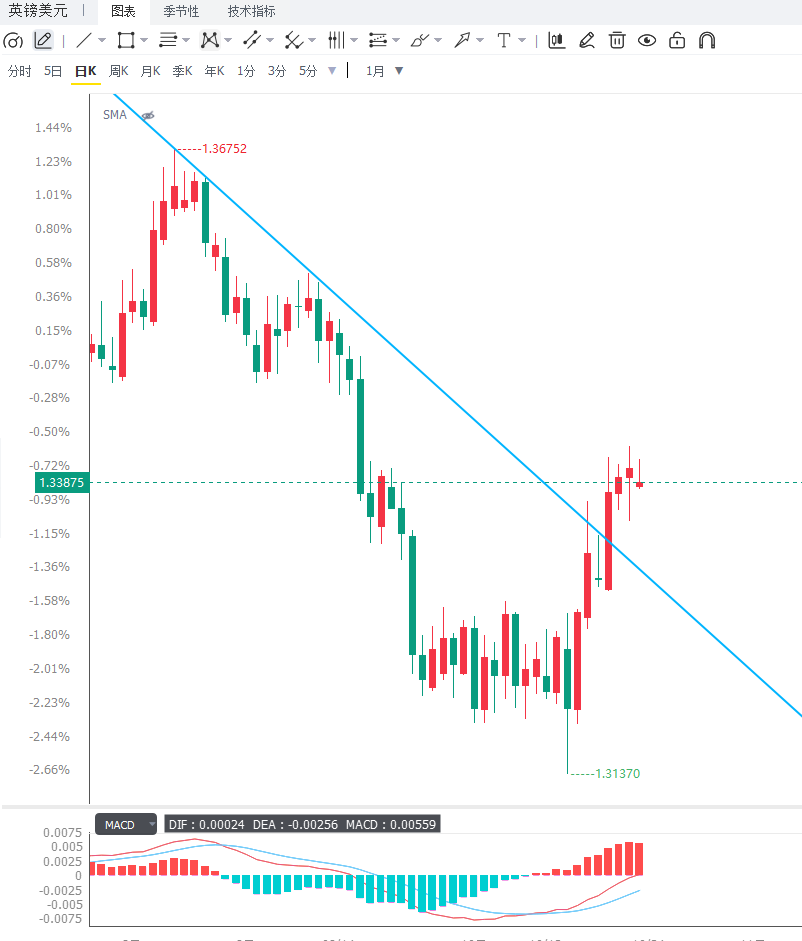
On Friday morning in Asia, the pound traded around 1.3400 against the dollar, continuing its recent moderate upward trend. The core contradiction in the current exchange rate lies in the following: the stronger-than-expected rebound in UK inflation provides the Bank of England with a clear reason to raise interest rates, making the pound a high-interest-rate currency among European currencies; while the dollar, though lacking the momentum to rise due to the Federal Reserve's "no rush to raise rates," still has room for further upside as the year-end tightening path remains unproven. This combination results in a tug-of-war pattern in the exchange rate, characterized by "easy to rise but difficult to fall, but a catalyst is needed for a breakout."  From the perspective of the pound, the across-the-board rise in inflation data constitutes the main driving force behind this round of strength. Data released by the UK Office for National Statistics on Wednesday showed that, driven by a sharp increase in petrol and diesel costs, the September CPI reached 3.5% year-on-year, and the core CPI rose to 2.8%, both exceeding market expectations. This means that the rebound in UK inflation is not limited to temporary disturbances in the energy sector, but is spreading to core areas—precisely the signal that the central bank is most wary of. Bank of England Governing Council member Green's recent speech received a score of 7.4/10, in line with the historical average, but his tone was clearly hawkish: he emphasized that the wage deflation process has stalled at a level inconsistent with the 2% target, and believes that policy should proactively guard against a second round of effects, and that this risk is "greater than previously thought." Although forward-looking data shows that wage growth is approaching 3.5%, Green still judges that the labor market is tight and slack may have peaked. This statement reinforces the policy inclination to "maintain tightening for a longer period" and also limits the near-term downside of the pound. For the pound, this is a combination of "data validation + official endorsement": as long as wages and service sector prices do not fall rapidly, the interest rate hike path is expected to continue to be supported, and the pound's interest rate advantage will also continue. Traders are pricing in a 98% probability of the Bank of England raising interest rates by 25 basis points to 4.0% next month, and most have already factored in a second rate hike of the same magnitude at the final meeting in December. If this materializes, it will be the bank's first rate hike since 2023, and one of the few central banks among the G10 currencies that is still substantially tightening. ING analysts point out that the recent strength of the pound in the euro/pound exchange rate is not simply due to domestic political sentiment. "It seems that the pound is riding on the coattails of Prime Minister Andy Burnham's high popularity. In fact, the euro/pound exchange rate movement includes both the pound's independent strengthening and the euro's independent weakening." The bank acknowledges that "earlier this year we thought the pound's gains were unsustainable," but "increased market confidence in the Bank of England's rate hike cycle—we expect 25 basis point hikes in February and November—has made the pound a high-interest-rate currency in Europe." This assessment has direct implications for the GBP/USD exchange rate: when the pound possesses both an interest rate advantage and attractiveness for capital allocation, its pullback against the dollar is more likely to encounter support at relatively high levels. However, the pound's upside potential is also constrained by multiple factors. On the one hand, Federal Reserve Chairman Warsh avoided providing guidance on the timing and necessity of future rate hikes last week, with almost all surveyed economists expecting the Fed to skip a rate hike in October and wait until December to take action. This combination of "uncertain direction and delayed timing" allows the dollar's interest rate advantage to continue while avoiding a risk-averse reversal triggered by excessive hawkishness. For GBP/USD, this is an environment of "a catalyst for the pound and a floor for the dollar": the year-end tightening path has not been disproven, providing bottom support for the index; however, the lack of additional hawkish catalysts in the short term makes the pound's breakout less smooth. On the other hand, ING expects fiscal policy to have a limited impact on the market, stating that "next week's UK budget is unlikely to reverse the recent decline of the euro/pound below 0.8400," and judges that the cross-currency "can currently continue to be under pressure in the 0.8360-0.8430 range." This means that the strength of the pound is more reflected against European currencies such as the euro, while its relative performance against the dollar is constrained by the dollar's own interest rate anchor—investors should not simply extrapolate the strength of the euro-to-dollar cross rate linearly to the pound against the dollar. UK retail sales data will be released later today, providing direct evidence that inflation has substantially transmitted to the consumer side; weak retail sales could undermine the credibility of the "inflation-wage-interest rate hike" chain, potentially triggering short-term profit-taking in the pound. Next week's UK budget is considered by institutions to have limited impact, but any unexpected fiscal expansion statements could still indirectly disrupt the pound's movement through the GILT yield channel. For investors, this means that before the data is released, a range-bound approach is more prudent than a trend-following approach, and the success rate of chasing highs and lows will significantly decrease. From a cross-asset perspective, the current fluctuations in the pound against the dollar are essentially a confluence of three factors: first, proactive interest rate differential support provided by UK inflation and wage stickiness; second, a passive pullback in the dollar due to the Fed's "no rush to raise interest rates but uncertainties at the end of the year"; and third, the continued weakening of the euro due to France's fiscal and political predicament, indirectly raising the pound's relative position within the currency basket. It is worth noting that high oil prices are both a cost source of rising UK inflation and a reason for global central banks to maintain high interest rates—making the pound's interest rate differential advantage and the dollar's interest rate floor coexist, constituting the structural reason for the current market's "ability to rise, but not rapidly." On the daily chart, the pound/dollar pair is holding above the 100-day simple moving average (approximately 1.3390) and significantly above the Bollinger Band middle line (approximately 1.3275), indicating a mildly bullish bias in the short term. The price is approaching the upper Bollinger Band (approximately 1.3412), indicating that it is testing short-term upward resistance. The RSI (14) is at 58.6, in positive territory and not yet in overbought territory, indicating a moderate release of upward momentum, with further upside potential before the indicator overextends. The immediate resistance is defined by the upper Bollinger Band at 1.3412. A close above this level on the daily chart would open up space for the continuation of the recent rebound. Higher resistance levels to watch are 1.3480 and 1.3550. The first support level to watch is the 100-day moving average at approximately 1.3390, followed by the Bollinger Band middle line at approximately 1.3275 and the lower Bollinger Band at approximately 1.3140. As long as the overall bullish tone continues, these levels are expected to support a pullback. On the 4-hour chart, after rebounding from around 1.3380, the exchange rate has been slowly moving upwards along the short-term moving average. The MACD histogram is expanding above the zero line, and the fast and slow lines are diverging upwards, indicating that the bulls are in control in the short term. Currently, the price is consolidating in a narrow range between 1.3400 and 1.3415. If it retraces to 1.3390-1.3400 and finds support, there is still a chance to retest 1.3412-1.3430. If it breaks below 1.3380 with significant volume, it may seek support at 1.3350 or even 1.3275.
 Editor's Summary: The core contradiction in the short-term GBP/USD exchange rate lies in the UK inflation hitting an 11-month high and Green's hawkish remarks reinforcing expectations of interest rate hikes. Meanwhile, the fact that the Fed's year-end tightening path has not been disproven limits upside potential. These two forces suggest the exchange rate is more likely to consolidate within a narrow range of 1.3390-1.3412, awaiting a data-driven breakout. Three key variables to watch going forward are: first, the UK retail sales data released later today, which will provide direct evidence of inflation transmission and consumer resilience; second, the wording of next week's UK budget and the reaction of GILT yields; although institutions anticipate limited impact, unexpected fiscal statements could still disrupt short-term trends; and third, the outcome of the Fed's October meeting and the final confirmation of its December path, which will determine the tightness or looseness of the dollar's interest rate floor.
From the perspective of the pound, the across-the-board rise in inflation data constitutes the main driving force behind this round of strength. Data released by the UK Office for National Statistics on Wednesday showed that, driven by a sharp increase in petrol and diesel costs, the September CPI reached 3.5% year-on-year, and the core CPI rose to 2.8%, both exceeding market expectations. This means that the rebound in UK inflation is not limited to temporary disturbances in the energy sector, but is spreading to core areas—precisely the signal that the central bank is most wary of. Bank of England Governing Council member Green's recent speech received a score of 7.4/10, in line with the historical average, but his tone was clearly hawkish: he emphasized that the wage deflation process has stalled at a level inconsistent with the 2% target, and believes that policy should proactively guard against a second round of effects, and that this risk is "greater than previously thought." Although forward-looking data shows that wage growth is approaching 3.5%, Green still judges that the labor market is tight and slack may have peaked. This statement reinforces the policy inclination to "maintain tightening for a longer period" and also limits the near-term downside of the pound. For the pound, this is a combination of "data validation + official endorsement": as long as wages and service sector prices do not fall rapidly, the interest rate hike path is expected to continue to be supported, and the pound's interest rate advantage will also continue. Traders are pricing in a 98% probability of the Bank of England raising interest rates by 25 basis points to 4.0% next month, and most have already factored in a second rate hike of the same magnitude at the final meeting in December. If this materializes, it will be the bank's first rate hike since 2023, and one of the few central banks among the G10 currencies that is still substantially tightening. ING analysts point out that the recent strength of the pound in the euro/pound exchange rate is not simply due to domestic political sentiment. "It seems that the pound is riding on the coattails of Prime Minister Andy Burnham's high popularity. In fact, the euro/pound exchange rate movement includes both the pound's independent strengthening and the euro's independent weakening." The bank acknowledges that "earlier this year we thought the pound's gains were unsustainable," but "increased market confidence in the Bank of England's rate hike cycle—we expect 25 basis point hikes in February and November—has made the pound a high-interest-rate currency in Europe." This assessment has direct implications for the GBP/USD exchange rate: when the pound possesses both an interest rate advantage and attractiveness for capital allocation, its pullback against the dollar is more likely to encounter support at relatively high levels. However, the pound's upside potential is also constrained by multiple factors. On the one hand, Federal Reserve Chairman Warsh avoided providing guidance on the timing and necessity of future rate hikes last week, with almost all surveyed economists expecting the Fed to skip a rate hike in October and wait until December to take action. This combination of "uncertain direction and delayed timing" allows the dollar's interest rate advantage to continue while avoiding a risk-averse reversal triggered by excessive hawkishness. For GBP/USD, this is an environment of "a catalyst for the pound and a floor for the dollar": the year-end tightening path has not been disproven, providing bottom support for the index; however, the lack of additional hawkish catalysts in the short term makes the pound's breakout less smooth. On the other hand, ING expects fiscal policy to have a limited impact on the market, stating that "next week's UK budget is unlikely to reverse the recent decline of the euro/pound below 0.8400," and judges that the cross-currency "can currently continue to be under pressure in the 0.8360-0.8430 range." This means that the strength of the pound is more reflected against European currencies such as the euro, while its relative performance against the dollar is constrained by the dollar's own interest rate anchor—investors should not simply extrapolate the strength of the euro-to-dollar cross rate linearly to the pound against the dollar. UK retail sales data will be released later today, providing direct evidence that inflation has substantially transmitted to the consumer side; weak retail sales could undermine the credibility of the "inflation-wage-interest rate hike" chain, potentially triggering short-term profit-taking in the pound. Next week's UK budget is considered by institutions to have limited impact, but any unexpected fiscal expansion statements could still indirectly disrupt the pound's movement through the GILT yield channel. For investors, this means that before the data is released, a range-bound approach is more prudent than a trend-following approach, and the success rate of chasing highs and lows will significantly decrease. From a cross-asset perspective, the current fluctuations in the pound against the dollar are essentially a confluence of three factors: first, proactive interest rate differential support provided by UK inflation and wage stickiness; second, a passive pullback in the dollar due to the Fed's "no rush to raise interest rates but uncertainties at the end of the year"; and third, the continued weakening of the euro due to France's fiscal and political predicament, indirectly raising the pound's relative position within the currency basket. It is worth noting that high oil prices are both a cost source of rising UK inflation and a reason for global central banks to maintain high interest rates—making the pound's interest rate differential advantage and the dollar's interest rate floor coexist, constituting the structural reason for the current market's "ability to rise, but not rapidly." On the daily chart, the pound/dollar pair is holding above the 100-day simple moving average (approximately 1.3390) and significantly above the Bollinger Band middle line (approximately 1.3275), indicating a mildly bullish bias in the short term. The price is approaching the upper Bollinger Band (approximately 1.3412), indicating that it is testing short-term upward resistance. The RSI (14) is at 58.6, in positive territory and not yet in overbought territory, indicating a moderate release of upward momentum, with further upside potential before the indicator overextends. The immediate resistance is defined by the upper Bollinger Band at 1.3412. A close above this level on the daily chart would open up space for the continuation of the recent rebound. Higher resistance levels to watch are 1.3480 and 1.3550. The first support level to watch is the 100-day moving average at approximately 1.3390, followed by the Bollinger Band middle line at approximately 1.3275 and the lower Bollinger Band at approximately 1.3140. As long as the overall bullish tone continues, these levels are expected to support a pullback. On the 4-hour chart, after rebounding from around 1.3380, the exchange rate has been slowly moving upwards along the short-term moving average. The MACD histogram is expanding above the zero line, and the fast and slow lines are diverging upwards, indicating that the bulls are in control in the short term. Currently, the price is consolidating in a narrow range between 1.3400 and 1.3415. If it retraces to 1.3390-1.3400 and finds support, there is still a chance to retest 1.3412-1.3430. If it breaks below 1.3380 with significant volume, it may seek support at 1.3350 or even 1.3275. Editor's Summary: The core contradiction in the short-term GBP/USD exchange rate lies in the UK inflation hitting an 11-month high and Green's hawkish remarks reinforcing expectations of interest rate hikes. Meanwhile, the fact that the Fed's year-end tightening path has not been disproven limits upside potential. These two forces suggest the exchange rate is more likely to consolidate within a narrow range of 1.3390-1.3412, awaiting a data-driven breakout. Three key variables to watch going forward are: first, the UK retail sales data released later today, which will provide direct evidence of inflation transmission and consumer resilience; second, the wording of next week's UK budget and the reaction of GILT yields; although institutions anticipate limited impact, unexpected fiscal statements could still disrupt short-term trends; and third, the outcome of the Fed's October meeting and the final confirmation of its December path, which will determine the tightness or looseness of the dollar's interest rate floor.
- Risk Warning and Disclaimer
- The market involves risk, and trading may not be suitable for all investors. This article is for reference only and does not constitute personal investment advice, nor does it take into account certain users’ specific investment objectives, financial situation, or other needs. Any investment decisions made based on this information are at your own risk.