Japan's inflation exceeded its target for the first time in nine months, boosting the yen and putting downward pressure on the dollar against the yen.
2026-10-23 14:16:22
On Friday morning in Asia, the USD/JPY pair traded around 156.25, continuing its correction after falling from above 160. The core contradiction in the current exchange rate lies in the following: Stronger-than-expected Japanese inflation data provided the Bank of Japan with a clear reason to raise interest rates, leading to proactive buying of the yen; while the dollar, though lacking the momentum to raise rates due to the Federal Reserve's "no rush to raise rates," still has room to rise as the year-end tightening path remains unproven. This combination results in a tug-of-war pattern in the exchange rate, characterized by "easy to fall but difficult to rise sharply, but a catalyst is needed for a breakout."  From the perspective of the yen, the across-the-board rise in inflation data constitutes the main driving force behind this round of strengthening. Data released by the Statistics Bureau of Japan on Friday showed that the September CPI reached 2.1% year-on-year, with the core CPI rising to 2.1% simultaneously (August's was 1.8%, revised upward from 1.7%). More importantly, the index excluding fresh food and energy, considered by the Bank of Japan as a better indicator of demand-driven price pressures, climbed to 2.4% from 2.0% in August (revised upward from 1.9%). This reading indicates that Japan's inflation rebound is not limited to temporary fluctuations in the energy sector, but is spreading to core demand-driven areas—this spread is precisely the interest rate hike signal that the central bank values most, and is the fundamental reason for the yen's strength following the release of this round of inflation data. It is worth noting that the upward revision of the August data further reinforces this judgment: the rise in inflation is not a single-month accident, but a trend. Expectations for the policy path have also undergone a substantial shift. Standard Chartered analysts point out that the Bank of Japan (BOJ) is expected to keep its policy rate unchanged at 1.25% at its October 29-30 meeting (following a 25 basis point hike in September), but policymakers will maintain a distinctly hawkish tone. "Therefore, market discussions are increasingly shifting from whether the BOJ will raise rates again to when the next hike will occur." The bank also emphasizes that "although the December meeting has become a realistic option, January 2027 remains our base case for the next rate hike," highlighting a very gradual tightening path. However, the bank also notes that "the BOJ has an incentive to continue normalizing policy to support interest rate differentials and reduce the risk of a renewed weakening of the yen, especially if the Federal Reserve resumes tightening or maintains a restrictive stance for longer than expected." This assessment has direct implications for USD/JPY: the BOJ's motivation to raise rates is partly driven by "preventing excessive yen depreciation," meaning its actions will be influenced by the Federal Reserve's movements—as long as there are uncertainties surrounding the Fed at the end of the year, the yen's upside potential will be limited by the interest rate differential ceiling. This is also the structural reason why the current yen's strengthening has lacked smoothness. The US dollar, on the other hand, provides a reverse boost. Recent statements from Federal Reserve officials suggest there is little need to rush into accelerating policy tightening. Chairman Warsh expressed optimism about the resilience of the US economy last week but avoided addressing whether and when further interest rate hikes are needed. According to the CME FedWatch tool, traders are pricing in a 92.8% probability of no change at the October 27-28 policy meeting. Warsh's recent speeches received a 5.6/10 rating, slightly below the historical average of 6.1/10, indicating a cautious tone. He acknowledged being "deeply wounded by the global financial crisis," highlighting a continued wariness of financial stability while emphasizing structural growth and surging investment. He also viewed artificial intelligence as a short-term demand-side force and refused to predict decisions in October and December. The FXS Fed Sentiment Index remained unchanged at a high of 127.51, well above the neutral benchmark. This means that despite the lack of incremental signals in his speeches, the overall policy narrative remains firmly in the hawkish range, which the market should interpret as a framework of "high easing thresholds." For USD/JPY, this presents a "short-term dovish, medium-term hawkish" combination: no change in interest rates next week is widely expected, but the year-end tightening path has not been disproven, making the dollar's pullback more of a technical correction than a trend reversal. As long as the sentiment index remains above 127 and the year-end tightening path remains unproven, the interest rate differential will struggle to systematically decline, and every rise in the yen will be more likely to be met with carry trade cover-ups. The preliminary S&P Global Purchasing Managers' Index (PMI) will be released later today, providing direct evidence of the resilience of the US economy and the strength of demand. If the data is stronger than expected, it could weaken the Fed's narrative of "no rush to raise rates," potentially triggering short-term profit-taking in the yen. For investors, this means that before the data is released, a range-bound approach is more prudent than a trend-following approach, significantly reducing the probability of success for chasing highs and lows. Furthermore, the Bank of Japan's meeting results and statement from October 29th to 30th will be the next key juncture—even if interest rates remain unchanged, any changes in forward guidance regarding "when to raise rates" could potentially repric the exchange rate through interest rate differentials. From a cross-asset perspective, the current USD/JPY fluctuations are essentially a confluence of three factors: first, proactive interest rate hikes supported by the spread of core inflation in Japan; second, a passive pullback in the dollar due to the Fed's "no rush to raise rates but uncertainties at year-end"; and third, two-way disturbances caused by high oil prices—rising energy costs have both increased Japan's imported inflation (strengthening the rationale for rate hikes) and exacerbated deteriorating trade conditions and growth concerns (suppressing risk appetite). This combination suggests that the exchange rate is more likely to digest divergences within a range rather than exhibiting a smooth, one-sided trend. It is worth noting that the yen's performance during this round of geopolitical tensions exhibits typical characteristics of "safe-haven demand and interest rate differentials": on the one hand, escalating tensions in the Middle East have boosted safe-haven demand, benefiting the yen; on the other hand, high oil prices have worsened Japan's trade balance, putting pressure on the yen. After offsetting each other, the actual trend of the yen depends more on the change in interest rate expectations than on the geopolitical narrative. On the daily chart, the USD/JPY pair has been in a correction phase since it peaked above 160. The price is trading below the lower Bollinger Band (approximately 156.75), middle Bollinger Band (approximately 157.85), and upper Bollinger Band (approximately 159.00) of the 20-day Bollinger Bands, and is also constrained by the 100-day simple moving average (approximately 159.35). The moving averages and volatility resistance bands are densely distributed above the price, and the rebound continues to be suppressed. The medium-term bearish structure has not been repaired. The RSI (14) is at 38.20, which has fallen below the 50 neutral line, indicating that the downward pressure still dominates. Although the exchange rate has digested some of the overbought conditions, it is a typical "weak consolidation, near support" pattern. The upside resistance levels to watch are the lower Bollinger Band (around 156.75, previously support now resistance), the middle Bollinger Band (around 157.85), and the broad supply zone formed by the upper Bollinger Band (around 159.00) and the 100-day moving average (around 159.35). Only a decisive break above 156.75 on the daily chart can alleviate the current bearish bias and open up space for an upward move towards 157.85. On the downside, the first support level to watch is the psychological level of 156.00, followed by 155.50 and 155.00. Given the current concentration of data below 156.38 and the lack of near-term technical support, a break below 156.00 could lead to a downward move without clear technical references, requiring a wait for a new demand zone to emerge. On the 4-hour chart, the price has been consolidating slowly along the short-term moving averages after falling from around 156.60. The MACD histogram is close to the zero line, with the fast and slow lines repeatedly intertwined, indicating weak momentum.
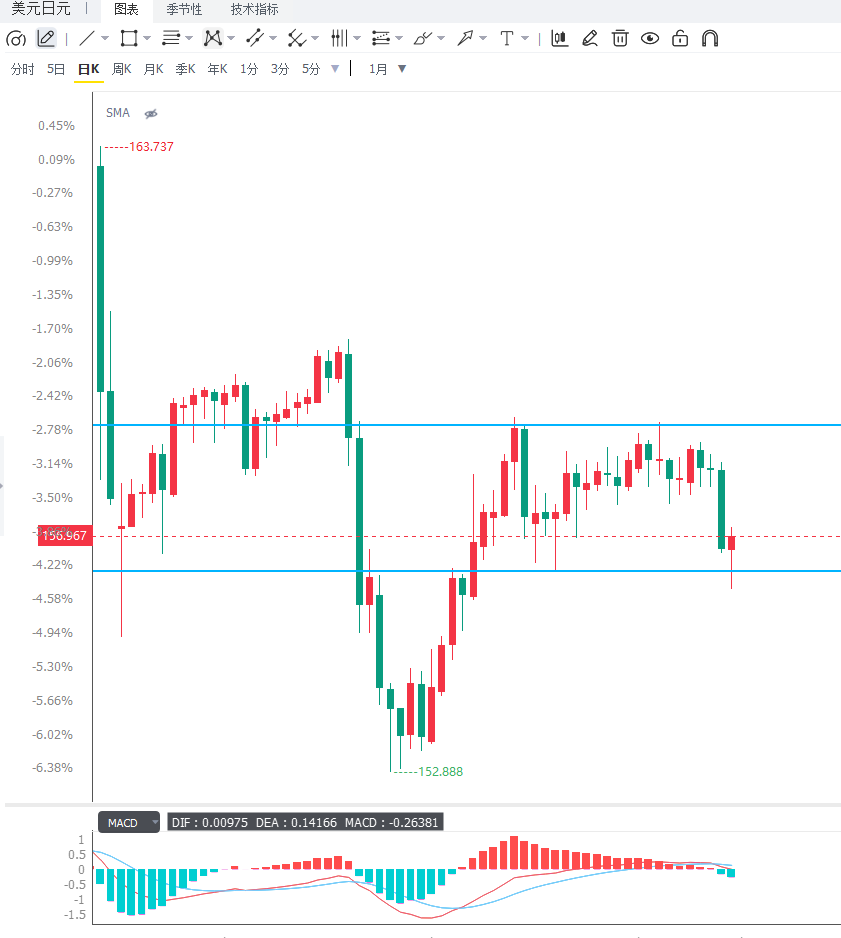 Editor's Summary: The core contradiction in the USD/JPY exchange rate in the short term lies in the fact that Japanese inflation has exceeded its target for the first time in nine months, strengthening expectations of an interest rate hike. Meanwhile, the fact that the Fed's year-end tightening path has not been disproven limits the yen's upside potential. This two-way driver makes the exchange rate more likely to consolidate within the 156.00-156.75 range, awaiting a breakthrough. Three variables need to be closely watched going forward: first, the preliminary S&P Global PMI reading to be released later today, which is direct evidence of the resilience of the US economy and the bottom line of dollar interest rates; second, the outcome and wording of the Bank of Japan's meeting on October 29-30. Even if rates remain unchanged, changes in forward guidance regarding "when to raise interest rates" will repric the exchange rate through interest rate differentials; and third, the situation of the Strait of Hormuz and oil price trends. The dual transmission of imported inflation and terms of trade will determine the net direction of the yen.
From the perspective of the yen, the across-the-board rise in inflation data constitutes the main driving force behind this round of strengthening. Data released by the Statistics Bureau of Japan on Friday showed that the September CPI reached 2.1% year-on-year, with the core CPI rising to 2.1% simultaneously (August's was 1.8%, revised upward from 1.7%). More importantly, the index excluding fresh food and energy, considered by the Bank of Japan as a better indicator of demand-driven price pressures, climbed to 2.4% from 2.0% in August (revised upward from 1.9%). This reading indicates that Japan's inflation rebound is not limited to temporary fluctuations in the energy sector, but is spreading to core demand-driven areas—this spread is precisely the interest rate hike signal that the central bank values most, and is the fundamental reason for the yen's strength following the release of this round of inflation data. It is worth noting that the upward revision of the August data further reinforces this judgment: the rise in inflation is not a single-month accident, but a trend. Expectations for the policy path have also undergone a substantial shift. Standard Chartered analysts point out that the Bank of Japan (BOJ) is expected to keep its policy rate unchanged at 1.25% at its October 29-30 meeting (following a 25 basis point hike in September), but policymakers will maintain a distinctly hawkish tone. "Therefore, market discussions are increasingly shifting from whether the BOJ will raise rates again to when the next hike will occur." The bank also emphasizes that "although the December meeting has become a realistic option, January 2027 remains our base case for the next rate hike," highlighting a very gradual tightening path. However, the bank also notes that "the BOJ has an incentive to continue normalizing policy to support interest rate differentials and reduce the risk of a renewed weakening of the yen, especially if the Federal Reserve resumes tightening or maintains a restrictive stance for longer than expected." This assessment has direct implications for USD/JPY: the BOJ's motivation to raise rates is partly driven by "preventing excessive yen depreciation," meaning its actions will be influenced by the Federal Reserve's movements—as long as there are uncertainties surrounding the Fed at the end of the year, the yen's upside potential will be limited by the interest rate differential ceiling. This is also the structural reason why the current yen's strengthening has lacked smoothness. The US dollar, on the other hand, provides a reverse boost. Recent statements from Federal Reserve officials suggest there is little need to rush into accelerating policy tightening. Chairman Warsh expressed optimism about the resilience of the US economy last week but avoided addressing whether and when further interest rate hikes are needed. According to the CME FedWatch tool, traders are pricing in a 92.8% probability of no change at the October 27-28 policy meeting. Warsh's recent speeches received a 5.6/10 rating, slightly below the historical average of 6.1/10, indicating a cautious tone. He acknowledged being "deeply wounded by the global financial crisis," highlighting a continued wariness of financial stability while emphasizing structural growth and surging investment. He also viewed artificial intelligence as a short-term demand-side force and refused to predict decisions in October and December. The FXS Fed Sentiment Index remained unchanged at a high of 127.51, well above the neutral benchmark. This means that despite the lack of incremental signals in his speeches, the overall policy narrative remains firmly in the hawkish range, which the market should interpret as a framework of "high easing thresholds." For USD/JPY, this presents a "short-term dovish, medium-term hawkish" combination: no change in interest rates next week is widely expected, but the year-end tightening path has not been disproven, making the dollar's pullback more of a technical correction than a trend reversal. As long as the sentiment index remains above 127 and the year-end tightening path remains unproven, the interest rate differential will struggle to systematically decline, and every rise in the yen will be more likely to be met with carry trade cover-ups. The preliminary S&P Global Purchasing Managers' Index (PMI) will be released later today, providing direct evidence of the resilience of the US economy and the strength of demand. If the data is stronger than expected, it could weaken the Fed's narrative of "no rush to raise rates," potentially triggering short-term profit-taking in the yen. For investors, this means that before the data is released, a range-bound approach is more prudent than a trend-following approach, significantly reducing the probability of success for chasing highs and lows. Furthermore, the Bank of Japan's meeting results and statement from October 29th to 30th will be the next key juncture—even if interest rates remain unchanged, any changes in forward guidance regarding "when to raise rates" could potentially repric the exchange rate through interest rate differentials. From a cross-asset perspective, the current USD/JPY fluctuations are essentially a confluence of three factors: first, proactive interest rate hikes supported by the spread of core inflation in Japan; second, a passive pullback in the dollar due to the Fed's "no rush to raise rates but uncertainties at year-end"; and third, two-way disturbances caused by high oil prices—rising energy costs have both increased Japan's imported inflation (strengthening the rationale for rate hikes) and exacerbated deteriorating trade conditions and growth concerns (suppressing risk appetite). This combination suggests that the exchange rate is more likely to digest divergences within a range rather than exhibiting a smooth, one-sided trend. It is worth noting that the yen's performance during this round of geopolitical tensions exhibits typical characteristics of "safe-haven demand and interest rate differentials": on the one hand, escalating tensions in the Middle East have boosted safe-haven demand, benefiting the yen; on the other hand, high oil prices have worsened Japan's trade balance, putting pressure on the yen. After offsetting each other, the actual trend of the yen depends more on the change in interest rate expectations than on the geopolitical narrative. On the daily chart, the USD/JPY pair has been in a correction phase since it peaked above 160. The price is trading below the lower Bollinger Band (approximately 156.75), middle Bollinger Band (approximately 157.85), and upper Bollinger Band (approximately 159.00) of the 20-day Bollinger Bands, and is also constrained by the 100-day simple moving average (approximately 159.35). The moving averages and volatility resistance bands are densely distributed above the price, and the rebound continues to be suppressed. The medium-term bearish structure has not been repaired. The RSI (14) is at 38.20, which has fallen below the 50 neutral line, indicating that the downward pressure still dominates. Although the exchange rate has digested some of the overbought conditions, it is a typical "weak consolidation, near support" pattern. The upside resistance levels to watch are the lower Bollinger Band (around 156.75, previously support now resistance), the middle Bollinger Band (around 157.85), and the broad supply zone formed by the upper Bollinger Band (around 159.00) and the 100-day moving average (around 159.35). Only a decisive break above 156.75 on the daily chart can alleviate the current bearish bias and open up space for an upward move towards 157.85. On the downside, the first support level to watch is the psychological level of 156.00, followed by 155.50 and 155.00. Given the current concentration of data below 156.38 and the lack of near-term technical support, a break below 156.00 could lead to a downward move without clear technical references, requiring a wait for a new demand zone to emerge. On the 4-hour chart, the price has been consolidating slowly along the short-term moving averages after falling from around 156.60. The MACD histogram is close to the zero line, with the fast and slow lines repeatedly intertwined, indicating weak momentum. Editor's Summary: The core contradiction in the USD/JPY exchange rate in the short term lies in the fact that Japanese inflation has exceeded its target for the first time in nine months, strengthening expectations of an interest rate hike. Meanwhile, the fact that the Fed's year-end tightening path has not been disproven limits the yen's upside potential. This two-way driver makes the exchange rate more likely to consolidate within the 156.00-156.75 range, awaiting a breakthrough. Three variables need to be closely watched going forward: first, the preliminary S&P Global PMI reading to be released later today, which is direct evidence of the resilience of the US economy and the bottom line of dollar interest rates; second, the outcome and wording of the Bank of Japan's meeting on October 29-30. Even if rates remain unchanged, changes in forward guidance regarding "when to raise interest rates" will repric the exchange rate through interest rate differentials; and third, the situation of the Strait of Hormuz and oil price trends. The dual transmission of imported inflation and terms of trade will determine the net direction of the yen.
- Risk Warning and Disclaimer
- The market involves risk, and trading may not be suitable for all investors. This article is for reference only and does not constitute personal investment advice, nor does it take into account certain users’ specific investment objectives, financial situation, or other needs. Any investment decisions made based on this information are at your own risk.