With the ECB almost certain to hold rates steady next week, what are euro traders betting on?
2026-10-23 19:50:22
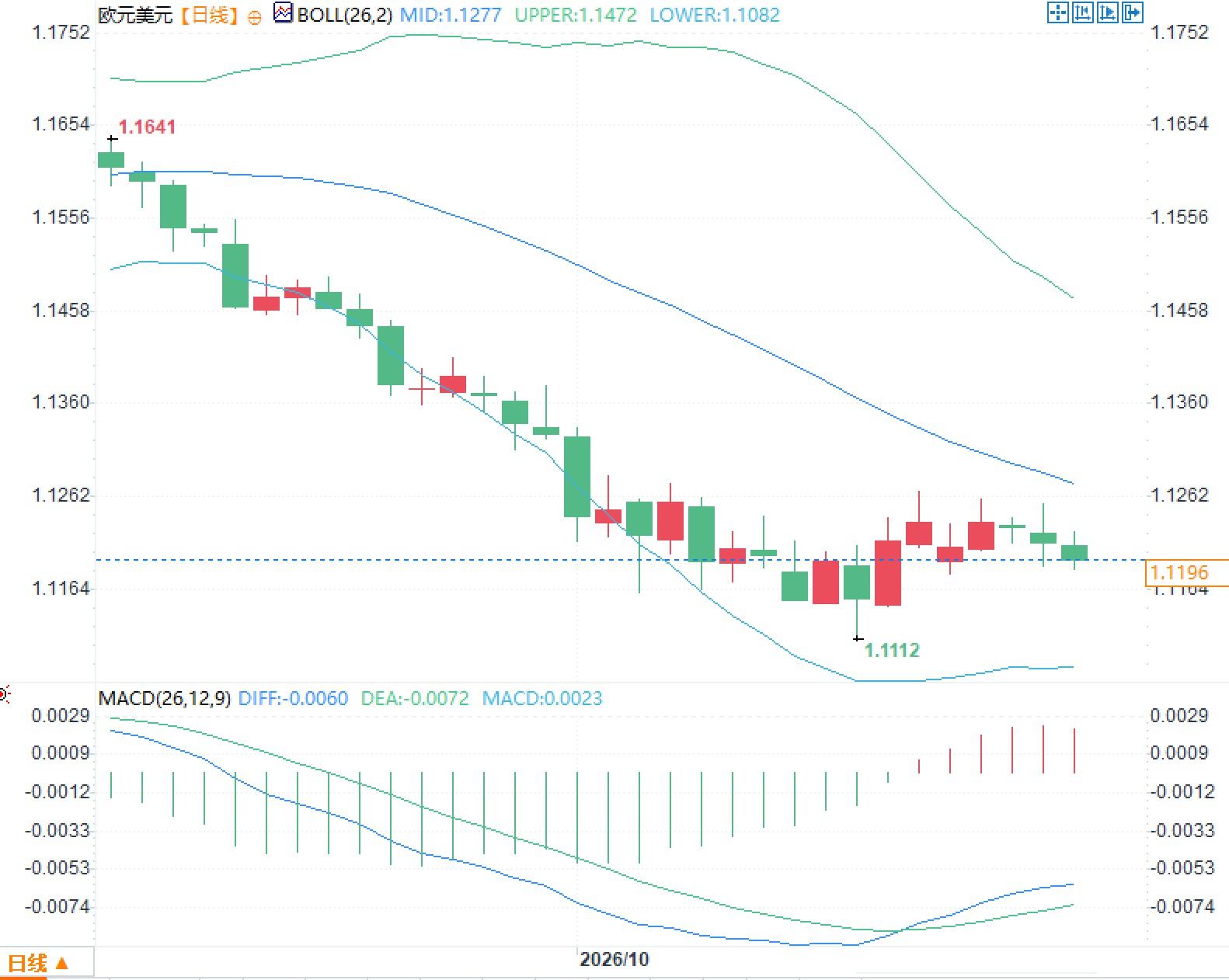
On Friday, October 23, the preliminary readings of the Eurozone's October manufacturing and services Purchasing Managers' Indices (PMIs) were released. The composite index fell to 51.9, the lowest level in four months, while the manufacturing index dropped to 52.4 and the services index fell to 51.7, both below previous expectations. The data reflects a slowdown in the pace of private sector expansion, while input costs accelerated due to rising energy prices, and the pace of output price increases moderated. The euro traded around 1.120 against the dollar after the data release. Market expectations were high that the European Central Bank would keep interest rates unchanged at its meeting next week, but there was still disagreement about pricing in further adjustments in December. Growth momentum within the region diverged significantly, with France falling back into contraction, while Germany maintained expansion but at a slower pace. The overall pattern of coexisting fundamental and price pressures continued. 
Eurozone private sector expansion slows
The Eurozone's composite Purchasing Managers' Index (PMI) fell to 51.9 in October from 53.1 in September, marking its lowest reading since June. The manufacturing PMI dropped to 52.4 from 52.9, and the services PMI fell to 51.7 from 53.0, both missing market expectations. New orders growth slowed to its slowest pace in the current expansion cycle, job growth nearly stalled, and business confidence fell to a five-month low. Chris Williamson, chief business economist at S&P Global Market Intelligence, noted that the Eurozone economy still recorded growth at the start of the fourth quarter, with the PMI corresponding to a quarterly GDP growth of approximately 0.3%, lower than September's performance but still within one of the better ranges of the past three years. However, input prices in manufacturing accelerated sharply due to rising energy costs, prompting companies to push up prices to protect profit margins, but the pace of price increases slowed compared to the previous month, indicating increased difficulty in passing costs down to downstream customers. Overall, expansion continues, but weakening momentum is a reality, and cautious sentiment is rising on the demand side.French activity has once again fallen into contraction, dragging down regional performance.
France was the main drag on the data. In October, France's composite Purchasing Managers' Index (PMI) plummeted from 51.1 to 48.4, with the manufacturing index falling to 49.3 and the services index to 48.4, both returning to contraction territory. New orders declined at the fastest pace since May, exports fell for the 11th consecutive month, and business confidence dropped to a near two-year low, with some companies linking their pessimism to fiscal conditions and uncertainty surrounding next year's elections. Germany's composite PMI fell from 53.8 to 52.8, with the manufacturing index rising to 54.2 and the services index falling to 51.7, maintaining overall expansion but at a slower pace. Other regions of the Eurozone also recorded slower growth. Williamson stated that the renewed contraction in France's services sector was one of the key factors in the region's slowdown, but manufacturing and service activity in the rest of the Eurozone also weakened simultaneously. Fiscal concerns and public financing pressures were particularly pronounced in France, with related spillover effects posing additional constraints on overall regional demand.Cost pressures continue to push up inflation stickiness
Despite the slowdown in economic activity, price pressures have not eased accordingly. The Eurozone's Harmonized Index of Consumer Prices (HICP) rose 3.8% year-on-year in September, a further increase from 3.2% in August, with the energy component rising 18.9% year-on-year, becoming the main contributor. Core inflation rose to 2.5%. The October Purchasing Managers' Index (PMI) showed that input prices in manufacturing accelerated, mainly driven by energy, fuel, and transportation costs, marking the fastest pace since May. Output prices, however, rose slightly less than the previous month, putting some pressure on corporate profit margins. Williamson pointed out that input costs have risen sharply again, particularly in manufacturing due to rising energy prices. Companies are pushing up prices to protect profit margins, but higher interest rates have begun to suppress demand. The European Central Bank previously assessed that there is currently no significant evidence of a secondary transmission of the energy shock to wages and other prices, but persistently high energy prices may keep overall inflation above target levels in the short term. The divergence between input costs and output prices further highlights the cost transmission challenges faced by companies.The European Central Bank faces a trade-off in its policy path.
The current European Central Bank (ECB) deposit facility rate is 2.50%. The market prices approximately 90% to 93% that the rate will remain unchanged at the October 29th meeting, while the probability of a 25 basis point rate hike at the December meeting fluctuates between 68% and 81%. Economist surveys show that most expect the rate to remain around 2.75% after a December hike. Williamson stated that the coexistence of sustained growth and stubborn inflation could further fuel discussions about more proactive policy adjustments. The ECB faces a core dilemma: the coexistence of slowing economic activity and rising energy costs, with French fiscal pressures and public financing concerns potentially having additional impacts on regional demand. Policymakers need to balance inflationary pressures remaining above target with weakening growth momentum, while observing the potential transmission of energy prices to core inflation and wage settings. The expectation of no change at next week's meeting is relatively consistent; the subsequent path will depend on further confirmation from fourth-quarter growth data and energy price developments.Frequently Asked Questions
Question 1: What were the main reasons for the decline in the Eurozone Purchasing Managers' Index (PMI) in October? Answer: The composite index fell to 51.9, mainly dragged down by the renewed contraction in the French service sector. At the same time, the overall growth rate of new orders in both manufacturing and services slowed, and rising energy costs pushed up input prices and suppressed some demand. Question 2: How can inflationary pressures and slowing growth occur simultaneously? Answer: A significant year-on-year increase in energy prices pushed overall inflation to 3.8% in September, while private sector activity, although still expanding, slowed. Business input costs accelerated, but the pace of output price increases moderated, indicating incomplete cost transmission. Question 3: How has the market priced in subsequent policy adjustments by the European Central Bank? Answer: The probability of maintaining the 2.50% interest rate at next week's meeting is about 90% to 93%, while the probability of a 25 basis point rate hike in December is between 68% and 81%, reflecting that the trade-off between sticky inflation and slowing growth is not yet fully resolved.- Risk Warning and Disclaimer
- The market involves risk, and trading may not be suitable for all investors. This article is for reference only and does not constitute personal investment advice, nor does it take into account certain users’ specific investment objectives, financial situation, or other needs. Any investment decisions made based on this information are at your own risk.