Multiple countries travel to Tehran; US and Israeli elections restrain conflict; can oil prices escape their high levels?
2026-10-26 16:26:22
Under the constraints of the two key elections in the US and Israel, the geopolitical game in the Middle East has entered a brief window of risk convergence: The US midterm elections are putting pressure on Trump's chances, and he is inclined to avoid a direct war with Iran before the election to stabilize oil prices and votes; the uncertain prospects of the Israeli election may weaken the external impetus for a hardline stance against Iran. Meanwhile, a Qatari delegation has visited Tehran, and high-ranking officials from Saudi Arabia, Pakistan, and Turkey will also hold consultations with Iran in Tehran on regional security issues, indicating continued progress in regional mediation. Coupled with a partial ceasefire between Russia and Ukraine, market expectations for a temporary easing of pricing have been somewhat alleviated. However, Iran is internally divided; while the pro-peace faction has a desire for negotiations, the hardliners continue their attacks on ships. Institutions generally believe that this easing is a temporary truce driven by the election, and the geopolitical premium is unlikely to be cleared quickly. Oil prices are expected to continue to fluctuate at high levels. 
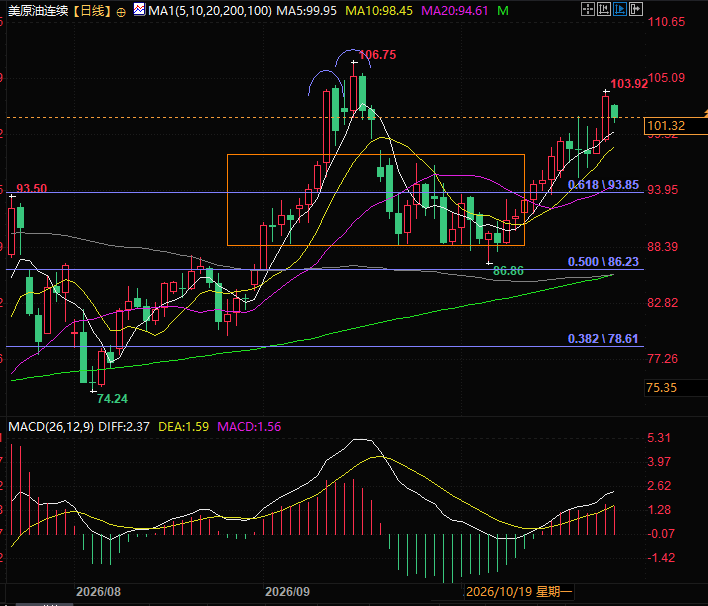 (WTI crude oil futures daily chart, source: EasyTrade) At 16:18 Beijing time, WTI crude oil futures are currently trading at $101.39 per barrel.
Headwinds in the US midterm elections temporarily dampen the impulse for a US-Iran war.
With the Republican majority in the Senate continuing to shrink and the election trend gradually shifting towards the Democrats, the Trump team has adopted a defensive stance, focusing resources on consolidating traditionally Republican strongholds. High oil prices are a highly sensitive factor for American voters, and with only a little over ten days until the November 3rd election, the White House currently has no intention of actively escalating US-Iran tensions or adding further negative impacts to oil prices. Multiple macroeconomic institutions predict that launching a large-scale attack on Iran before the election, further raising gasoline retail prices, would directly damage the Republican base and even increase the likelihood of the Democrats winning both the House and Senate. Trump has clearly stated that he will not attack Iran at present, claiming that the Iranian conflict may soon reach some kind of conclusion; at the same time, he is emphasizing the results of his maritime escort efforts—assisting Gulf partners in exporting over 1.5 billion barrels of crude oil since this summer—and stressing that the main shipping lanes of the Strait of Hormuz are under control, using the narrative of stable shipping to reassure the market and secure votes. CNN reports that US forces in the Middle East have completed their operational deployments and can launch a large-scale strike within 96 hours of receiving orders. Trump has not ruled out the option of using force after the election, reflecting a typical pre-election risk management strategy and a contingency plan for the post-election period.The Israeli election remains uncertain, and the driving force of conflict may be weakening.
Israel will hold its general election on October 27th. Netanyahu's election prospects are under pressure, and he has repeatedly called Trump requesting public endorsements, even personally drafting his own support rhetoric. The US views this as a signal of his lagging campaign and precarious position. Market analysts such as SoSoValue suggest that Netanyahu has an incentive to mobilize votes by focusing on a hardline stance against Iran; however, the Israeli military leadership and opposition parties do not support launching a large-scale war against Iran before the election, limiting Israel's ability to launch a high-intensity strike alone. While Trump has publicly expressed support for Netanyahu, his core advisors have begun assessing the cooperation opportunities with other candidates. Many US officials believe that a new Israeli government lacking far-right allies would be more likely to cooperate with the US in advancing the Middle East negotiation agenda. Analysts believe that if Netanyahu loses the election, the core motivation for continued lobbying for a hardline stance against Iran will weaken, which is also reflected in the gradually softening expectations being priced into the oil market.Several Gulf states have traveled to Tehran to mediate and attempt to establish a regional security dialogue.
A Qatari delegation visited Tehran yesterday, marking an important part of the current regional mediation and conciliation process. Meanwhile, the Saudi Defense Minister, the Pakistani Army Chief of Staff, and the Turkish intelligence chief will also travel to Tehran for a joint security meeting to discuss a regional security framework led by regional countries. Trade information agencies generally believe that this series of meetings constitutes a series of probing, closed-door consultations among major regional powers, with the core purpose of reducing the probability of a black swan event such as a complete blockade of the Strait of Hormuz, leading to a slight decline in geopolitical risk premiums. However, the significant differences in the demands of the parties make it difficult to reach a binding navigation agreement in the short term, indicating a clear ceiling to this round of easing tensions.Russia and Ukraine signal a de-escalation, temporarily easing pressure on refined oil prices.
A glimmer of hope for easing tensions between Russia and Ukraine has cooled risk sentiment in the refined oil market. Trump revealed that trilateral talks between the US, Russia, and Ukraine will begin soon, and that a partial ceasefire agreement has been reached in Kherson. Futures companies believe that if the negotiations are finalized and sanctions are eased, Russian crude oil and fuel oil exports are expected to recover, alleviating the global shortage of medium and heavy crude oil. This could lead to a correction in high refined oil refining spreads, exerting marginal pressure on crude oil bulls. KCM Trade further cautions that there is a significant time lag between the ceasefire agreement and actual market volume, and given the continued attacks on Russian refining facilities, the increase in diesel supply is limited and unlikely to completely eliminate the global structural diesel shortage. This could only bring about a temporary recovery in sentiment and cannot generate a sustained bearish trend.Iran is internally divided: peacemakers demand negotiations, while hardliners continue to create disturbances.
The market should not overestimate the sustainability of this round of oil price easing. Internal factional divisions within Iran mean that geopolitical risk premiums are unlikely to be fully cleared. The ongoing conflict has severely damaged Iran's natural gas refining facilities, and with the peak winter gas consumption season approaching, a domestic gas supply shortage is becoming increasingly apparent. The Iranian parliament speaker has called on the public to save 10% of their natural gas consumption, with corresponding energy-saving incentives. Coupled with the real pressures of high inflation and continuous depletion of reserves, the pragmatic pro-peace faction within the Iranian civilian system has a strong willingness to negotiate. Iran previously proposed a seven-day plan to restore navigation, contingent on the US lifting its maritime blockade. Energy agencies divide Iran's decision-making body into a pragmatic civilian camp and a hardline faction within the Revolutionary Guard with independent operational authority; the latter is not entirely bound by the civilian government. Data tracked by Kpler and the UK Maritime Trade Office shows that October saw a record number of attacks on ships in the Strait of Hormuz, with 28 confirmed attacks, 11 of which severely damaged very large crude carriers (VLCCs). Many more attacks remain undisclosed; the Houthi rebels also continue to launch missiles at Saudi oil infrastructure. Goldman Sachs commented that as long as Iran cannot form a unified external strategy, attacks on ships will continue to occur, the recovery of shipping in the Straits is very fragile, and the geopolitical premium will be difficult to eliminate all at once.Market Summary: With the election window in effect for a brief lull, oil prices are likely to fluctuate at high levels.
The current situation is essentially a passive, temporary truce driven by the election cycle, rather than a long-term reconciliation among all parties. Trump is merely postponing the window for military strikes, retaining the option to act after the midterm elections, while also having the opportunity to release more positive news to stimulate a short-term pullback in oil prices. Iran, on the one hand, hopes to negotiate for the lifting of the blockade and the relief of its domestic energy and livelihood crises; on the other hand, it allows maritime harassment to continue, lacking a unified and clear external strategy. Goldman Sachs maintains its benchmark scenario of high oil prices, with Middle East supply disruptions being the primary upside risk, and current prices already incorporating a significant geopolitical premium. Citi echoes this view, stating that a complete and long-term closure of the Strait of Hormuz is a low-probability event, but sporadic attacks on ships and intermittent shipping disruptions will become the norm. Crude oil is more suited to a high-level consolidation trading strategy, and a one-sided trend is not yet feasible. Uncertainty surrounding the Hormuz waterway and sudden news of ship attacks will continue to repeatedly impact the market, making it difficult for oil prices to experience a significant downward trend. The market focus will continue to be anchored to two key events: the results of the US midterm elections on November 3rd, and the Middle East policy orientation of the new Israeli government after the election. Technical Analysis: International oil prices have seen a significant pullback, but the overall trend remains upward. Continue to monitor the support levels around the 5-day moving average and 101, followed by the support at the bottom of the trading range at 97.63. (WTI crude oil futures daily chart, source: EasyTrade) At 16:18 Beijing time, WTI crude oil futures are currently trading at $101.39 per barrel.
- Risk Warning and Disclaimer
- The market involves risk, and trading may not be suitable for all investors. This article is for reference only and does not constitute personal investment advice, nor does it take into account certain users’ specific investment objectives, financial situation, or other needs. Any investment decisions made based on this information are at your own risk.