Oil prices retreated from their highs as expectations for easing tensions between the US and Iran rose.
2026-10-26 16:14:22
Oil prices retreated from their highs on Monday (October 26) as a Qatari mediator's visit to Tehran brought hopes for a de-escalation of hostilities between the US and Iran, but attacks on key Saudi oil production facilities continued over the weekend. Both WTI and Brent crude futures fell by more than 1%. 
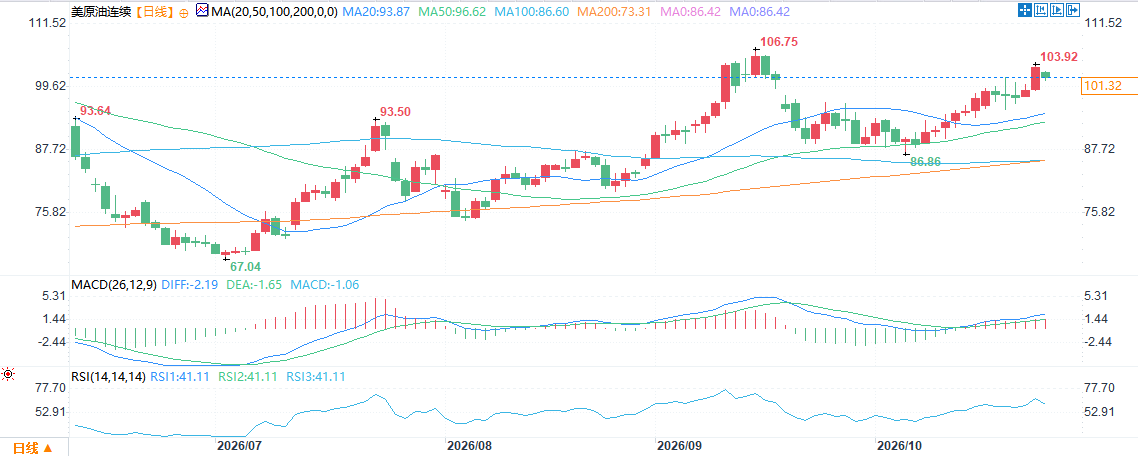 (US crude oil futures daily chart, source: FX678) At 16:05 Beijing time, US crude oil futures were trading at $101.20 per barrel.
Callback Triggered: Qatari mediator travels to Tehran, but easing tensions may be short-lived.
An official familiar with the matter said that Qatari mediators traveled to Tehran on Sunday to cooperate with US efforts to de-escalate regional tensions. Vandana Hari, founder of oil market analysis firm Vanda Insights, said, “Concerns about a renewed military conflict in the Middle East—which drove most of last week’s oil gains—have eased this morning, but this respite may be temporary.” She noted that US President Trump has not dispelled market expectations of a possible strike on Iran after the November 3 midterm elections, “so we expect volatility to remain high, and risks remain skewed to the upside.” Despite the mediation talks, attacks continued over the weekend. The Iranian-backed Houthi rebels claimed responsibility for attacks on a Saudi airport and oil facilities on Saturday, and Saudi Arabia said on Sunday it had intercepted more missiles and drones. The impact of the US-Israeli military action against Iran, which began on February 28, continues to unfold, with businesses adjusting to the disruptions to commercial shipping in the Strait of Hormuz and the Bab el-Mandeb Strait caused by the conflict.Supply reality: Hormuz risk is deeply entrenched, pullbacks are more like position adjustments.
On Monday, the energy ministers of Saudi Arabia and Singapore said Saudi Aramco will begin storing crude oil in Singapore in the second half of 2027 to enhance the company's supply chain resilience in the region. Priyanka Sachdeva, head of market insights at Phillip Nova, said, "While supply risks around the Strait of Hormuz remain deeply entrenched, the current pullback appears to reflect more positioning and risk management than any substantial improvement in the underlying supply situation." International Energy Agency Executive Fatih Birol reinforced concerns about the supply situation at an industry event in Singapore on Monday, saying he does not expect the energy market to return to its pre-Iranian conflict state by 2027.Export data and tanker attacks: Behind the rebound in numbers lies a stack of costs and risks.
Over the past two weeks, reports of the resumption of oil flows in the Persian Gulf and the Red Sea have dominated headlines, but oil prices have risen, suggesting that barrel counts alone are insufficient to convince the world that things have returned to normal. According to the latest data from Kpler, total Middle Eastern oil exports in October were actually higher than before the US and Israel's initial strikes against Iran at the end of February. The average daily flow through the Strait of Hormuz alone this month is estimated at 11.7 million barrels, up from 9.8 million barrels in September and approaching the pre-war level of 14.5 million barrels per day in February. However, these figures are the product of significant effort, expenditure, and risk. Another major development in the region is Iran's intensified attacks on oil tankers. According to statements from the UK's Office for Maritime Trade Operations and the Iranian Islamic Revolutionary Guard Corps, at least 25 ships were attacked in the Strait of Hormuz in the first 20 days of October. Agencies tracking these incidents indicate that many ships did not report attacks for various reasons, and the actual number may be higher, reaching 40 to 50, most of which are oil tankers. Meanwhile, Kpler itself reported a sharp decline in tanker traffic through the Strait of Hormuz this month due to the attacks. A report by two Kpler analysts in early October stated that "crude oil transiting the Strait of Hormuz has fallen 27% from the previous week's wartime high to at least 10.1 million barrels per day." The company's statistics show that only seven cargo ships transited the Strait on October 6th, the lowest number since the end of July. Furthermore, based on Kpler data, Reuters reported earlier this week that at least 18 oil tanker attacks had occurred in the past two weeks alone. The company also reported earlier this week that daily oil outflows from the Persian Gulf had shrunk dramatically from "over 20 million barrels per day" two weeks ago to 8.5 million barrels per day. This contradictory data from the same source makes it difficult to feel reassured about Middle Eastern oil supplies, especially given the continued reports of tanker attacks.Ship-to-ship transshipment and capacity bottlenecks: Relaxing sanctions will not solve the immediate problem.
A significant amount of Persian Gulf oil is transported via ship-to-ship transshipment, pushing freight rates to record highs and maintaining them there. This problem is so severe that Trump has been said to be considering lifting sanctions on some tankers carrying Russian oil to alleviate the tanker shortage caused by the expansion of ship-to-ship transshipment off the coast of Oman. However, this would be to no avail. The supply of so-called “shadow fleet” tankers is equally limited—they are busy transporting sanctioned oil. Rahul Kapoor, head of global shipping analysis and research at S&P Global Energy, was quoted by Bloomberg earlier this week as saying, “Resistance easing does not equate to immediately available mainstream tanker capacity. The number of vessels realistically returning to mainstream trade is likely to be far smaller than the overall size of the sanctioned fleet.”Futures and spot markets diverge: futures rise while spot prices fall, with winter heating demand becoming a variable.
Given the interplay of these factors and the fact that the likelihood of a US-Iran peace agreement remains as slim as it was three months ago, the rise in oil prices is not surprising—at least in the futures market. Media reports indicate that spot market prices are actually falling due to a supposed rebound in traffic through the Hormuz (despite tanker attacks) and a slight decline in freight rates. Analysts stated, "There are still a lot of headline risks at play. Oil inventories are quite low, and given the current dynamics, it's difficult to see inventory rebuilding." Analysts also noted that if El Niño develops as expected, there is still hope for reduced winter heating demand, which could provide some relief to prices. However, betting on the weather is not the safest strategy, which is why prices are likely to remain high at least until the end of the year.Summarize
The arrival of Qatari mediators in Tehran brought hope for a de-escalation of US-Iran hostilities, but attacks on Saudi airports and oil facilities continued over the weekend, and Trump failed to dispel expectations of a post-midterm election strike against Iran. Analysts generally believe that this pullback reflects more position adjustments and risk management than a substantial improvement in supply fundamentals: supply risks in the Strait of Hormuz are deeply entrenched, tanker attacks continue, ship-to-ship transshipment has pushed freight rates to record highs, and easing sanctions is unlikely to alleviate capacity bottlenecks. Futures and spot prices are diverging, low inventories limit rebuilding potential, and the International Energy Agency executive director predicts that the energy market will be unlikely to return to pre-war levels by 2027. Oil price volatility is expected to remain high, with risks still skewed to the upside. Winter heating demand and geopolitical developments will be key variables going forward. (US crude oil futures daily chart, source: FX678) At 16:05 Beijing time, US crude oil futures were trading at $101.20 per barrel.
- Risk Warning and Disclaimer
- The market involves risk, and trading may not be suitable for all investors. This article is for reference only and does not constitute personal investment advice, nor does it take into account certain users’ specific investment objectives, financial situation, or other needs. Any investment decisions made based on this information are at your own risk.