A chart shows that the Baltic Dry Index is under downward pressure, with all ship types showing weakness.
2026-10-28 01:06:23
Latest data shows that on October 27, 2026, the Baltic Dry Index (BDI) closed at 2603 points, a five-day low, down 0.95% from the previous day, marking the third consecutive day of decline (including zero growth). Looking at the short-term charts, the BDI has seen positive growth four times, negative growth seven times, and zero growth in the last 11 BDI data points. Specifically, the Panamax Freight Index (BPI) closed at 2021 points, down 2.60% from the previous day; the Capesize Freight Index (BCI) closed at 3702 points, down 0.64%; and the Supramax Freight Index (BSI) closed at 1883 points, down 0.26%. For detailed charts of the Baltic Dry Index and its three main sub-indices, including the latest 720-day and ten-year trends, please refer to the charts specially created by FX678. 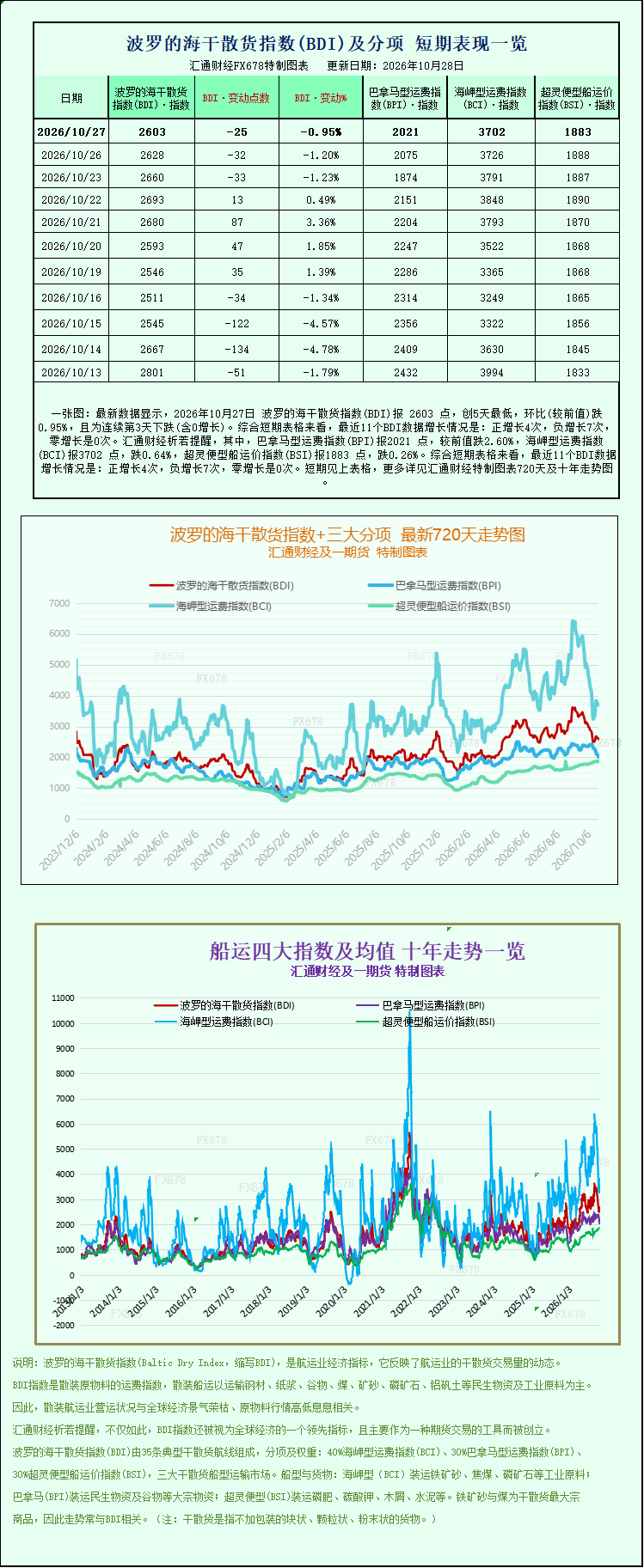 On Tuesday, the Baltic Dry Index (BDI), a major shipping index that tracks global dry bulk shipping rates, fell as freight rates across all major vessel types weakened, putting significant pressure on market sentiment. As a leading indicator of global commodity trade activity, the decline in the BDI has drawn widespread attention to the outlook for dry bulk shipping demand. Major indices all fell, hitting recent lows . The Baltic Dry Index (BDI) fell 25 points, or 0.95%, to close at 2603 points on Tuesday, its lowest level since October 20. The BDI is a composite freight rate index compiled and published by the Baltic Exchange, which calculates freight rates for three major vessel types using weighted averages. It is widely regarded as a "barometer" of the global dry bulk shipping market and even the overall macroeconomic and trade activity. Looking at specific vessel types, all sectors performed poorly. The Capesize index fell 24 points, or 0.64%, to 3702 points, a one-week low. The Panamax index fell even more sharply, dropping 54 points, or 2.60%, to close at 2021 points, hitting a low since July 29. In the smaller vessel sector, the Supramax index also declined slightly by 5 points, or 0.26%, to 1883 points. Analysts pointed out that this across-the-board decline in freight rates was not due to an abnormal performance of a single vessel type, but rather the result of pressure across various market segments, reflecting a temporary weakness in overall dry bulk shipping demand. Daily Revenue Generally Shrinks Across Vessel Types Corresponding to the index trend, the average daily revenue of various vessel types also declined to varying degrees. Capesize bulk carriers saw an average daily revenue decrease of $220 to $30,072. These large vessels are typically used to carry around 150,000 tons of cargo, mainly including bulk commodities such as iron ore and coal, and their freight rates are closely related to the global mining trade and steel production climate. Panamax vessels experienced a larger decline in average daily revenue, decreasing by $479 to $18,193. These vessels typically carry 60,000 to 70,000 tons of coal or grain and are the main means of transport in international grain and coal trade. Their freight rate fluctuations are often linked to agricultural trade cycles and regional supply and demand changes. In contrast, while the Supramax vessel index also declined, the drop was relatively mild, and the impact on daily revenue was relatively limited. Overall, the decline in freight rates for larger vessels was significantly greater than that for smaller vessels, indicating a divergence in demand for different types of cargo. Iron ore prices are under pressure, with concerns about China's demand prospects. Behind this round of freight rate declines, the trend in the commodity market is particularly noteworthy. On Tuesday, affected by heightened concerns about the demand prospects of China, the world's largest consumer, iron ore prices fell to their lowest point in more than two years. As one of the main sources of cargo for Capesize bulk carriers, the weak demand for iron ore transportation directly dragged down the trend of freight rates for larger vessels. Market analysts believe that as a major importer of global commodities such as iron ore, coal, and grain, China's industrial activity pace, steel production levels, and macroeconomic policy direction all have a significant impact on the dry bulk shipping market. Current market concerns about Chinese demand mainly focus on a wait-and-see attitude regarding the operating rate of downstream steel industries, infrastructure investment, and the overall pace of economic recovery. It is noteworthy that the decline in iron ore prices has created a certain correlation with the decrease in Capesize freight rates. Industry insiders generally believe that weakening commodity prices often suppress traders' willingness to transport and stockpile, which in turn transmits to the shipping market, forming a chain reaction between "commodity prices—trade volume—freight rates." Market Outlook: Short-term pressure, focus on demand changes From recent trends, the dry bulk shipping market is currently undergoing a phase of adjustment. On the one hand, fluctuations in global commodity prices, changes in demand in major economies, and the freight pace of trade routes are all continuously affecting freight rate levels; on the other hand, ship capacity supply, port congestion, and seasonal factors are also working together on both the supply and demand sides, limiting the rebound potential of freight rates. Analysts point out that whether freight rates can stabilize in the short term will largely depend on whether commodity trade demand can recover, especially the demand performance of the Chinese market. If trade volumes of major commodities such as iron ore and coal rebound, freight rates for large vessel types like Capesize and Panamax are expected to be supported; conversely, if demand remains weak, freight rates may continue to fluctuate within a low range. It is worth noting that the dry bulk shipping market has strong cyclical characteristics, and freight rate fluctuations are often quite dramatic. Market participants, while focusing on short-term freight rate changes, also need to look at the longer-term evolution of supply and demand patterns. Industry experts believe that a temporary correction in freight rates does not signify a fundamental change in the industry's fundamentals, and its future trend still needs to be comprehensively assessed in conjunction with global macroeconomic conditions, trade policies, and commodity market dynamics. Overall, the across-the-board decline in the Baltic Dry Index reflects the current pressure on global dry bulk trade demand. Given the continued uncertainty surrounding the global economic recovery, the shipping market is likely to continue its volatile pattern, and the future direction of freight rates warrants close monitoring.
- Risk Warning and Disclaimer
- The market involves risk, and trading may not be suitable for all investors. This article is for reference only and does not constitute personal investment advice, nor does it take into account certain users’ specific investment objectives, financial situation, or other needs. Any investment decisions made based on this information are at your own risk.