Energy prices are forcing a rate hike! The Bank of Canada raises interest rates for the first time in three years, causing the USD/CAD exchange rate to fluctuate by 40 points!
2026-10-28 21:56:23
On Wednesday (October 28) at 21:45 Beijing time, the Bank of Canada announced its interest rate decision, raising the overnight rate by 25 basis points to 2.50%, the first rate hike since July 2023.  Following the announcement of the resolution, the US dollar initially fell against the Canadian dollar before rising, fluctuating by approximately 40 points, reaching a high of 1.4067. Global financial markets reacted swiftly to this cautiously hawkish shift, with energy price stickiness and economic resilience becoming the core points of contention.
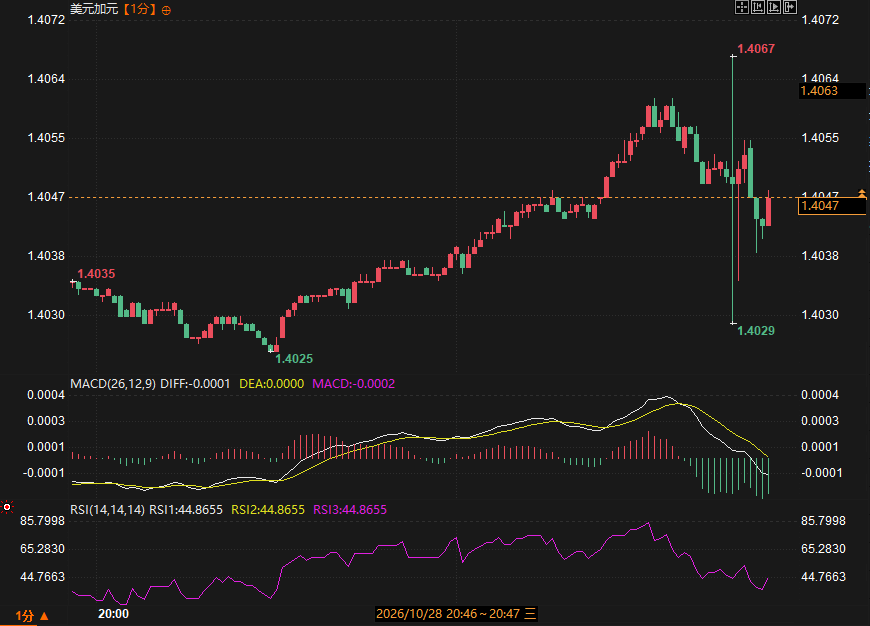
Following the announcement of the resolution, the US dollar initially fell against the Canadian dollar before rising, fluctuating by approximately 40 points, reaching a high of 1.4067. Global financial markets reacted swiftly to this cautiously hawkish shift, with energy price stickiness and economic resilience becoming the core points of contention. Market Background
Ahead of the decision, the market was generally focused on the existing spare capacity in the Canadian economy and the risk of energy price transmission to inflation. The USD/CAD pair remained relatively stable in the lead-up to the decision, trading within its previous range. Historical trends show that the Bank of Canada has maintained a relatively accommodative to neutral stance for extended periods, primarily adopting a wait-and-see approach to interest rate policy. The latest quotes showed rapid fluctuations immediately following the decision: a short-term strengthening of the Canadian dollar pushed the USD/CAD pair lower, followed by a rapid rebound and increased volatility due to the statement's indication that "further rate hikes may be necessary." This demonstrates a consistency between short-term and long-term logic—short-term sentiment-driven trading dominates instantaneous fluctuations, while medium-term focus revolves around the persistence of inflation and the uncertainty of the policy path.Deep interconnect analysis
On the fundamental front, the Bank of Canada explicitly stated that the ongoing situation in the Middle East continues to push up energy prices and prolong their high levels, coupled with the rising risk of cost transmission to a wider range of goods and services, which was the core consideration for this interest rate hike. The statement emphasized that although core inflation remains close to 2% and there is still some slack in the economy, near-term inflation expectations have risen, while long-term expectations remain anchored. Regarding growth, Canada's second-quarter GDP showed strong performance, with third-quarter indicators pointing to approximately 2% growth, better than the July forecast, supported by exports and business investment. The central bank also cautioned that the growth and inflation outlook still face uncertainty, especially regarding the evolution of trade relations with the United States. Technical and fundamental factors are in sync. The USD/CAD pair was in the middle of its historical trading range before the decision, and the latest quote broke through the intraday high before pulling back, indicating a rapid exchange of hands between bulls and bears within a 40-point range. For related instruments, the interest rate hike directly benefits the Canadian dollar in the short term, but the "cautious approach" statement limits the potential for further gains, resulting in an overall pattern of initial decline followed by a rise in the USD/CAD pair. The contrasting viewpoints are striking. Prior to the decision, some institutional accounts emphasized economic slack and controlled core inflation, favoring maintaining interest rates to observe data; retail investors focused more on the impact of energy prices on daily life, with a cautious wait-and-see attitude. After the decision, institutional perspectives quickly shifted to "rising inflation risks and narrowing policy space," acknowledging the necessity of a rate hike and focusing on subsequent meetings' decisions; retail investors reacted more directly to the statement "possible another rate hike," with discussion centered on instantaneous fluctuations in the foreign exchange market and the short-term direction of the Canadian dollar. The expectation discrepancy mainly manifested in the judgment of the timing of the rate hike—most traders underestimated the urgency of energy cost transmission, leading to concentrated position adjustments after the decision. Overall, this decision rebalanced the fundamentals of inflation stickiness and growth resilience, while the technical aspects absorbed some of the expectation gap through rapid fluctuations, maintaining consistency between long-term and short-term logic under the main theme of "persistent inflation."Trend Outlook
From a technical perspective, after completing a 40-pip fluctuation, the USD/CAD pair may enter a short-term consolidation phase, with the trading range likely to oscillate around the new range established after the policy decision. If energy prices continue to remain high, the market's pricing in the interest rate hike path may be further adjusted; conversely, if economic data shows more signs of sluggishness, a cautious tone may regain dominance. The rebalancing of bullish and bearish forces will depend on the actual progress of inflation transmission and the mutual verification of growth data. The market is expected to primarily find direction through consolidation rather than a unilateral acceleration.Further Reading
Q: Why did the Bank of Canada choose to raise interest rates at this time? Mainly because energy prices are expected to remain high for a longer period, increasing the risk of cost transmission to other goods and services. The central bank believes the economy has shown some resilience, and the downward pressure on prices from spare capacity has weakened, necessitating an interest rate hike to reduce the possibility of widespread inflation. Q: How should we interpret the phrase "may require further rate hikes" in the policy statement? This is a conditional statement. The central bank clearly stated that future decisions will be made on a case-by-case basis, while emphasizing high uncertainty and therefore proceeding cautiously. The market interpreted this as a hawkish policy stance, but not a commitment to a continuous rate hike path. Q: What was the direct cause of the USD/CAD exchange rate's initial decline followed by a rise? The rate hike itself was beneficial to the Canadian dollar, pushing the USD/CAD exchange rate down in the short term; subsequently, the coexistence of "may require further rate hikes" and "proceed cautiously" in the statement triggered a reassessment by both bulls and bears, with capital inflows pushing the exchange rate back up, resulting in a complete fluctuation of approximately 40 points. Q: What changes were made to the assessment of the inflation outlook in this policy decision? Compared to the July report, the inflation path has been significantly revised upwards. CPI inflation is projected to rise to around 3.5% this year, and will remain higher than previously estimated in 2027, only returning to around 2% by mid-2028. The core reason is the increased persistence of energy price and cost transmission. Q: What does the discrepancy between institutional and retail investor expectations before and after the decision indicate? The discrepancy mainly focuses on the assessment of the urgency of interest rate hikes. Institutions are more concerned with core indicators and spare capacity, while retail investors are more sensitive to the direct impact of energy prices. The consensus after the decision leans towards "inflation risk rising," indicating that the market's understanding of the policy response function is being updated.- Risk Warning and Disclaimer
- The market involves risk, and trading may not be suitable for all investors. This article is for reference only and does not constitute personal investment advice, nor does it take into account certain users’ specific investment objectives, financial situation, or other needs. Any investment decisions made based on this information are at your own risk.