One chart: The Baltic Dry Index rises, with Capesize freight rates leading the gains.
2026-10-28 22:22:23
Latest data shows that the Baltic Dry Index (BDI) reached 2652 points on October 28, 2026, a three-day high, up 1.88% month-on-month (compared to the previous value), marking the largest increase since October 21, 2026. Looking at the short-term charts, the BDI has seen positive growth 5 times, negative growth 6 times, and zero growth 0 times in the last 11 BDI data points. Specifically, the Panamax Freight Index (BPI) was 1965 points, down 2.77% from the previous value; the Capesize Freight Index (BCI) was 3886 points, up 4.97%; and the Supramax Freight Index (BSI) was 1878 points, down 0.27%. For detailed charts of the latest 720-day and 10-year trends of the Baltic Dry Index and its three main sub-indices, please refer to the charts specially created by FX678. 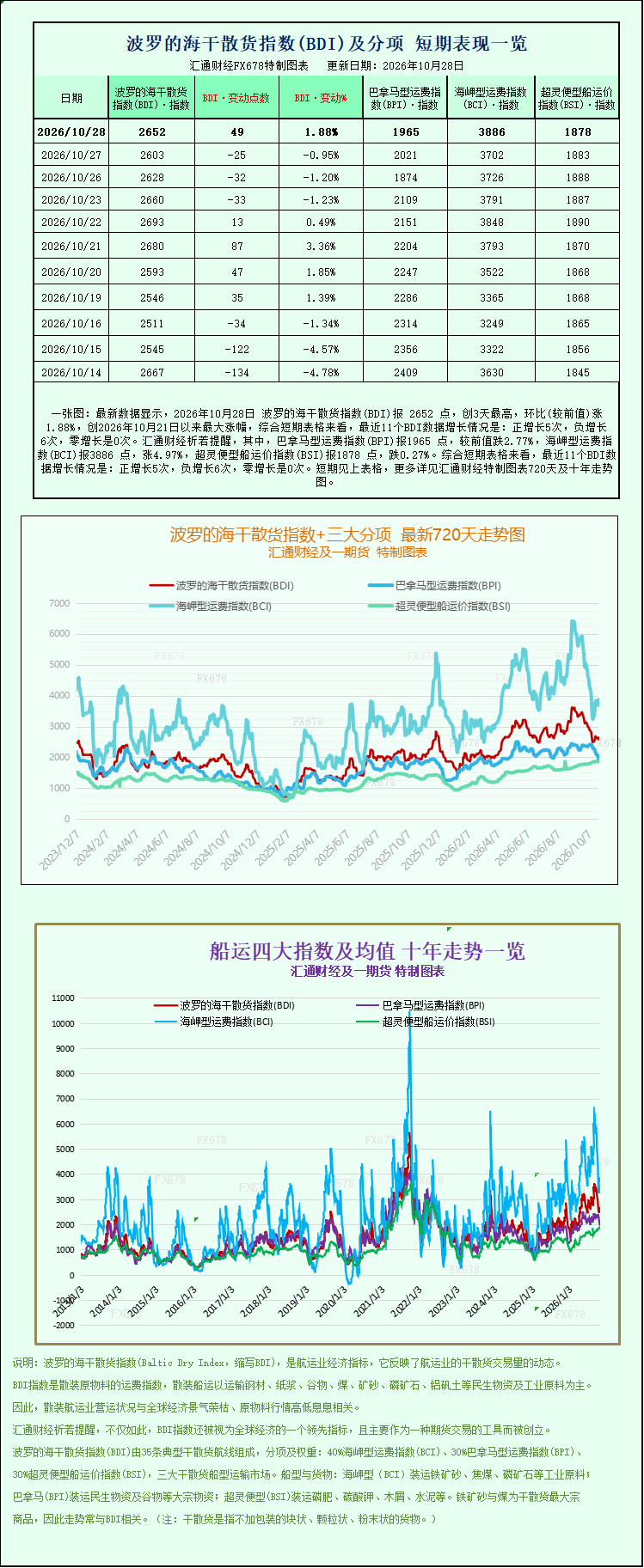 Boosted by stronger Capesize (Good Hope) freight rates, the Baltic Dry Index (BDI), a composite index tracking dry bulk shipping rates, rose on Wednesday. As a key indicator of the international dry bulk shipping market, the BDI rose 49 points, or 1.88%, to close at 2652 points. Capesize vessels led the gains, with rates hitting a two-week high . By vessel type, the Capesize Index (BCI) performed the strongest, surging 184 points, or 4.97%, to 3886 points, a near two-week high. Capesize vessels typically transport bulk cargoes, including iron ore and coal, with a deadweight tonnage of approximately 150,000 tons. Their average daily revenue increased by $1670 to $31742. Market analysts pointed out that the direct driver of the significant increase in Capesize freight rates was the recovery in the iron ore market. Iron ore futures prices rose on Wednesday, driven by two main factors: firstly, the resumption of production and restocking demand at domestic steel mills boosted demand for ore shipping capacity; secondly, although arrivals at major ports increased, market expectations of increased supply pressure were partially offset by the demand from resuming production. Capesize freight rates, which had been under pressure for some time, saw this rise as a corrective rebound from low levels, reflecting a marginal improvement in demand sentiment. From a broader perspective, Capesize vessels, as the largest component of the Baltic Dry Index (BDI) (accounting for approximately 40%), have the most significant impact on the overall index. The strong performance of the Capesize sector in this recent rally was the primary driver of the overall BDI increase. Panamax freight rates fell, hitting a four-month low. In stark contrast to Capesize vessels, the Panamax Freight Index (BPI) fell 56 points, or 2.77%, to 1965 points, its lowest level since late April. Panamax vessels, typically carrying 60,000 to 70,000 tons of coal or grain, saw their average daily revenue decline by $507 to $17,686. Analysts believe the weakening of Panamax freight rates is related to weak demand for grain and coal. Unlike Capesize vessels, which are primarily driven by iron ore, Panamax vessels have a more diversified cargo structure. Reduced grain transport during the off-season and low coal trading activity have jointly depressed charter rates for this vessel type. This also reflects the divergent trends among different vessel types within the current dry bulk market. Supramax Vessels Slightly Decline In the small and medium-sized vessel sector, the Supramax Bulk Index (BSIS) fell slightly by 5 points, a decrease of 0.27%, to 1878 points, a new low in a week. Supramax vessels mainly transport small and medium-sized bulk commodities such as grain, fertilizer, and bauxite. Their freight rate fluctuations are relatively mild, but they also failed to maintain their upward trend, indicating that the overall market for small and medium-sized vessels remains weak. Index Mechanism and Market Outlook The Baltic Dry Index (BDI) is the most representative dry bulk shipping price indicator in the international shipping industry. Published daily by the Baltic Exchange, it comprehensively reflects the spot freight rates of three main vessel types: Capesize, Panamax, and Supramax, with weights roughly 40% for Capesize, 30% for Panamax, and 30% for Supramax. Because dry bulk shipping is highly correlated with global trade volumes of commodities such as iron ore, coal, and grains, BDI fluctuations are generally considered a leading indicator of global physical demand. Looking ahead, whether the rebound in Capesize freight rates can be sustained depends crucially on actual changes in iron ore demand. Current steel mills' willingness to resume production and low inventory levels provide support for ore restocking, but the continued increase in port arrivals also indicates pressure on the supply side, resulting in a coexistence of bullish and bearish factors. The weakness in Panamax and smaller vessel types suggests that the overall dry bulk market has not yet fully recovered, and the divergent trends among different vessel types may continue. Overall, the market is expected to fluctuate and diverge in the short term, influenced by factors such as expectations of production resumption, delivery schedules, and seasonality.
- Risk Warning and Disclaimer
- The market involves risk, and trading may not be suitable for all investors. This article is for reference only and does not constitute personal investment advice, nor does it take into account certain users’ specific investment objectives, financial situation, or other needs. Any investment decisions made based on this information are at your own risk.