Gold fell 1% as US PCE inflation data reinforced expectations of a Fed rate hike in December.
2026-10-29 23:24:23
On Thursday (October 29), spot gold continued its intraday decline. This followed the release of the latest US Personal Consumption Expenditures (PCE) inflation data, which further strengthened market expectations that the Federal Reserve, after keeping interest rates unchanged at its October meeting, will begin raising rates in December. Spot gold traded around $4023.61, down 1.11% on the day.  The Personal Consumption Expenditures (PCE) price index rose 0.5% month-over-month in September, in line with expectations and up from 0.3% in August; year-over-year inflation rose to 3.6%, higher than the previous 3.4%, also in line with market forecasts. The core PCE price index, excluding food and energy, rose 0.3% month-over-month, in line with expectations and unchanged from the revised August reading (originally reported as 0.2%); the core PCE price index rose 3.1% year-over-year, up from 3.0% in the previous month, in line with market expectations. The Federal Open Market Committee (FOMC) on Wednesday voted 10-2 to keep interest rates in the 3.75%-4.00% range. Governor Lisa Cook and Cleveland Fed President Beth Hammark favored a 25 basis point rate hike. Although the pause in rate hikes was widely anticipated by the market, the Federal Reserve's cautious approach to combating inflation in the face of persistently rising price pressures initially led to a slightly dovish interpretation: gold prices rose accordingly, and the dollar and short-term Treasury yields declined in tandem. However, the Fed's overall policy stance remains hawkish. Fed Chairman Kevin Warsh reiterated its commitment to achieving price stability. Warsh stated, "While overall financial conditions have tightened, I cannot and should not conclude that the current environment has reached a sufficiently tightening level." Rabobank analysts pointed out that although policy remained unchanged, the committee "stated that more economic data is needed to determine the appropriate policy stance." Chairman Warsh also emphasized that "the FOMC will receive a large amount of economic data in the weeks leading up to the next policy meeting," reiterating that the Fed's policy decisions are highly dependent on data performance. The bank's US strategists summarized, "Warsh did not provide clear forward guidance, but in fact, he has laid the groundwork for a December rate hike," meaning the door to further tightening monetary policy remains open. The latest PCE data shows that inflation remains above the Federal Reserve's 2% target, partly due to rising energy costs driven by tensions in the Middle East. Meanwhile, preliminary Q3 US GDP figures show an annualized growth rate of 3.4%, higher than the market expectation of 3.2% and the previous quarter's 2.2%. The persistently high inflation coupled with a stronger-than-expected economy has further fueled market bets on a December rate hike. The CME FedWatch Tool shows an 83% probability of a December rate hike. Rate hike expectations support a stronger dollar while putting downward pressure on gold prices – rising interest rates increase the opportunity cost of holding non-interest-bearing assets like gold. The US Dollar Index (DXY), which measures the dollar's performance against six major currencies, reversed its previous day's losses and traded around 102.30. A stronger dollar increases the cost for buyers using other currencies to purchase gold, thus putting downward pressure on gold prices. Technical Analysis: Spot gold is holding above the lower Bollinger Band.
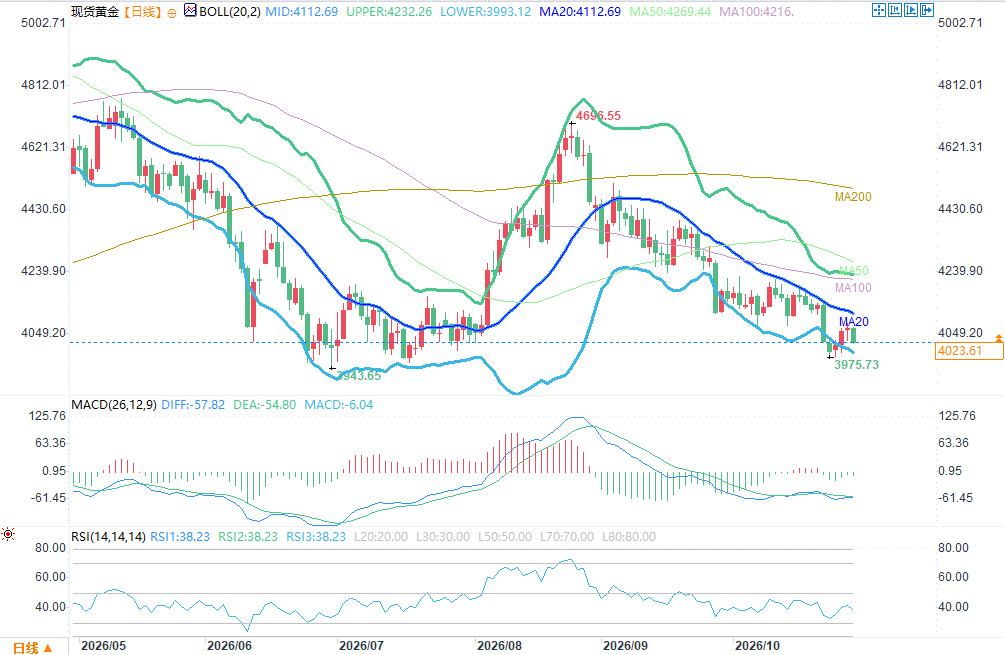 (Spot Gold Daily Chart Source: EasyForex) On the daily chart, the Bollinger Bands parameter BOLL(20,2) shows the middle band (20-period SMA) at $4112.69, the upper band at $4232.26, and the lower band at $3993.12. XAU/USD is trading below the middle Bollinger Band, indicating a short-term bearish bias. Indicator readings: RSI(14) is currently at 38.23, indicating weak buying momentum, but not yet in oversold territory; MACD's DIFF=-57.82, DEA=-54.80, and the MACD histogram remains slightly negative, indicating that sellers still dominate. Resistance levels: The first resistance is at the middle Bollinger Band (20-period moving average) at $4112.69, followed by the upper Bollinger Band at $4232.26. If the gold price can hold above these levels, it is expected to rise further to $4400. Support levels: The lower Bollinger Band is around $3993.12, coinciding with the previous low of $3975.73, creating a support range of $3975–$3993, which will likely limit further downside. However, if gold prices break below this range, it could trigger a deeper correction.
The Personal Consumption Expenditures (PCE) price index rose 0.5% month-over-month in September, in line with expectations and up from 0.3% in August; year-over-year inflation rose to 3.6%, higher than the previous 3.4%, also in line with market forecasts. The core PCE price index, excluding food and energy, rose 0.3% month-over-month, in line with expectations and unchanged from the revised August reading (originally reported as 0.2%); the core PCE price index rose 3.1% year-over-year, up from 3.0% in the previous month, in line with market expectations. The Federal Open Market Committee (FOMC) on Wednesday voted 10-2 to keep interest rates in the 3.75%-4.00% range. Governor Lisa Cook and Cleveland Fed President Beth Hammark favored a 25 basis point rate hike. Although the pause in rate hikes was widely anticipated by the market, the Federal Reserve's cautious approach to combating inflation in the face of persistently rising price pressures initially led to a slightly dovish interpretation: gold prices rose accordingly, and the dollar and short-term Treasury yields declined in tandem. However, the Fed's overall policy stance remains hawkish. Fed Chairman Kevin Warsh reiterated its commitment to achieving price stability. Warsh stated, "While overall financial conditions have tightened, I cannot and should not conclude that the current environment has reached a sufficiently tightening level." Rabobank analysts pointed out that although policy remained unchanged, the committee "stated that more economic data is needed to determine the appropriate policy stance." Chairman Warsh also emphasized that "the FOMC will receive a large amount of economic data in the weeks leading up to the next policy meeting," reiterating that the Fed's policy decisions are highly dependent on data performance. The bank's US strategists summarized, "Warsh did not provide clear forward guidance, but in fact, he has laid the groundwork for a December rate hike," meaning the door to further tightening monetary policy remains open. The latest PCE data shows that inflation remains above the Federal Reserve's 2% target, partly due to rising energy costs driven by tensions in the Middle East. Meanwhile, preliminary Q3 US GDP figures show an annualized growth rate of 3.4%, higher than the market expectation of 3.2% and the previous quarter's 2.2%. The persistently high inflation coupled with a stronger-than-expected economy has further fueled market bets on a December rate hike. The CME FedWatch Tool shows an 83% probability of a December rate hike. Rate hike expectations support a stronger dollar while putting downward pressure on gold prices – rising interest rates increase the opportunity cost of holding non-interest-bearing assets like gold. The US Dollar Index (DXY), which measures the dollar's performance against six major currencies, reversed its previous day's losses and traded around 102.30. A stronger dollar increases the cost for buyers using other currencies to purchase gold, thus putting downward pressure on gold prices. Technical Analysis: Spot gold is holding above the lower Bollinger Band. (Spot Gold Daily Chart Source: EasyForex) On the daily chart, the Bollinger Bands parameter BOLL(20,2) shows the middle band (20-period SMA) at $4112.69, the upper band at $4232.26, and the lower band at $3993.12. XAU/USD is trading below the middle Bollinger Band, indicating a short-term bearish bias. Indicator readings: RSI(14) is currently at 38.23, indicating weak buying momentum, but not yet in oversold territory; MACD's DIFF=-57.82, DEA=-54.80, and the MACD histogram remains slightly negative, indicating that sellers still dominate. Resistance levels: The first resistance is at the middle Bollinger Band (20-period moving average) at $4112.69, followed by the upper Bollinger Band at $4232.26. If the gold price can hold above these levels, it is expected to rise further to $4400. Support levels: The lower Bollinger Band is around $3993.12, coinciding with the previous low of $3975.73, creating a support range of $3975–$3993, which will likely limit further downside. However, if gold prices break below this range, it could trigger a deeper correction.
- Risk Warning and Disclaimer
- The market involves risk, and trading may not be suitable for all investors. This article is for reference only and does not constitute personal investment advice, nor does it take into account certain users’ specific investment objectives, financial situation, or other needs. Any investment decisions made based on this information are at your own risk.