A chart shows the Baltic Dry Index hitting a more than two-week high, with cape-type stocks leading the gains.
2026-10-29 23:38:23
Latest data shows that the Baltic Dry Index (BDI) reached 2712 points on October 29, 2026, a new high since October 13, 2026, up 2.26% month-on-month, the largest increase since October 21, 2026, and the second consecutive day of increase (including zero growth). Looking at the short-term charts, the recent 11 BDI data points show: 6 positive increases, 5 negative increases, and 0 zero increases. Specifically, the Panamax Freight Index (BPI) was 1921 points, down 2.24% from the previous value; the Capesize Freight Index (BCI) was 4090 points, up 5.25%; and the Supramax Freight Index (BSI) was 1870 points, down 0.43%. For detailed 720-day and 10-year trend charts of the Baltic Dry Index and its three sub-indices, please refer to the charts specially prepared by FX678. 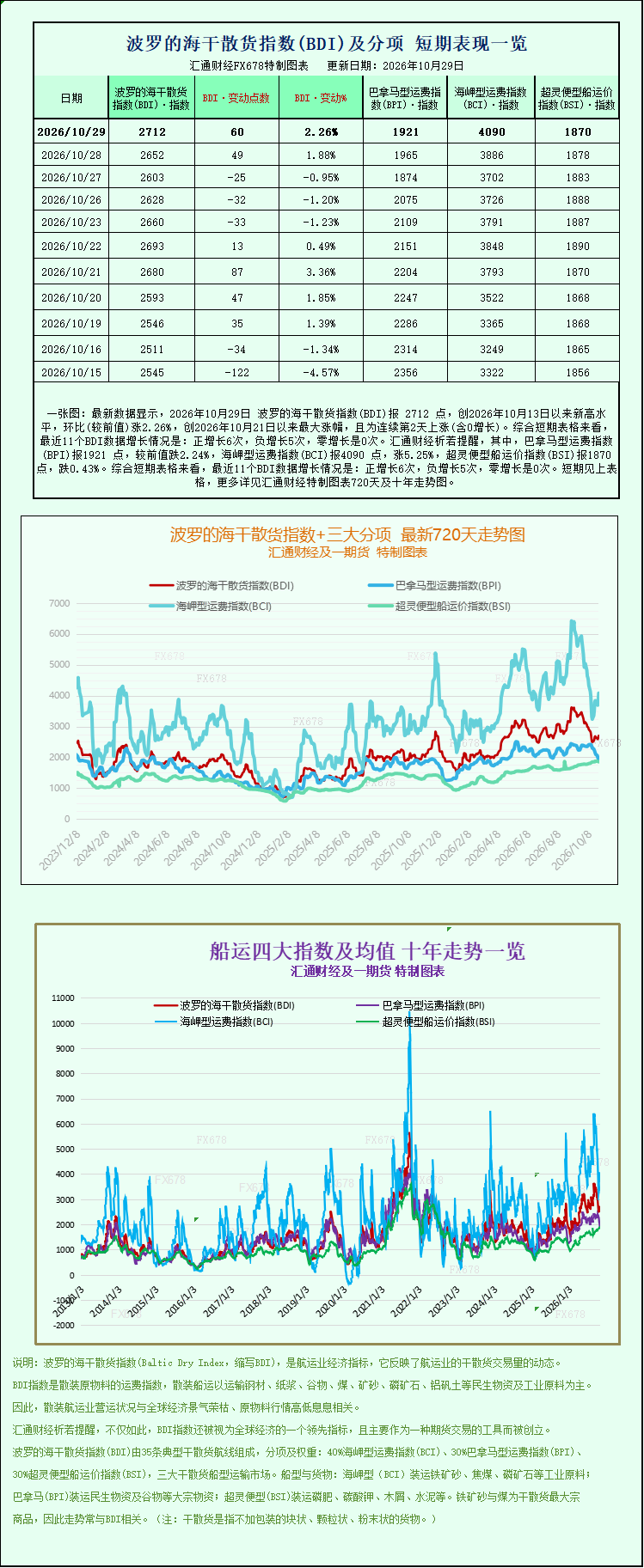 The Baltic Dry Index, the main shipping index tracking dry bulk freight rates, rose to its highest level in more than two weeks on Thursday, primarily driven by a strong surge in Capesize (Capesize) freight rates. As a key indicator of global dry bulk shipping activity, the index's recent fluctuations reflect the latest changes in the supply and demand dynamics of the commodities market and shipping. Overall Index Trend: Single-Day Rebound, Monthly Pressure Remains Data shows that the Baltic Dry Index, which tracks Capesize, Panamax, and Supramax vessel freight rates, rose 60 points, or 2.26%, to 2712 points, its highest level since October 13. However, despite the significant single-day rebound, the index is still on track for its second consecutive monthly decline, with a monthly drop of 14.8%. This contrast clearly indicates that the market is currently in a state of "short-term sentiment recovery" coupled with "weakening medium-term fundamentals." On the one hand, the sharp single-day increase reflects a temporary boost in demand in the shipping market; on the other hand, the continued monthly decline indicates that the overall dry bulk market still faces structural pressures in the longer term, including ample capacity supply and weak demand during the traditional off-season. Capesize Sector: Strongest Rebound, Most Volatile Among the three major ship types, the Capesize bulk carrier sector performed the best. The Capesize bulk carrier index surged 204 points, a 5.25% increase, to 4090 points, the highest level since October 12th. It is worth noting that although this sector saw the largest single-day rebound, it also faced a significant monthly decline of approximately 22%, reflecting the typical characteristics of high volatility and elasticity in freight rates for this ship type. Capesize vessels are the largest ship type in the dry bulk market, typically used to carry approximately 150,000 tons of bulk cargo, including raw materials crucial for steel production such as iron ore and coal. Data shows that the average daily earnings of Capesize bulk carriers increased by $1,850 this week, reaching $33,592, a relatively high level. The strong performance of the Capesize sector is closely related to the iron ore market. From the demand side, iron ore is one of the main cargoes for Capesize vessels, and its transportation demand directly affects the freight rate trend of this type of vessel. Recently, the output of hot metals from blast furnaces in Chinese steel mills has increased, providing strong demand support for iron ore transportation, thereby driving up freight rates in the Capesize sector. Iron Ore Futures: A Game Between Demand Recovery and Policy Constraints Echoing the shipping market, the iron ore futures market also showed signs of rebounding on the same day. Supported by both increased hot metals output from Chinese steel mills and rising shipping freight rates, iron ore futures prices climbed to their highest level in nearly two weeks. However, market bullish sentiment has not been fully released. Hebei Province, as an important steel-producing province in China, has recently implemented production reduction measures, which to some extent have limited the further upside potential of iron ore prices. This policy signal indicates that, against the backdrop of environmental constraints and industrial restructuring, the production pace of China's steel industry remains significantly affected by supply-side policies, thus creating a temporary constraint on iron ore demand expectations. This also means that the subsequent trend of the iron ore market will depend on the outcome of the interplay between the strength of demand recovery and policy-imposed production restrictions. If production cuts in Hebei and other regions continue to be implemented, iron ore demand may be further suppressed; conversely, if steel mill production recovers more rapidly, it is expected to continue supporting the Capesize segment and iron ore freight rates. Panamax Segment: Continues to Weaken, Hitting a Multi-Month Low In stark contrast to the strength of the Capesize segment, the Panamax bulk carrier segment continued to be under pressure. The Panamax index fell 44 points, a drop of 2.24%, to 1921 points, its lowest level since April 14. The index is expected to fall by approximately 17.6% this month, significantly underperforming other major ship types. Panamax vessels, with a capacity between Capesize and Handysize, typically carry 60,000 to 70,000 tons of cargo such as coal or grain. Data shows that the average daily revenue for Panamax vessels decreased by $397 to $17,289. The continued weakness in the Panamax sector is mainly related to the seasonal decline in demand for food and coal transportation. Currently, it is the off-season for food transportation in the Northern Hemisphere, and coal trade is also affected by seasonal demand changes, resulting in overall weak demand for this vessel type and putting pressure on freight rates. Supramax Sector: Narrow Fluctuations, Monthly Upward Trend In the smaller vessel sector, the Supramax bulk carrier index fell slightly by 8 points, a decrease of 0.43%, to 1870 points, hitting its lowest point since October 20th. Despite the single-day decline, this sector's overall performance remains the most stable among the three vessel types—the Supramax bulk carrier index is on track for its third consecutive month of increase, with a monthly rise of 4.5%. This trend reflects that, against the backdrop of overall pressure on the global dry bulk market, smaller vessels, with their flexible transportation attributes and ability to carry diversified cargoes (such as agricultural products and minor bulk commodities), maintain relatively strong demand resilience, thus exhibiting a counter-trend upward trend on a monthly basis. Market Outlook and Key Observations In summary, the current Baltic dry bulk market presents a complex pattern of "sectoral differentiation, short-term rebound, and medium-term pressure." The Capesize segment is strongly led by the recovery in iron ore demand, but still faces a significant monthly decline; the Panamax segment continues to weaken, hitting a multi-month low; while the Supramax segment maintains relative resilience in the overall downward environment. Looking ahead, market participants are mainly focused on the actual production pace and policy trends of China's steel industry. On the one hand, the increase in hot metal production by steel mills provides support for iron ore transportation demand; on the other hand, production reduction measures in Hebei Province and other regions constrain demand expectations. The tug-of-war between these two forces will largely determine the short-term trend of Capesize freight rates and even the overall dry bulk market. In addition, seasonal factors, global economic conditions, commodity price fluctuations, and shipping capacity supply will remain key variables influencing the future trend of the Baltic Dry Index. Investors and market participants need to continuously monitor marginal changes in relevant data to grasp the market's periodic opportunities and risks.
- Risk Warning and Disclaimer
- The market involves risk, and trading may not be suitable for all investors. This article is for reference only and does not constitute personal investment advice, nor does it take into account certain users’ specific investment objectives, financial situation, or other needs. Any investment decisions made based on this information are at your own risk.