The US dollar has risen for two consecutive months, but six major central banks have collectively held off on monetary policy; the key variables will emerge next week.
2026-10-31 11:08:24
The currency market in October continued its divergent pattern dominated by the US dollar. The US dollar index fluctuated at high levels, and is poised for two consecutive monthly gains; the euro hit a new low in more than a year, marking its second consecutive monthly decline; the yen rebounded in the short term but remains weak on the monthly chart; the pound sterling rebounded after hitting a low and turned positive first. At the end of the month, the Bank of Japan remained hawkish and did not raise interest rates, and the window for recovery for non-US dollar currencies under the pressure of interest rate differentials has not yet opened. 
 Economic Data and Events Summary The Federal Reserve kept interest rates unchanged this month, choosing to remain on the sidelines amid persistently high inflation and tightening financial conditions. Lower US Treasury yields at the end of the month weighed on the dollar; earnings reports from several tech giants raised concerns about AI spending, leading to a sell-off in tech stocks and increased risk aversion. However, the drag from declining yields was more direct, and safe-haven buying failed to fully offset the impact. Analyst and Institutional Views Summary Some forex analysts pointed out that the Fed's policy stance is still offsetting the actions of other central banks, which is the core support for the dollar's consolidation at high levels. Major overseas institutions believe that the direction of yields will determine whether the dollar can continue its two-month winning streak.
 Economic Data and Events Summary As widely expected, the Bank of Japan (BOJ) kept its benchmark interest rate unchanged at 1.25% at the end of the month, but raised its inflation forecast and emphasized that its policy has entered a more hawkish phase, potentially raising rates every few months. This concluded a series of central bank meetings this week. Analyst and Institutional Views Summary A senior market analyst stated that the market was slightly disappointed with the BOJ. Although the yen strengthened for three consecutive trading days, the strength was less than before, and the Federal Reserve's policy stance continued to offset its impact. Major overseas institutions expect the BOJ to raise interest rates multiple times in December and next year, ultimately raising rates to 2% before assessing the tightening effect.
 Economic Data and Events Summary The European Central Bank (ECB) kept interest rates unchanged this month, noting that rising bond yields had tightened financial conditions. This statement prompted traders to lower their expectations for a December rate hike, becoming a significant trigger for the euro's weakness. The gap in fundamental growth between the Eurozone and the United States further weighed on the exchange rate. Analyst and Institutional Views Summary A foreign exchange strategist from a major bank stated that while the euro initially received support from market sentiment fluctuations, this strength is likely to fade quickly given the Eurozone's lagging economic growth compared to the United States. Institutions generally maintain a cautious tone regarding the euro's medium-term outlook.
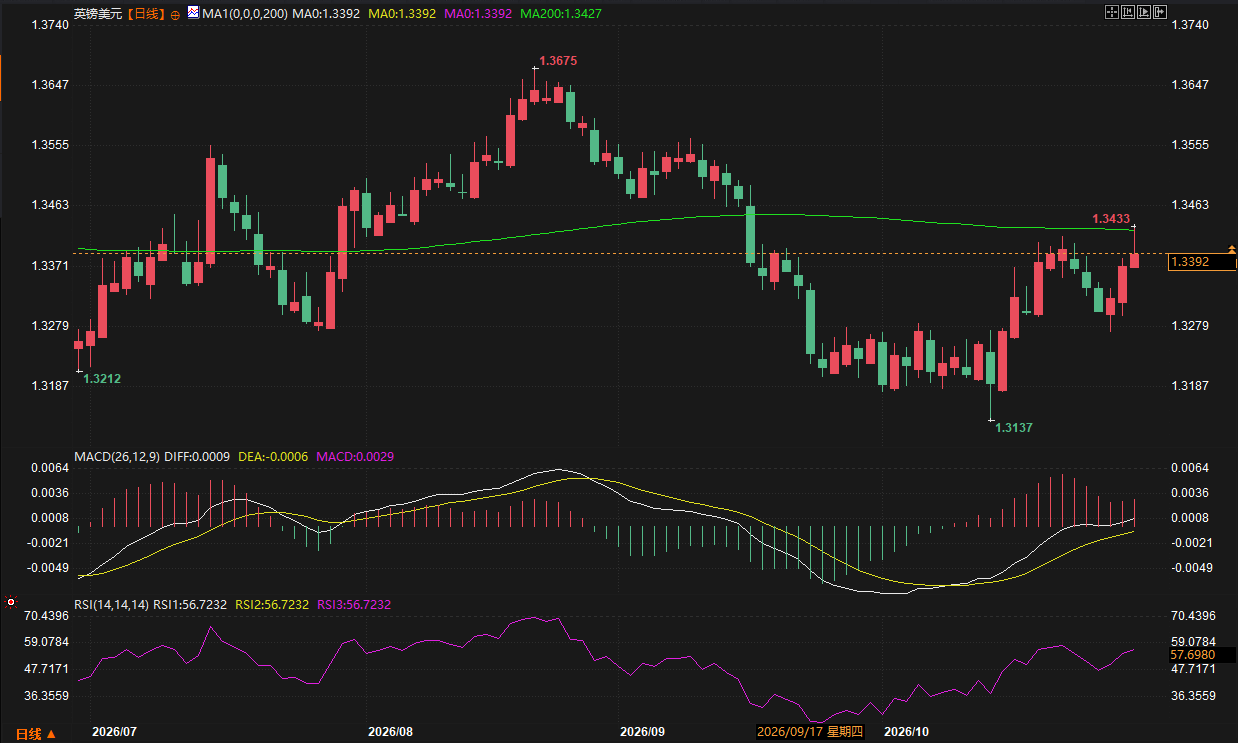 Economic Data and Events Summary The Bank of England, along with other major central banks, chose to remain on the sidelines this month. The pound rose 0.15% against the dollar at the end of the month, indicating a relative increase in investor preference for the pound amid pressure on the euro. Analyst and Institutional Views Summary Major overseas institutions believe that the pound is relatively resilient among major non-US dollar currencies. If the Bank of England releases a hawkish signal next week, the pound may have further room for recovery, but the overall strength of the US dollar remains a suppressive factor.
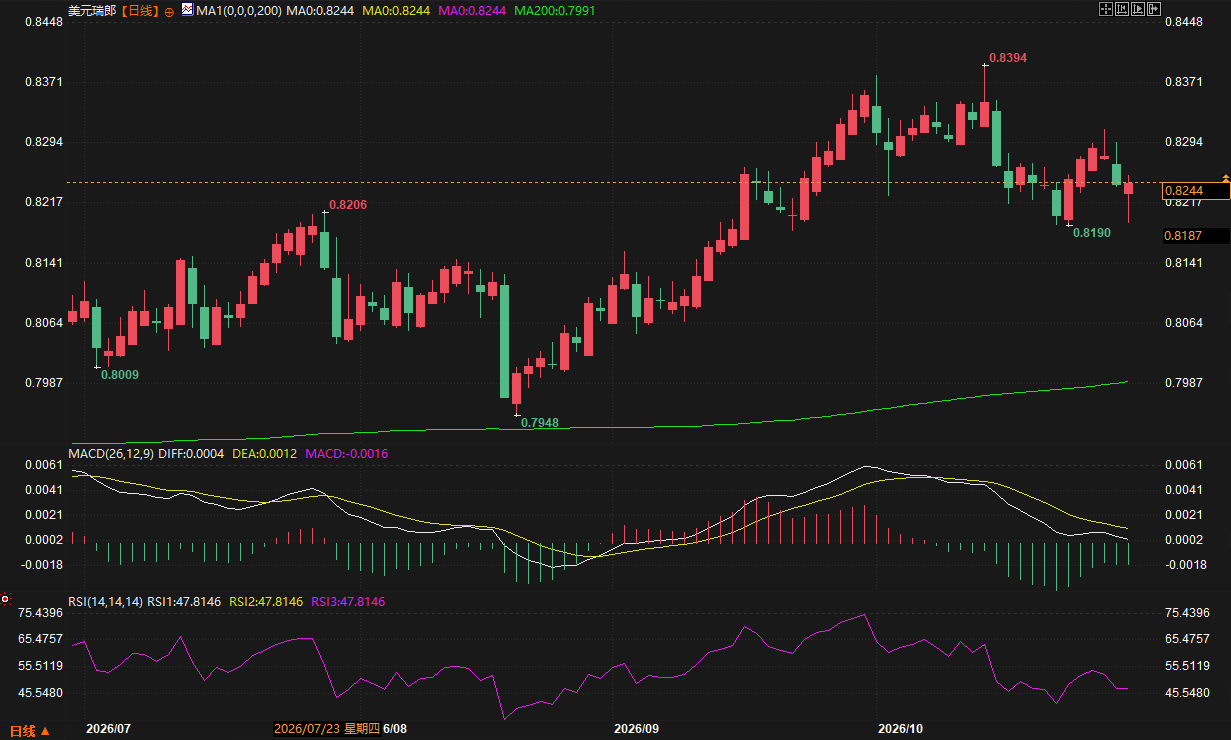 Economic Data and Events Summary The Federal Reserve's decision to hold rates steady this month, coupled with lower US Treasury yields at the end of the month, gave the Swiss franc a temporary advantage due to its safe-haven and low-interest-rate attributes, becoming a key factor in the pullback of the USD/CHF exchange rate from its highs. Analyst and Institutional Views Summary Major overseas institutions believe that in an environment of increased market volatility, the Swiss franc's safe-haven appeal will continue to attract capital, and further appreciation of the USD/CHF exchange rate will require a renewed strengthening of yields.
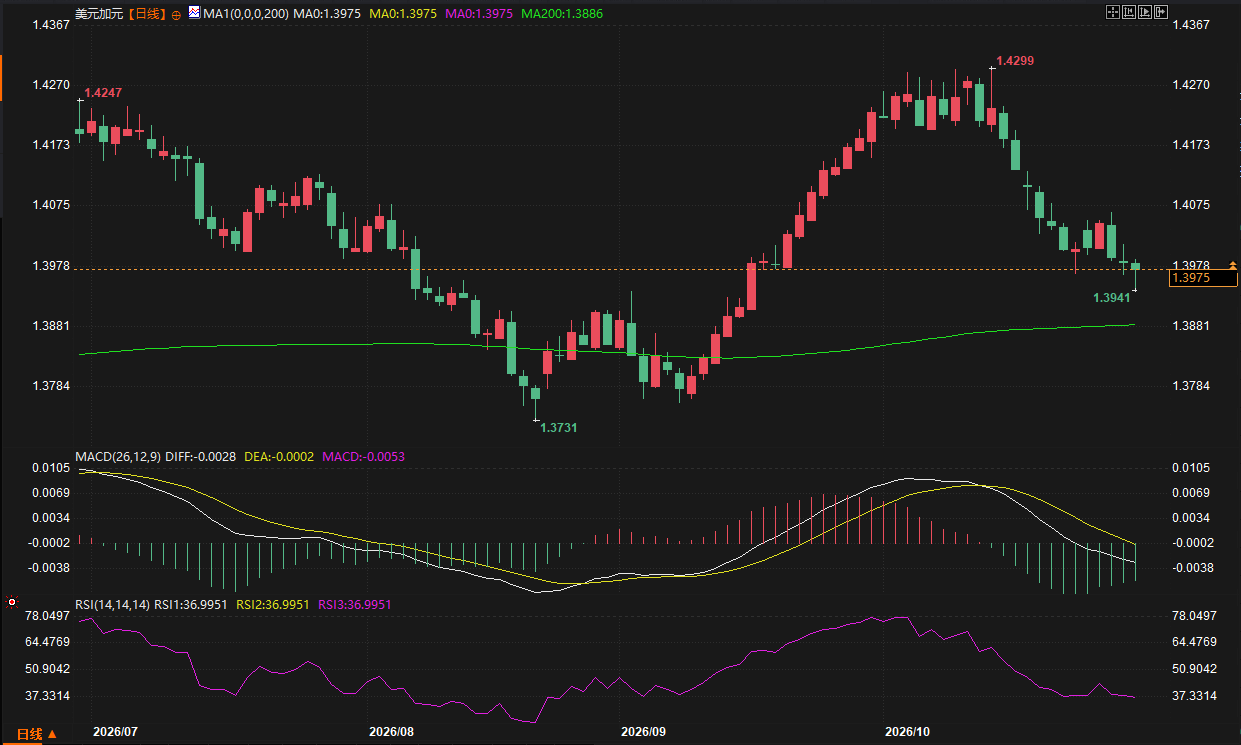 Economic Data and Event Summary This month, crude oil prices surged, and Brent crude recorded double-digit monthly gains, providing commodity-driven support for the Canadian dollar, an oil currency. Meanwhile, the US dollar index fluctuated at high levels, and the Canadian dollar strengthened significantly after these two forces offset each other. Analyst and Institutional Views Summary Major overseas institutions believe that if the strength of oil prices continues, the commodity-driven support of the Canadian dollar is likely to continue to suppress the USD/CAD exchange rate. However, the actions of the Bank of England and the Reserve Bank of Australia next week, as well as the path of US dollar interest rates, will still influence the overall foreign exchange market rhythm. The main theme of the foreign exchange market in October was the divergence between strong and weak currencies driven by interest rate differentials: the US dollar consolidated at high levels with two consecutive days of gains, the euro led the decline to a new low, the pound sterling turned positive first, the Canadian dollar rebounded supported by oil prices, and the yen and Swiss franc each had support but struggled to break out of their respective patterns. After the Bank of England and the Reserve Bank of Australia's decisions next week, the answer to whether non-US dollar currencies can open a window for recovery will gradually become clearer.
US Dollar Index
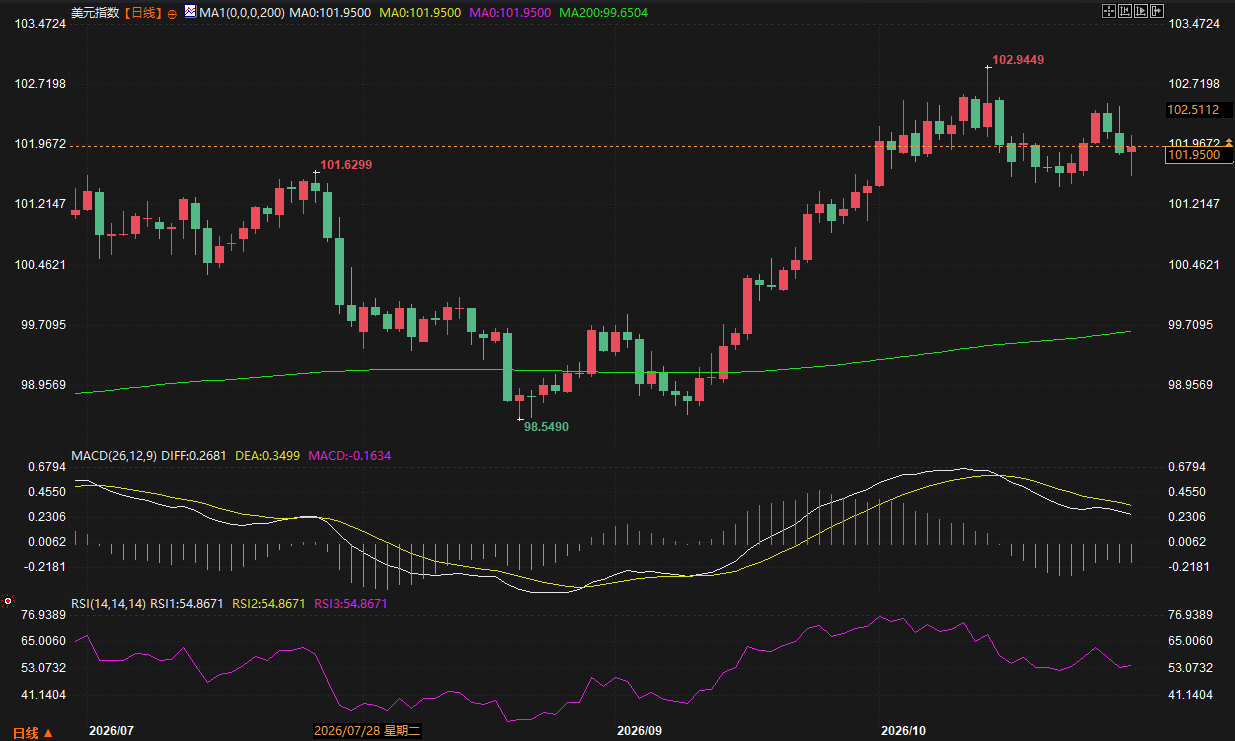
Monthly Market Review The US dollar index rebounded from its lows in October and then entered a period of high-level consolidation, reaching a high of 102.94 mid-month before falling back to around 101.95 at the end of the month, marking its second consecutive month of gains. The index had previously bottomed out at 98.55 in mid-August, and its center of gravity had been steadily rising since September; the strength in October continued the rebound structure that had begun at the end of the third quarter. Economic Data and Events Summary The Federal Reserve kept interest rates unchanged this month, choosing to remain on the sidelines amid persistently high inflation and tightening financial conditions. Lower US Treasury yields at the end of the month weighed on the dollar; earnings reports from several tech giants raised concerns about AI spending, leading to a sell-off in tech stocks and increased risk aversion. However, the drag from declining yields was more direct, and safe-haven buying failed to fully offset the impact. Analyst and Institutional Views Summary Some forex analysts pointed out that the Fed's policy stance is still offsetting the actions of other central banks, which is the core support for the dollar's consolidation at high levels. Major overseas institutions believe that the direction of yields will determine whether the dollar can continue its two-month winning streak.US Dollar Japanese Yen
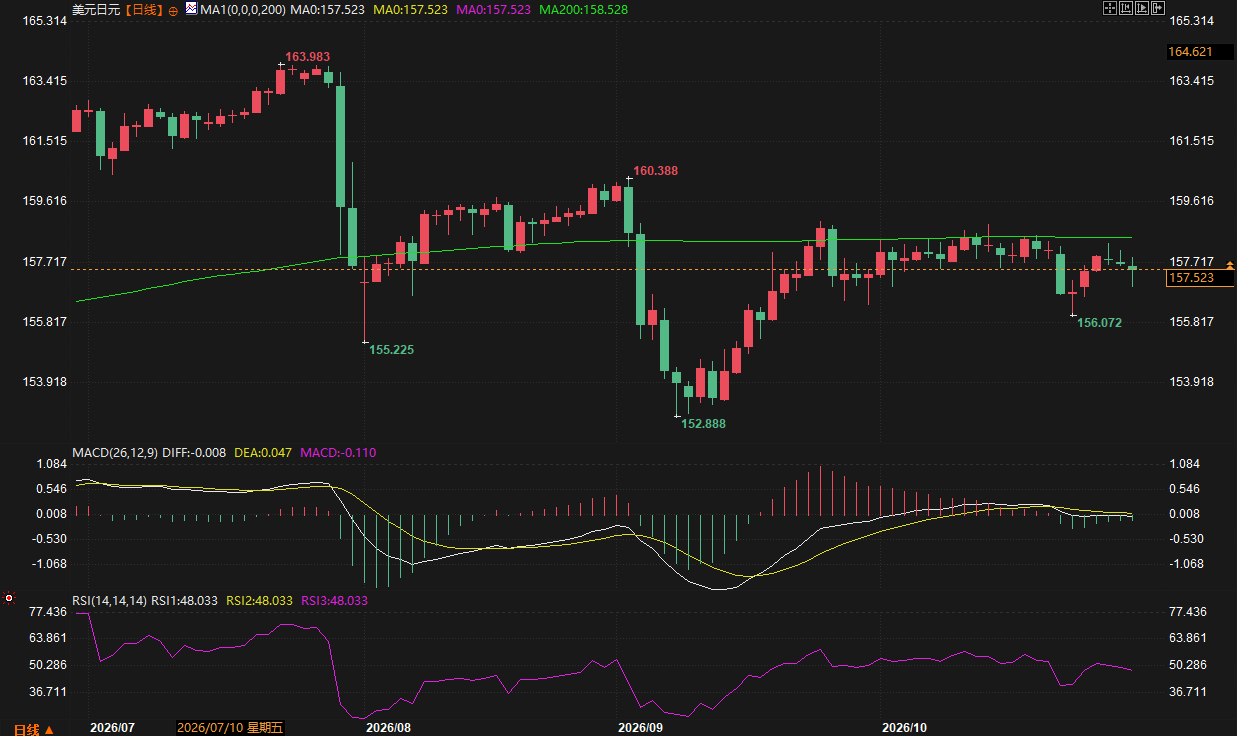
Monthly Price Movement Review The USD/JPY pair fluctuated between 156 and 158 in October, recovering to around 157.57 by the end of the month. Previously, the exchange rate experienced two significant declines in August and September from its high of 163.98 at the end of July, stabilizing after reaching a low of 152.89 in early September. October was generally a bottoming-out phase, but the monthly chart still recorded a decline. Economic Data and Events Summary As widely expected, the Bank of Japan (BOJ) kept its benchmark interest rate unchanged at 1.25% at the end of the month, but raised its inflation forecast and emphasized that its policy has entered a more hawkish phase, potentially raising rates every few months. This concluded a series of central bank meetings this week. Analyst and Institutional Views Summary A senior market analyst stated that the market was slightly disappointed with the BOJ. Although the yen strengthened for three consecutive trading days, the strength was less than before, and the Federal Reserve's policy stance continued to offset its impact. Major overseas institutions expect the BOJ to raise interest rates multiple times in December and next year, ultimately raising rates to 2% before assessing the tightening effect.Eurodollar
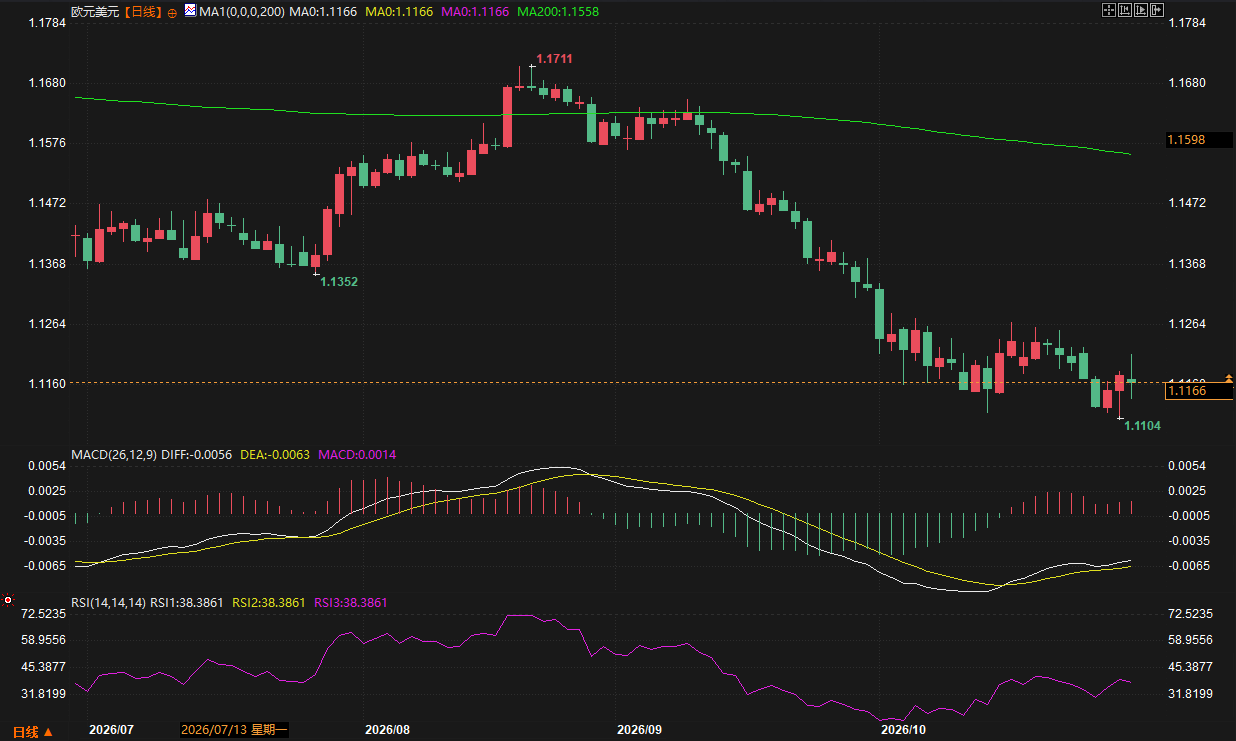
Monthly Price Movement Review The euro continued its downward trend against the US dollar in October, falling to a new low of 1.1104 at the end of the month, approaching its lowest level since May 2025. Currently, it is consolidating weakly around 1.1166, with the price trading below the long-term moving average. This marks the second consecutive month of decline. Economic Data and Events Summary The European Central Bank (ECB) kept interest rates unchanged this month, noting that rising bond yields had tightened financial conditions. This statement prompted traders to lower their expectations for a December rate hike, becoming a significant trigger for the euro's weakness. The gap in fundamental growth between the Eurozone and the United States further weighed on the exchange rate. Analyst and Institutional Views Summary A foreign exchange strategist from a major bank stated that while the euro initially received support from market sentiment fluctuations, this strength is likely to fade quickly given the Eurozone's lagging economic growth compared to the United States. Institutions generally maintain a cautious tone regarding the euro's medium-term outlook.British pound and US dollar
Monthly Performance Review The British pound rebounded steadily against the US dollar after bottoming out at 1.3137 in early October, rising to around 1.3396 by the end of the month, achieving a monthly gain and becoming the first major non-US dollar currency to turn positive. Previously, the exchange rate had retreated after reaching a high of 1.3675 in mid-August, and is currently back near its long-term moving average. Economic Data and Events Summary The Bank of England, along with other major central banks, chose to remain on the sidelines this month. The pound rose 0.15% against the dollar at the end of the month, indicating a relative increase in investor preference for the pound amid pressure on the euro. Analyst and Institutional Views Summary Major overseas institutions believe that the pound is relatively resilient among major non-US dollar currencies. If the Bank of England releases a hawkish signal next week, the pound may have further room for recovery, but the overall strength of the US dollar remains a suppressive factor.US Dollar and Swiss Franc
Monthly Price Movement Review The USD/CHF pair touched a high of 0.8394 in mid-October before slightly retreating, consolidating around 0.8244 at the end of the month. Previously, the exchange rate had been trending upwards from a low of 0.7948 at the end of August, and the upward movement in October continued a recovery trend that had lasted for more than two months, with limited pullback at the end of the month. Economic Data and Events Summary The Federal Reserve's decision to hold rates steady this month, coupled with lower US Treasury yields at the end of the month, gave the Swiss franc a temporary advantage due to its safe-haven and low-interest-rate attributes, becoming a key factor in the pullback of the USD/CHF exchange rate from its highs. Analyst and Institutional Views Summary Major overseas institutions believe that in an environment of increased market volatility, the Swiss franc's safe-haven appeal will continue to attract capital, and further appreciation of the USD/CHF exchange rate will require a renewed strengthening of yields.US dollars and Canadian dollars
Monthly Performance Review The USD/CAD pair reached a high of 1.4299 in mid-October before falling back to close at 1.3978 at the end of the month, erasing nearly half a month's gains and recording a significant monthly decline. Previously, the pair had risen strongly from a low of 1.3731 in mid-August; the October pullback essentially wiped out all the gains made during the month. Economic Data and Event Summary This month, crude oil prices surged, and Brent crude recorded double-digit monthly gains, providing commodity-driven support for the Canadian dollar, an oil currency. Meanwhile, the US dollar index fluctuated at high levels, and the Canadian dollar strengthened significantly after these two forces offset each other. Analyst and Institutional Views Summary Major overseas institutions believe that if the strength of oil prices continues, the commodity-driven support of the Canadian dollar is likely to continue to suppress the USD/CAD exchange rate. However, the actions of the Bank of England and the Reserve Bank of Australia next week, as well as the path of US dollar interest rates, will still influence the overall foreign exchange market rhythm. The main theme of the foreign exchange market in October was the divergence between strong and weak currencies driven by interest rate differentials: the US dollar consolidated at high levels with two consecutive days of gains, the euro led the decline to a new low, the pound sterling turned positive first, the Canadian dollar rebounded supported by oil prices, and the yen and Swiss franc each had support but struggled to break out of their respective patterns. After the Bank of England and the Reserve Bank of Australia's decisions next week, the answer to whether non-US dollar currencies can open a window for recovery will gradually become clearer.QA
Q1: What is the core logic behind the US dollar's two consecutive monthly gains? The interest rate differential advantage is fundamental. Although the Federal Reserve held rates steady, its policy inclination remains stronger than that of most non-US central banks. The rising US Treasury yield continues to attract funds, and the foundation for the dollar's consolidation at high levels remains unshaken. Q2: Why did the yen still close lower on the monthly chart despite the Bank of Japan's hawkish shift? The decision did not bring any new information, and the market had already partially priced it in. Furthermore, the narrowing of the US-Japan interest rate differential is slow, and the expected rate hike path is expected to be delayed, thus limiting the yen's rebound momentum. Q3: Why are the euro and pound sterling diverging against the dollar? The pound sterling had already fully released its correction pressure and recovered first in early October, while the euro was pressured by both lagging growth in the Eurozone and downward revisions in rate hike expectations. The fundamental differences determine the strength difference between the two. Q4: What is driving the Canadian dollar's reversal of its dollar gains? The surge in oil prices in a single month is a key variable. The oil currency attribute provides commodity-based support for the Canadian dollar. If the strength of oil prices continues, the downward pressure on the USD/CAD exchange rate may persist. Q5: What is the biggest point to observe in the foreign exchange market in November? First, the policy statements from the Bank of England and the Reserve Bank of Australia; second, the direction of US Treasury yields. If yields stabilize and rise, the dollar's strength will continue; conversely, a recovery in non-US currencies will officially begin.- Risk Warning and Disclaimer
- The market involves risk, and trading may not be suitable for all investors. This article is for reference only and does not constitute personal investment advice, nor does it take into account certain users’ specific investment objectives, financial situation, or other needs. Any investment decisions made based on this information are at your own risk.