The US dollar index has seen no positive impact for three consecutive weeks. What changes have occurred in the underlying pricing logic?
2026-11-02 20:56:26
On Monday, November 2nd, the US dollar index was trading around 101.6, failing to achieve sustained gains for the third consecutive week despite positive economic data and risk aversion. Last week, the Federal Reserve maintained the target range for the federal funds rate at 3.75% to 4%, but two dissenting votes emerged advocating for a rate hike. US third-quarter GDP annualized growth was 3.4%, and the September personal consumption expenditures price index rose to 3.6% year-on-year, with core inflation reaching 3.1%. The market has priced in a 75% probability of a December rate hike. This week's main risk events are concentrated on the US midterm elections on Tuesday and the non-farm payroll report on Friday. Market pricing indicates a roughly 95% probability that the Republicans will lose control of at least one House of Representatives. 
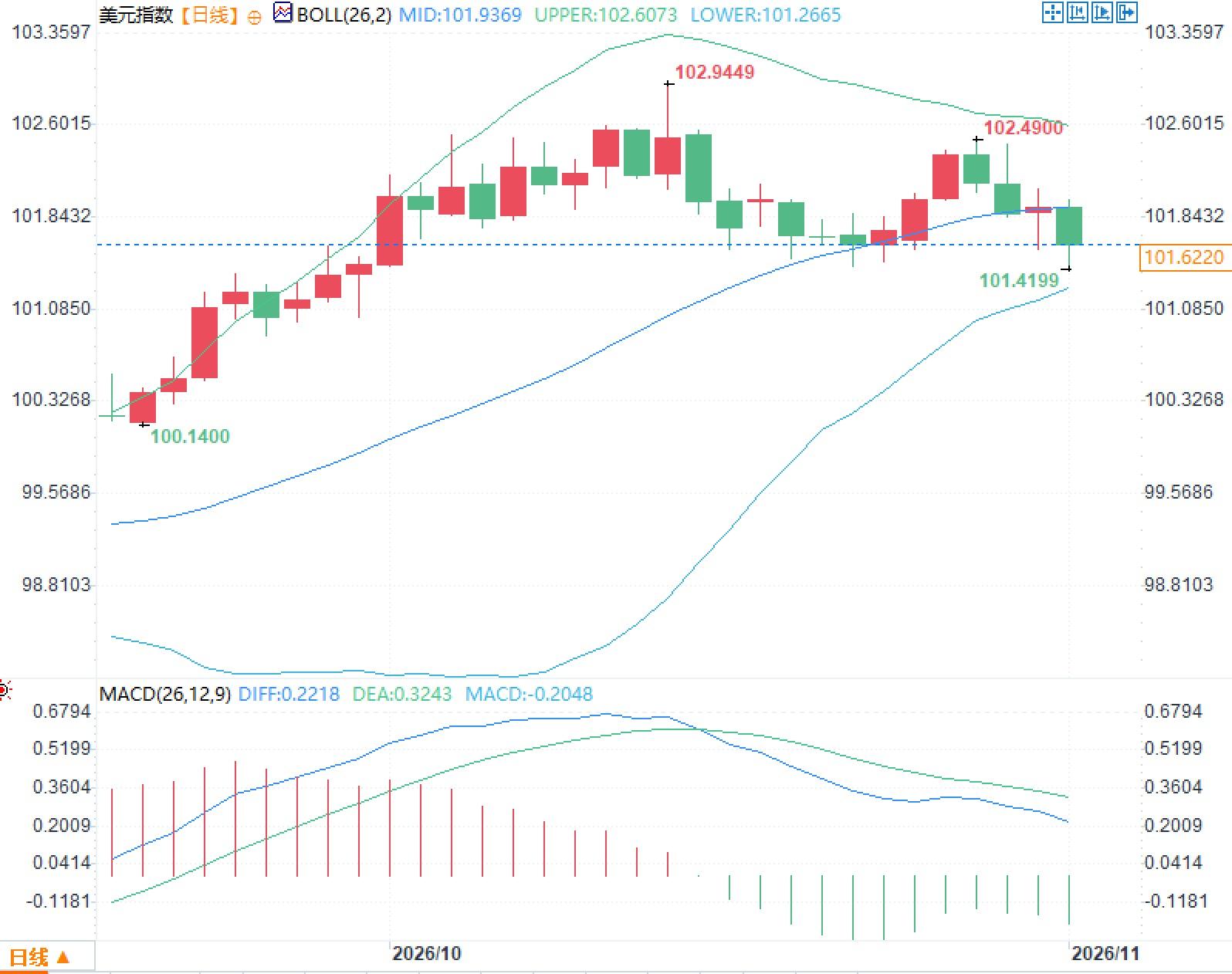
The market performance of the US dollar index under continuous pressure
The US dollar index has failed to provide a sustained response to positive fundamental news and risk aversion demand over the past three weeks. US Q3 GDP growth rose to 3.4% from 2.2% in the previous quarter, and both overall and core inflation data rebounded in September. Traditionally, such combinations support the dollar's performance relative to other major currencies. However, the index has remained range-bound between 101.6 and 102.3 during this period, failing to break through previous highs. The market has already fully priced in the possibility of further tightening in the Fed's policy path, with short-term interest rate futures indicating a roughly 75% probability of a 25 basis point rate hike in December, and pricing in no more than one additional rate hike in 2027. Regarding safe-haven demand, despite geopolitical uncertainties, the dollar has not received the significant premium seen in previous cycles, indicating that funds are increasingly focusing on subsequent political and fiscal variables.Federal Reserve Decision and Data Interpretation
The Federal Reserve last week voted 10-2 to keep interest rates unchanged, with dissenting opinions coming from Governor Cook and Cleveland Fed President Hammark, both of whom advocated for a 25-basis-point rate hike. The statement upgraded its assessment of economic activity to strong expansion, noting that inflation remained high and that more information was needed to determine the appropriate policy stance to ensure inflation fell back to the 2% target in a timely manner. Chairman Warsh emphasized the anti-inflation stance after the meeting, rejecting a soft inflation target, and did not provide clear guidance for December, announcing a gradual reduction in the number of interest rate decision meetings starting in 2027. The US Personal Consumption Expenditures (PCE) price index rose 0.5% month-over-month and 3.6% year-over-year in September, while the core index rose 0.3% month-over-month and 3.1% year-over-year, both higher than the previous month. Third-quarter GDP grew at an annualized rate of 3.4%, higher than expected, mainly contributed by investment, consumption, and government spending, while net exports were a drag. The Fed's statement that previous tightening measures had already taken effect provided support for the market to view a December rate hike as a possible "last" instance. Several regional Federal Reserve presidents publicly stated after the decision that at least one or two more rate hikes would be needed, but emphasized a gradual approach to minimize unnecessary shocks to economic activity. This internal divergence, combined with the data, has focused the uncertainty surrounding the policy path on the subsequent performance of the labor market, rather than simply inflation stickiness.US Midterm Elections and This Week's Risk Events
Tuesday's midterm elections are the core political variable this week. Market pricing indicates a roughly 95% probability that Republicans will lose control of at least one house, and only a 5% to 6% probability that they will control both houses. In the tail-end scenario of a Republican sweep, the market typically reassesses the path of tax cuts, increased spending, and the fiscal deficit, and reprices concerns about the Fed's independence. Historically, such a combination has often provided temporary support for the dollar. However, current pricing already fully reflects the baseline scenario, and if the election results meet expectations, the marginal impact on the dollar will be limited. Friday's US non-farm payrolls report poses another major data risk. If job growth and wage growth continue to be stronger than expected, it could further solidify the pricing of a December rate hike; a significant slowdown could compress the room for further tightening in 2027. Markets tend to reduce risk exposure before the election and data releases, which partly explains why the dollar lacks sustained momentum despite positive data. Potential changes in the fiscal outlook and policy independence constitute an important dimension in dollar pricing, alongside the interest rate path.Technical Indicators
On the daily chart, Bollinger Bands show the middle band at 101.9369, the upper band at 102.6073, and the lower band at 101.2665. The current price is below the middle band and close to the lower band, with volatility at a moderate level. The MACD indicator shows a DIFF reading of 0.2218, a DEA reading of 0.3243, and a MACD histogram reading of -0.2048, with the histogram below the zero line. The relative position of the price to the moving average system indicates a recent narrowing of the trading range, and the indicator crossover status reflects the difference between short-term momentum and the medium-term trend.Frequently Asked Questions
Question 1: The Federal Reserve kept interest rates unchanged, but two members advocated for a rate hike. How does the market interpret this divergence? Answer: The divergence reflects differences within the committee regarding the stickiness of inflation and the effectiveness of policy. Cook and Hammark advocated for an immediate rate hike, while the majority of members chose to observe the transmission effects of previous tightening. The market interprets this as an increase in the probability of a December rate hike to approximately 75%, while pricing in limited room for further rate hikes in 2027. Question 2: What are the main reasons for the dollar index's lack of sustained response to positive data and risk aversion for three consecutive weeks? Answer: The interest rate path has been fully priced in, market expectations for a "pause after one round" have converged, and increased uncertainty surrounding the midterm elections and fiscal variables has led funds to reduce risk exposure before these events, weakening the marginal impact of traditional supporting factors.- Risk Warning and Disclaimer
- The market involves risk, and trading may not be suitable for all investors. This article is for reference only and does not constitute personal investment advice, nor does it take into account certain users’ specific investment objectives, financial situation, or other needs. Any investment decisions made based on this information are at your own risk.