The ECB's TPI and OMT have never been implemented; will the current French risks change this pattern?
2026-11-02 22:00:25
On Monday, November 2nd, the euro was fluctuating around 1.122 against the US dollar. The yield on French 10-year government bonds was in the range of 4.91% to 4.97%, with the spread between French and German 10-year bond yields remaining at approximately 160 basis points. This is a slight decrease from the peak in late October but still significantly higher than the average level for the year. On October 29th, the European Central Bank maintained its deposit facility rate at 2.50%, its main refinancing rate at 2.65%, and its marginal lending facility rate at 2.90%, while noting that continued rising energy prices pose an upside risk to the inflation outlook and a downside risk to the growth outlook. Uncertainty surrounding France's fiscal path and the fragmentation of its political landscape make sovereign bond market volatility a significant variable in Eurozone financial conditions. 
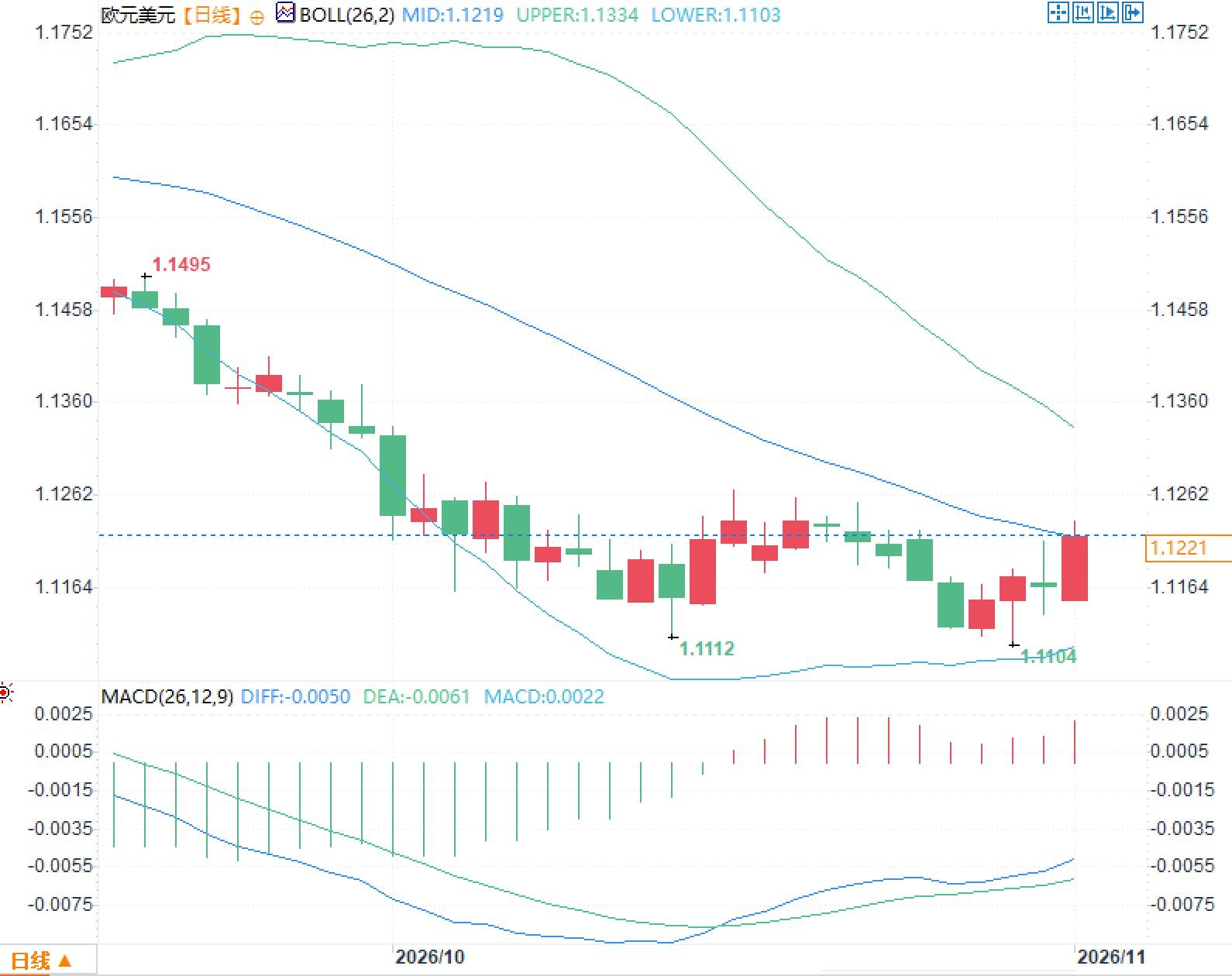
French fiscal uncertainty drives continued volatility in the bond market.
France's fiscal situation continues to face structural pressures. Rating agencies have revised France's sovereign outlook to negative, emphasizing that debt stability is constrained by both deteriorating fiscal conditions and political fragmentation, while also pointing to factors such as weak domestic growth, rising debt interest costs, and widening deficits. Market data shows that the yield on French 10-year government bonds hit its highest level since 2002 in October, with spreads widening to around 175 basis points. Anatoly Anenkov of Société Générale noted that the bond market's focus on France may continue long after the 2027 elections, with volatility and contagion risks remaining high until a clear and credible fiscal strategy emerges. The current spread level reflects a repricing of risk premiums, rather than a simple liquidity shock. While spreads in other Eurozone countries have widened, the adjustment in France is more pronounced, indicating that the market considers French fiscal sustainability an independent pricing factor. In its October statement, the European Central Bank emphasized that financing conditions have tightened since the last meeting, which will impact inflation and growth, but did not list the French factor as a separate trigger for intervention.Analysis of the ECB's Intervention Thresholds and Toolkit
The European Central Bank's (ECB) core responsibility is price stability, and its financial stability function serves the smooth transmission of monetary policy. Annenkov explicitly stated that the ECB does not have the authority to "rescue" individual countries; its tools will only be used when disorderly and non-fundamentally driven sell-offs in the sovereign bond market threaten the transmission of monetary policy. The Transmission Protection Instrument (TPI) and Outright Monetary Transactions (OMT) have not yet been used. ECB President Lagarde stated at a press conference on October 29 that the ECB has available tools if market developments threaten the smooth transmission of monetary policy, including unwarranted and disorderly market volatility. She also emphasized that highly indebted countries need to consider higher financing costs in their fiscal plans and comply with EU fiscal rules. Intervention thresholds remain high, and there are no automatic trigger thresholds for specific interest rate spreads or market dysfunction. In 2018, the Italian interest rate spread exceeded 300 basis points, and the ECB did not take action; this historical reference indicates that the current French interest rate spread has not yet reached the trigger standard. The use of tools must meet the requirements of being temporary, targeted, and customized, and must be accompanied by a clear exit strategy.Current Market Functions and Transmission Mechanisms Assessment
The current scale and degree of market repricing dysfunction have not reached the intervention threshold. The French bond market remains tradable, and while liquidity has fluctuated, there has been no systemic disruption. Anenkov believes that the ECB would only launch TPI, OMT, or temporary broad-based asset purchases if affected governments demonstrate credible prospects for corrective measures, potentially including EU support, or if there are unintended spillover effects on other markets and countries. Any measures would be conditional upon the implementation of corrective fiscal measures by the relevant countries. Internal estimates by the ECB prior to its October meeting indicated that rising bond yields would cumulatively drag down growth and inflation in 2027-2028, but this impact had already been factored into policy considerations and did not change the interest rate decision at the meeting level. The tightening of overall financing conditions in the Eurozone reflects more the global interest rate environment and energy shocks than the full contagion of risks in individual countries. Market participants are focusing on the conditionality of tools rather than their immediate deployment, consistent with the ECB's emphasis on data dependence and a meeting-by-meeting decision-making framework.Conditional support logic under the policy framework
The ECB's toolbox is designed to protect the monetary policy transmission mechanism, not to provide permanent support for individual sovereign debt. Anenkov emphasized that measures must be temporary, targeted, and tailored, predicated on credible fiscal corrections, and have clear exit arrangements. In the context of fragmented threat transmission, TPI can be used to address unwarranted and disorderly market dynamics, while OMT provides more direct purchase support under specific conditions. In the current environment, the ECB remains highly vigilant, but the threshold for unilateral action remains high. Lagarde's statements indicate that the availability of tools does not equate to the willingness to use them; the core factor remains whether market functions are substantially impaired and whether relevant countries demonstrate a willingness to adjust their policies. Eurozone overall inflation rose to 3.8% in September, with energy prices contributing significantly, while underlying inflation remained relatively stable, further reinforcing the ECB's data-driven stance. The continued fiscal uncertainty in France means that bond market volatility may remain a key focus of policy observation for an extended period, but intervention triggers will depend on the specific state of function and transmission rather than simply interest rate spreads.- Risk Warning and Disclaimer
- The market involves risk, and trading may not be suitable for all investors. This article is for reference only and does not constitute personal investment advice, nor does it take into account certain users’ specific investment objectives, financial situation, or other needs. Any investment decisions made based on this information are at your own risk.