Crude oil trading alert: Geopolitical risk premiums continue to decline, and US crude oil continues its volatile adjustment.
2026-11-04 09:40:25
On Wednesday during Asian trading hours, US benchmark WTI crude oil continued its volatile trading pattern, currently trading at $96.00 per barrel. Oil market investors continued to weigh the multiple uncertainties brought about by the US-Iran peace talks, with geopolitical risk premiums repeatedly roiling the market.  A spokesperson for the Qatari Ministry of Foreign Affairs stated that the US and Iran are currently assessing a new proposal put forward by the mediators in an attempt to bridge their differences. However, a senior Iranian national security official stated on social media that the US response remains unsatisfactory, and the negotiations have not achieved any substantial breakthrough. The US president stated that the US has no immediate plans to strike Iran, although it would take action if necessary, but there may be no realistic reason for military action; while the Israeli prime minister hinted at further attacks, further increasing the uncertainty of the situation. Earlier this week, the US launched a defensive strike against Iran, targeting air defense missile systems targeting US assets, but the scale of the strike was limited, indicating that a large-scale military conflict is unlikely in the short term. Despite a two-day rebound in oil prices, WTI crude oil still fell by about 6% this week, suppressed by optimistic market expectations of a diplomatic breakthrough and signals of a recovery in Middle Eastern oil exports. In the short term, the market will focus on the EIA crude oil inventory report tonight. A larger-than-expected increase in inventories will reflect weak demand, putting downward pressure on oil prices; a significant decrease in inventories will confirm the resilience of physical demand, supporting oil prices. Trade concerns have had a limited impact; the evolving geopolitical conflict between the US and Iran and US crude oil inventory data are the two core variables driving oil prices in the short term. On the daily chart, the medium-term upward trend of WTI crude oil has not been completely broken. Prices have rebounded from their lows and are currently approaching the upper Bollinger Band. The RSI indicator has risen from its lows to the neutral zone, indicating bullish momentum, but it has not yet entered overbought territory, and strong resistance remains above. The daily trading range remains between 94.30 and 99.20. Only a firm hold above 99.20 can open up further upside potential; a break below 94.30 would restart the pullback, with the next key support level at 88.70. On the 4-hour chart, prices have formed a corrective upward structure from the recent lows. Short-term moving averages are turning upwards, providing support, and indicators are gradually recovering from their lows, not yet entering overbought territory, suggesting potential for further testing of resistance levels in the short term. However, it is important to note that if significant easing of tensions is released, the rebound could easily be interrupted and prices could fall back again. The first resistance level is 96.80, with strong resistance at 99.20; immediate support is at 94.30, followed by 91.40. Until a breakout from these key levels is achieved, the market is considered to be consolidating within a low-level range, awaiting fundamental catalysts to determine its direction.
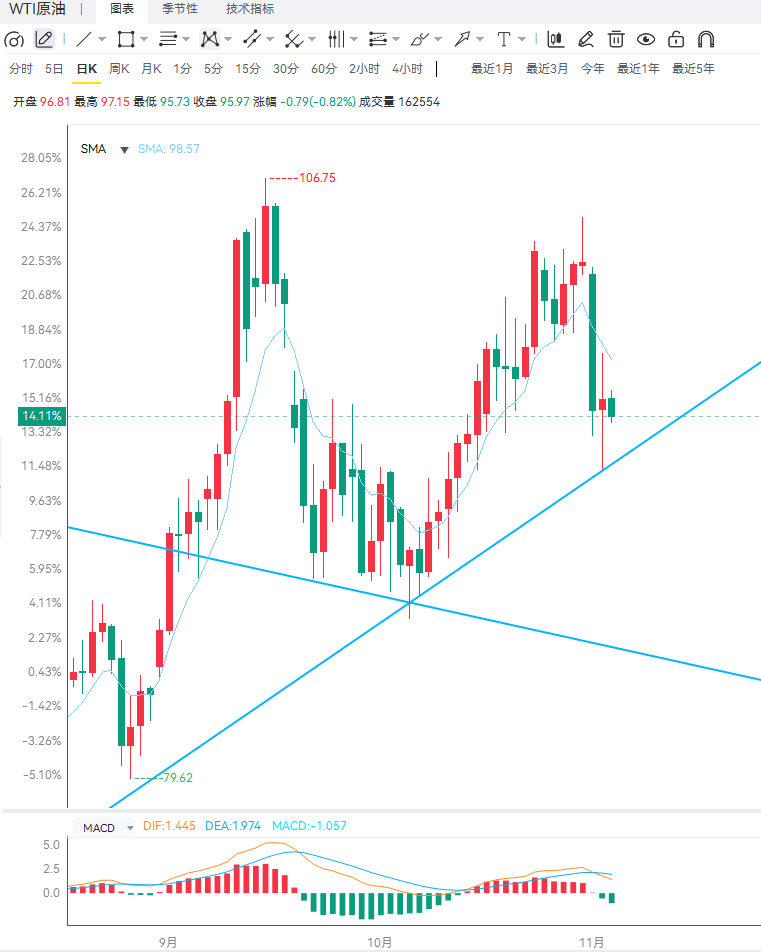 Editor's Summary: Crude oil is currently in a phase of back-and-forth negotiation regarding geopolitical risk premiums. Limited military action is boosting safe-haven demand, while expectations of diplomatic reconciliation continue to suppress oil prices, causing significant market volatility. Overall, oil prices recorded a significant decline this week, reflecting the possibility that the market has partially eased pricing tensions. However, without a final agreement, supply risks will not be completely eliminated. Short-term risks include a rapid decline in risk premiums due to significant progress in negotiations, leading to another price drop; a potential opportunity is a renewed escalation of the situation, pushing up geopolitical premiums and driving oil prices to test resistance levels. Blindly chasing rallies is not advisable. Focus should be placed on monitoring EIA inventory data and the dynamics of US-Iran negotiations, awaiting a breakout signal from the 94.30-99.20 range, and remaining highly vigilant for rapid fluctuations triggered by sudden geopolitical events.
A spokesperson for the Qatari Ministry of Foreign Affairs stated that the US and Iran are currently assessing a new proposal put forward by the mediators in an attempt to bridge their differences. However, a senior Iranian national security official stated on social media that the US response remains unsatisfactory, and the negotiations have not achieved any substantial breakthrough. The US president stated that the US has no immediate plans to strike Iran, although it would take action if necessary, but there may be no realistic reason for military action; while the Israeli prime minister hinted at further attacks, further increasing the uncertainty of the situation. Earlier this week, the US launched a defensive strike against Iran, targeting air defense missile systems targeting US assets, but the scale of the strike was limited, indicating that a large-scale military conflict is unlikely in the short term. Despite a two-day rebound in oil prices, WTI crude oil still fell by about 6% this week, suppressed by optimistic market expectations of a diplomatic breakthrough and signals of a recovery in Middle Eastern oil exports. In the short term, the market will focus on the EIA crude oil inventory report tonight. A larger-than-expected increase in inventories will reflect weak demand, putting downward pressure on oil prices; a significant decrease in inventories will confirm the resilience of physical demand, supporting oil prices. Trade concerns have had a limited impact; the evolving geopolitical conflict between the US and Iran and US crude oil inventory data are the two core variables driving oil prices in the short term. On the daily chart, the medium-term upward trend of WTI crude oil has not been completely broken. Prices have rebounded from their lows and are currently approaching the upper Bollinger Band. The RSI indicator has risen from its lows to the neutral zone, indicating bullish momentum, but it has not yet entered overbought territory, and strong resistance remains above. The daily trading range remains between 94.30 and 99.20. Only a firm hold above 99.20 can open up further upside potential; a break below 94.30 would restart the pullback, with the next key support level at 88.70. On the 4-hour chart, prices have formed a corrective upward structure from the recent lows. Short-term moving averages are turning upwards, providing support, and indicators are gradually recovering from their lows, not yet entering overbought territory, suggesting potential for further testing of resistance levels in the short term. However, it is important to note that if significant easing of tensions is released, the rebound could easily be interrupted and prices could fall back again. The first resistance level is 96.80, with strong resistance at 99.20; immediate support is at 94.30, followed by 91.40. Until a breakout from these key levels is achieved, the market is considered to be consolidating within a low-level range, awaiting fundamental catalysts to determine its direction. Editor's Summary: Crude oil is currently in a phase of back-and-forth negotiation regarding geopolitical risk premiums. Limited military action is boosting safe-haven demand, while expectations of diplomatic reconciliation continue to suppress oil prices, causing significant market volatility. Overall, oil prices recorded a significant decline this week, reflecting the possibility that the market has partially eased pricing tensions. However, without a final agreement, supply risks will not be completely eliminated. Short-term risks include a rapid decline in risk premiums due to significant progress in negotiations, leading to another price drop; a potential opportunity is a renewed escalation of the situation, pushing up geopolitical premiums and driving oil prices to test resistance levels. Blindly chasing rallies is not advisable. Focus should be placed on monitoring EIA inventory data and the dynamics of US-Iran negotiations, awaiting a breakout signal from the 94.30-99.20 range, and remaining highly vigilant for rapid fluctuations triggered by sudden geopolitical events.
- Risk Warning and Disclaimer
- The market involves risk, and trading may not be suitable for all investors. This article is for reference only and does not constitute personal investment advice, nor does it take into account certain users’ specific investment objectives, financial situation, or other needs. Any investment decisions made based on this information are at your own risk.