Is the yen's rebound from a three-week low a precursor to intervention or a boost from a weakening dollar?
2026-11-04 10:14:27
The dollar attracted some selling pressure against the yen in Asian trading on Wednesday (November 4), potentially ending a two-day winning streak after hitting a near three-week high of 158.76 the previous day. Japanese Finance Minister Katayama reiterated on Monday the validity of the US-Japan joint statement and the government's preparedness to address excessive or disorderly yen weakness. Diplomatic efforts towards Iran and falling US Treasury yields weighed on the dollar. However, rising job openings at JOLTS to 7.5 million, hawkish interest rate hike expectations, and a still wide US-Japan interest rate differential limited the downside for the dollar against the yen. 
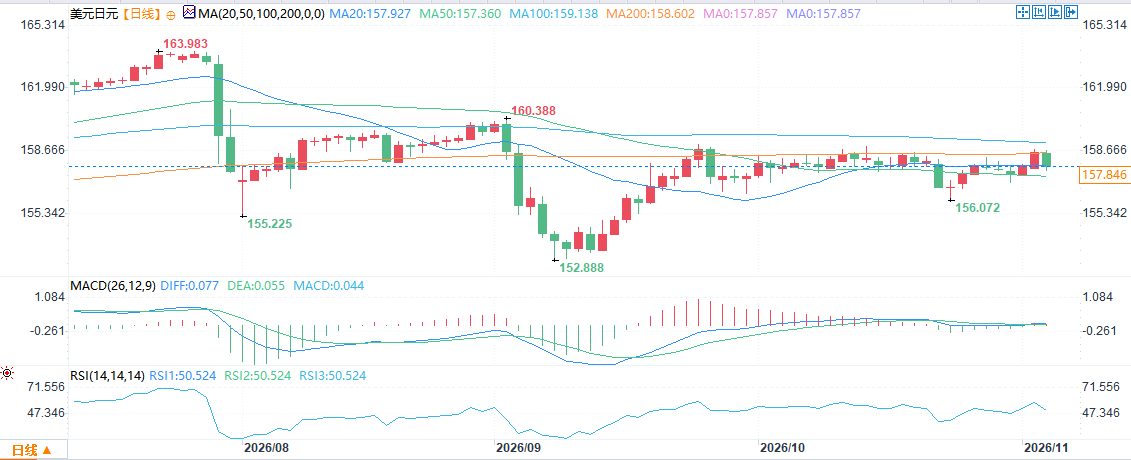 (USD/JPY daily chart, source: FX678) At 10:13 Beijing time, USD/JPY was trading at 157.80/81.
Intervention Risk: Katayama Reaffirms the Validity of the Joint Statement
Japanese Finance Minister Katayama reiterated on Monday that the joint Japan-US foreign exchange statement remains valid, and the government is prepared to take necessary action to curb excessive or disorderly weakness in the yen. This statement was not merely a vague one, but directly addressed the sensitive position of the yen near a three-week low, quickly triggering short covering. Traders remain highly vigilant because Japanese authorities have intervened at similar price levels multiple times in recent years, often with suddenness and scale. Katayama's statement resonated with the overall weakening of the US dollar, jointly putting downward pressure on the USD/JPY exchange rate. The fact that short sellers chose to take profits rather than add to their positions near previous highs directly reflects the pricing of intervention risk. This "cover first, then observe" approach effectively suppressed the upward momentum of the USD/JPY in the short term, and also made the market more cautious about further shorting the yen given the still high US-Japan interest rate differential. The expectation of intervention itself has become a significant pricing factor in current exchange rate fluctuations; any further hawkish rhetoric from Tokyo or signs of actual capital inflows or outflows could quickly amplify the yen's rebound.Dollar weakens: Iranian diplomatic hopes and falling US Treasury yields
Meanwhile, the weakening of the US dollar itself was also a significant factor dragging down the USD/JPY pair. Rising market optimism that the conflict between the US and Iran might de-escalate through diplomatic channels diminished the dollar's appeal as a safe-haven currency. Trump's public statement on Tuesday that the US had no immediate plans to strike Iran, adding that "we seem to be getting everything we want," was interpreted by traders as a signal that Washington was not seeking military escalation. Geopolitical risk premiums were thus partially squeezed out, putting pressure on the dollar across major currency pairs. This was accompanied by a decline in US Treasury yields. As investors began focusing on the early results of the US midterm elections and the prospect of Republicans losing their majority in the House and even the Senate, market expectations for the future path of fiscal and monetary policy adjusted. The decline in yields directly weakened the dollar's interest rate support, causing dollar bulls to become defensive in several currency pairs. For USD/JPY, the weakening of the dollar itself, combined with short covering in the yen, resulted in a significant pullback in the exchange rate during the Asian session. It should be noted that this weakness stemmed more from a recovery in risk appetite and the pricing of political uncertainty than from a fundamental reversal in the dollar's fundamentals. Once the midterm election results are finalized or geopolitical tensions re-emerge, the safe-haven demand for the US dollar could quickly return, thereby providing renewed support for the USD/JPY exchange rate.Limiting factors: Strong JOLTS and hawkish rate hike expectations; wide USD/JPY interest rate differential.
Despite a short-term pullback, the downside for USD/JPY remains limited by multiple factors. Tuesday's US labor market data was significantly stronger than expected, with the JOLTS report showing job openings rising to 7.5 million in September from 7.2 million, exceeding market expectations, and hiring activity remaining relatively stable. This data reinforced market expectations that the Federal Reserve will maintain a hawkish stance, and coupled with potential inflationary pressures from energy prices, it supports the case for further monetary tightening. Against this backdrop, traders must remain cautious before betting on further significant depreciation of the dollar and USD/JPY. More importantly, the persistently large interest rate differential between the US and Japan remains a core factor limiting the yen's appreciation. The Bank of Japan's policy normalization pace has been relatively slow, and even with a short-term decline in US Treasury yields, their absolute levels remain far higher than Japanese government bond yields, meaning the attractiveness of carry trades has not disappeared. Therefore, waiting for stronger and more sustained selling pressure to confirm a true peak in spot prices is a more prudent strategy. Looking ahead, traders will closely watch the upcoming ADP private sector employment report and ISM services PMI during the North American session. If these two data points continue to demonstrate the resilience of the US economy, the dollar may quickly recover its losses; conversely, if the data is weak, it could provide room for further pullback in the USD/JPY exchange rate. In the short term, the exchange rate will fluctuate between intervention risks, the strength of the dollar itself, and the USD/JPY interest rate differential.in conclusion
The yen rebounded from a three-week low, a result of the combined effects of intervention risks and a weaker dollar. Katayama reiterated the validity of the US-Japan joint statement and the government's preparedness to address excessive or disorderly yen weakness. Iranian diplomatic hopes and midterm election uncertainty pushed down US Treasury yields, suppressing the dollar. However, downside is limited by three factors: JOLTS job openings rose to 7.5 million, higher than expected, reinforcing expectations of a hawkish Fed; energy-driven inflation risks support the rationale for further tightening; and the wide US-Japan interest rate differential limits the appreciation potential of the low-yielding yen. Before confirming a peak in spot prices, the market needs to wait for strong follow-through selling, with the ADP and ISM services data from the North American session being the next source of short-term momentum. (USD/JPY daily chart, source: FX678) At 10:13 Beijing time, USD/JPY was trading at 157.80/81.
- Risk Warning and Disclaimer
- The market involves risk, and trading may not be suitable for all investors. This article is for reference only and does not constitute personal investment advice, nor does it take into account certain users’ specific investment objectives, financial situation, or other needs. Any investment decisions made based on this information are at your own risk.