Election news has been priced in, war expectations have been repriced, and oil prices have rebounded, but may gradually weaken.
2026-11-04 16:14:25
On Wednesday (November 4th) during the Asian and European sessions, international oil prices fluctuated slightly downwards. The WTI main contract is currently trading near the flat line of 96.20, having briefly dipped to -1% during the session. With the US midterm elections concluded and the Republicans losing control of both the House and Senate, the Democratic Party now holds the power of appropriations and legislation, naturally constraining Trump from launching a large-scale, sustained war against Iran. Many traders initially expected the geopolitical premium to subside after the election, leading to a weakening of oil prices. However, the market did not experience a sustained decline, but rather a slight dip followed by a rapid stabilization and rebound. The core reason is simple: the 7% drop in oil prices on Monday had already priced in part of the expected change in leadership, and the extreme risk had been fully released. The market's rebound today, driven by the "shoe dropping" effect after the election results, reflects the easing of negative sentiment. However, this does not mean that the risk premium has regained upward momentum. On the contrary, the pricing balance between war and peace has shifted, significantly increasing the odds of a further decline in oil prices, making a correction more likely. 
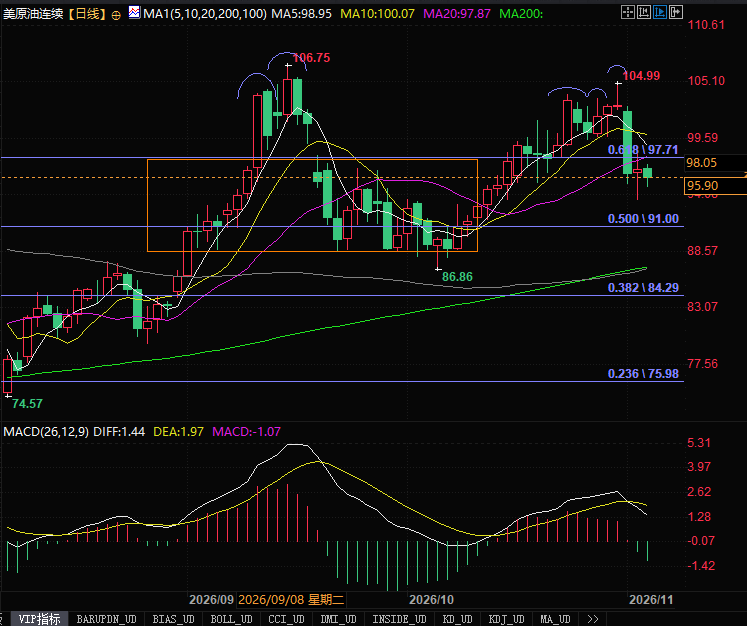 (WTI crude oil futures daily chart, source: EasyTrade) At 16:11 Beijing time, WTI crude oil futures are currently trading at $95.78 per barrel.
The earlier sharp decline was not due to bets on an immediate agreement between the US and Iran, but rather because the "risk of a major war" was being priced in.
Monday's sharp drop in oil prices didn't reflect the market's genuine belief that a formal ceasefire agreement between the US and Iran could be reached in the short term. While the initial trigger was news of US-Iran peace talks, traders were aware from the outset that the gap between the two sides' demands was vast, making the probability of an agreement inherently low. Monday's 7% drop in oil prices was essentially a concentrated retracement of tail risk premiums: the market lowered its expectations of Trump launching a large-scale war and completely blocking the Strait of Hormuz, leading to a concentrated liquidation of previously crowded geopolitical long positions. This decline was trading on the "disappearance of the possibility of a full-scale war," rather than "imminent peace."The difficulty in reaching a direct agreement in the short term has become a temporary support for oil prices.
Following the election results, two major constraints prevented oil prices from immediately plummeting. First, signing a full ceasefire agreement would be extremely politically costly for Trump. In an interview, he explicitly stated that he considered going to war with Iran a wise decision and had no regrets. Accepting all of Iran's demands, including lifting sanctions, canceling the naval blockade, unfreezing assets, and even war reparations, would face strong opposition from domestic conservatives and Israel's allies, shaking his political foundation. Second, Iran's negotiating stance remains hardline, with no significant concessions on its core demands. Qatar's mediation currently only maintains communication channels, and a concrete consensus remains a distant prospect. Therefore, a strong catalyst for a one-off positive easing is unlikely in the short term, providing a temporary floor for oil prices.Baseline scenario: Limited suppression + sanctions tug-of-war, the upper limit of conflict is locked.
The most probable path in the current market is neither a full-scale war nor a quick reconciliation, but rather a stalemate characterized by intermittent small-scale strikes coupled with long-term sanctions and pressure. While the Democratic Party in both houses of Congress cannot prevent the president from using existing military funds to launch targeted airstrikes like the one on Qeshm Island, they can block new war funding, fundamentally eliminating the option of large-scale, sustained bombing and ground intervention. Trump will likely maintain this "fight while negotiating, no negotiation, no peace" model: maintaining economic pressure through maritime blockades and sanctions while occasionally launching limited strikes to exert deterrence; simultaneously sending contradictory signals, sometimes expressing willingness to cooperate with the Democrats and initiate dialogue, and sometimes wielding his veto power to maintain a hardline stance. The key change in this pattern is that the upper limit of conflict has been lowered. It is unlikely that a black swan event of "rapid escalation of conflict and violent surge in oil prices" will occur again in the future. The upward elasticity of geopolitical risks has narrowed significantly, while the downward space is more easily opened up.Supply and demand factors offer short-term support, but are unlikely to reverse the weak pricing trend.
Supply and demand fundamentals are the underlying factors that allow oil prices to remain relatively stable in the short term. Vortexa data shows that the total flow of crude oil, condensate, and refined oil products through the Strait of Hormuz continued to decline month-on-month in October, with traffic volume far below pre-war levels. War insurance and rising shipping costs have led Rystad to conclude that even if an understanding is reached, the restoration of oil flow in the Persian Gulf will take a long time. However, high oil prices continue to suppress global physical demand for refined oil products and chemicals, and the pressure of weakening demand is accumulating, setting a clear ceiling for further price increases. Slow supply recovery and continued pressure on demand are pulling each other together, resulting in high-level fluctuations, but the overall trend is leaning towards a weaker position.Market Outlook: Awaiting concessions from Iran will be the key turning point for a continued downward trend.
Overall, the pricing logic in the oil market has shifted: previously, the biggest risk was "uncontrolled escalation of prices due to conflict," but now the biggest expectation gap has become "gradual easing of negotiations and a slow, sustained clearing of risk premiums." In the short term, a wide range of fluctuations is likely, with sporadic news of attacks and airstrikes potentially causing short-lived rebounds, but these rebounds will become increasingly weak. A signal that a deep correction is truly imminent requires substantial concessions from Iran, a reduction in its negotiating demands, and the formation of a workable framework of understanding. Once such a signal appears, the pent-up geopolitical premium will be further released, and a trend of price correction will officially begin. Technically, the triple top pattern on the daily chart for international oil prices is essentially confirmed, and the moving averages are starting to turn downwards. Current resistance is around 97.71. If a short-term rebound fails to overcome the triple top bearish threat, the downward trend in oil prices will become more certain. (WTI crude oil futures daily chart, source: EasyTrade) At 16:11 Beijing time, WTI crude oil futures are currently trading at $95.78 per barrel.
- Risk Warning and Disclaimer
- The market involves risk, and trading may not be suitable for all investors. This article is for reference only and does not constitute personal investment advice, nor does it take into account certain users’ specific investment objectives, financial situation, or other needs. Any investment decisions made based on this information are at your own risk.