Iran's granting of travel waivers to the four countries suggests it will not relinquish its dominant position.
2026-11-04 20:32:27
A senior official on Iran's National Security Committee recently confirmed verbally that merchant ships from China, India, Iraq, and Qatar would be exempt from Iran's wartime passage restrictions in the Strait of Hormuz. This strong statement eased market expectations of a complete strait blockade, and there is room for a decline in the geopolitical risk premium for crude oil. However, Iran also reiterated its claim to the strait, hinting at its bottom line in negotiations. 
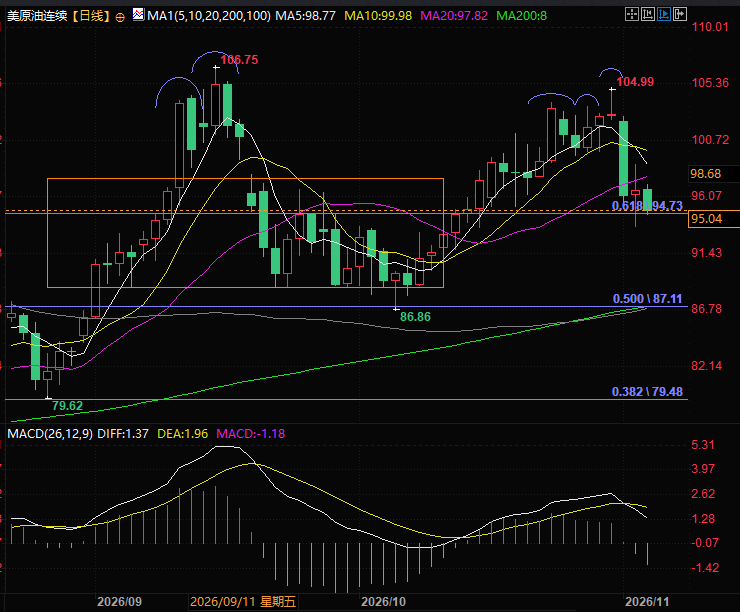 (WTI crude oil futures daily chart, source: EasyTrade) At 20:30 Beijing time, WTI crude oil futures are currently trading at $94.66 per barrel.
Targeted exemptions are not a completely new policy, but the way they are described has been upgraded this time.
As early as March 2026, after the escalation of the Gulf conflict, Iran implemented a tiered clearance mechanism, and the Strait of Hormuz was never completely closed. Ships associated with the US and Israel are subject to passage restrictions; Chinese, Indian, and Iraqi vessels were already on the permitted passage list, but they had to submit materials in advance, undergo screening, and obtain passage approval before being allowed to transit, not freely. Previously, a large number of Indian oil tankers were stranded in the Gulf, requiring the government to specifically coordinate with Iran. The early clearance list also included Russia and Pakistan, but this public speech narrowed the special passage to four countries, directly granting them exemption from wartime control procedures and unrestricted passage. The speech also frankly revealed the practical demands behind the policy: allowing passage to India was to ensure the import of medicines, while allowing passage to China was in exchange for political support. Qatar is a key new addition to this list; as a core mediator between the US and Iran, it rarely appeared on the priority clearance list alone before. From a legal and practical perspective, it is necessary to distinguish: under international law, the Strait of Hormuz is an international waterway, and all merchant ships enjoy the right of transit; the current passage restrictions are unilateral wartime control implemented by Iran in the context of conflict. Meanwhile, this exemption is currently only a verbal statement from lawmakers; the Iranian Ministry of Foreign Affairs and maritime authorities have not yet issued formal written notifications to the International Maritime Organization. Shipping companies, for risk management reasons, are unlikely to abandon the application process directly, and the policy's effectiveness remains uncertain.The timing of policies reveals underlying power struggles; internal divisions in Iran limit the extent of easing tensions.
The timing of this announcement is significant. Iran had previously stated that the Strait of Hormuz would not be opened unless the US met its seven conditions. Maintaining a tough stance against the US while simultaneously opening a dedicated passage for four countries clearly demonstrates Iran's intention to assert its ownership of the Strait. The market should not only focus on the easing of tensions; internal divisions within Iran pose a significant risk. Iranian president, parliament speaker, foreign minister, and other high-ranking political figures are pushing the military to engage in constructive dialogue regarding the ceasefire framework brought by Qatar, actively seeking diplomatic reconciliation. However, the Iranian military is more pessimistic, believing that direct conflict between the US and Iran remains a high-probability scenario. The political signals of exemptions and easing of tensions do not mean the overall wartime risk in the Strait has been eliminated. The threats of mines and attacks on ships remain, and the International Maritime Organization continues to issue risk warnings, advising against vessels entering the Strait.Key constraints: A written permit does not equate to an actual willingness to sail; insurance and crew risk are hard barriers.
This is a layer easily overlooked in transactions: even if Iran verbally grants passage to ships from these four countries, shipowners and crews may not be willing to use the Strait. The geopolitical risk of crossfire in the shipping lane is a real concern; the threats of attacks on ships, missiles, and mines will not disappear simply because of an exemption. Coupled with the current high premiums for Hormuz war risk insurance, and some policies even having payout limitations, the cost of insurance for each voyage puts enormous pressure on shipowners. At the same time, crew members themselves will resist high-risk routes, and shipowners will have to pay additional high hazard allowances, further increasing the overall cost of the route. Simply put: opening up passage rights is a "lowering of the entry barrier," but war risk premiums, crew's willingness to avoid risks, and the risk of sudden crossfire constitute another real barrier. Many shipowners, even with exemptions, will still actively choose to detour and will not immediately return to the Hormuz shipping lane on a large scale. This will weaken the effect of the exemption on improving shipping supply and limit the downside potential of oil prices.The easing of panic expectations led to a slight pullback in oil prices.
This preferential treatment applies only to vessels from the four countries mentioned above. Tankers and merchant ships from other countries still face passage barriers in the Strait of Hormuz, and it does not signify a complete opening of the Strait to foreign vessels. However, the ultimate goal is not to reduce passage costs for the four countries, as geopolitical risk management is the biggest issue. Even with free and unrestricted passage, insurance, crew issues, and the risk of real-time firefights will prevent any real improvement in navigation. Nevertheless, it does send a strong signal. For example, during the US election, when Trump lost congressional support, Iran specifically emphasized its ownership of the Strait and its ability to decide who can pass through for free. The market's previous pricing in an extreme risk premium of a "complete closure of the Strait" for oil prices will be reduced as a result. However, Iran has again reiterated its bottom line regarding control of the Strait, leading to a disappointment in negotiations. Therefore, the potential for a correction should not be overestimated. The exemption is only a partial opening of passage, not a cessation of conflict. The Iranian military still anticipates a high probability of direct conflict with the US, and the core contradictions between the US and Iran remain unresolved. The key indicator to watch going forward is whether Qatar's mediation can push for a substantial ceasefire agreement between the US and Iran. (WTI crude oil futures daily chart, source: EasyTrade) At 20:30 Beijing time, WTI crude oil futures are currently trading at $94.66 per barrel.
- Risk Warning and Disclaimer
- The market involves risk, and trading may not be suitable for all investors. This article is for reference only and does not constitute personal investment advice, nor does it take into account certain users’ specific investment objectives, financial situation, or other needs. Any investment decisions made based on this information are at your own risk.