The Democratic Party's landslide victory triggered a gold price rebound, but the Federal Reserve still dominates short-term market movements.
2026-11-09 12:40:27
The Democratic Party's sweeping victory in the US midterm elections initially spurred a surge in the gold market. However, the election-related benefits were only a secondary driver. Expectations regarding the Federal Reserve's monetary policy continue to dominate investor trading strategies. Whether gold prices can maintain their upward trend ultimately depends on the direction of interest rates.
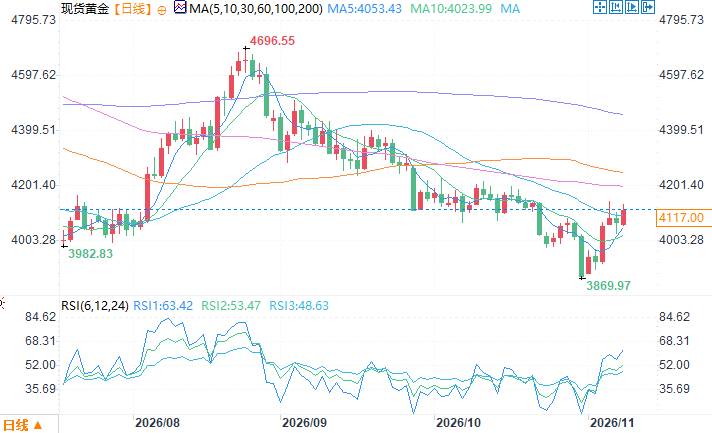 Spot gold daily chart source: FX678. As of 12:39 PM Beijing time on November 9th, spot gold was trading at $4128.40 per ounce.
Election-related gains boost gold prices; $4,000 level faces key test.
Following the midterm election results last Wednesday (November 4th), spot gold prices experienced a sharp rise, reaching a high of around $4146 on Thursday. On Friday, pressured by the non-farm payroll data, prices briefly fell to around $4028, but quickly found support from bargain hunters, closing near $4070, a 5% weekly gain. On Monday (November 9th) in Asian trading, spot gold continued its upward trend, currently hovering around $4130 per ounce. This rally was mainly driven by declining US Treasury yields, a weakening dollar, and buying pressure from short covering following the previous sharp drop in gold prices. However, market sentiment remains cautious, with investors still focusing on the key support level of $4000 per ounce. Whether this level holds or fails will directly impact short-term gold price movements.Short-term interest rates are putting downward pressure on gold prices, but long-term funds remain committed to buying on dips.
In the short term, expectations regarding Federal Reserve policy are the decisive variable for gold prices, but this does not mean that the long-term investment logic for gold has been undermined. Many market analysts believe that recent gold price pullbacks present tactical buying opportunities, and the underlying fundamentals supporting gold's long-term strength have not fundamentally changed. Over the past few months, the trading logic of a weakening US dollar has continued to attract attention. With US debt exceeding $40 trillion and its continued disorderly expansion, the market has long worried about the dilution of the dollar's purchasing power; this main theme has consistently provided underlying support for gold prices.With the congressional landscape shifting, it will be difficult to substantially reverse the US fiscal predicament.
With the Democrats gaining control of Congress, the political landscape in the United States has shifted. Starting next January, lawmakers will have greater say in federal budget spending. The separation of the executive and legislative branches may limit Trump's ability to implement his fiscal plans, but the market generally doubts that a Democratic-led Congress can fundamentally improve the continuously deteriorating US fiscal situation. Both parties lack the will to drastically cut spending; their differing approaches to support spending mean that the structural problems of rising government debt and persistent fiscal deficits are unlikely to disappear. Coupled with ongoing geopolitical uncertainties, financial market volatility could recur at any time, and gold, as a diversification and hedging tool in asset portfolios, still retains its long-term investment value.The main market trend is clear: elections change the narrative, and interest rates determine the trend.
In summary, while the midterm elections reshaped the US domestic political landscape, they did not alter the macroeconomic realities facing gold. Currently, the Federal Reserve still holds the reins in market movements, and as long as market expectations for monetary policy do not shift, it will be difficult for gold to experience a sustained and stable bullish trend. However, investors need to distinguish between short-term pullbacks and long-term prospects. Regardless of which party dominates Congress, the long-term investment value of gold will not disappear due to short-term price declines.Conclusion
The gold price rebound following the Democratic victory is an event-driven market movement and a short-term disturbance. The high-interest-rate environment continues to suppress the upside potential of gold prices, but long-term supporting factors such as US debt, deficits, and geopolitical risks remain, and the long-term investment logic for gold has not been broken. Spot gold daily chart source: FX678. As of 12:39 PM Beijing time on November 9th, spot gold was trading at $4128.40 per ounce.
- Risk Warning and Disclaimer
- The market involves risk, and trading may not be suitable for all investors. This article is for reference only and does not constitute personal investment advice, nor does it take into account certain users’ specific investment objectives, financial situation, or other needs. Any investment decisions made based on this information are at your own risk.