Crude oil trading alert: Optimism surrounding US-Iran diplomacy weighs on oil prices, with WTI crude falling to a new low since August.
2026-11-10 09:56:27
On Tuesday morning in Asia, WTI crude oil briefly fell to its lowest level since August at $85.30 before recovering to around $86.40. The core factor pressuring oil prices was the expectation of peace stemming from progress in Middle East diplomacy: US President Donald Trump stated over the weekend that it was "highly unlikely" he would order a large-scale attack on Iran, but emphasized that this depended on whether Iran signed a "very strong agreement." On Monday, Qatari Prime Minister and Foreign Minister Sheikh Mohammed bin Abdulrahman Al Thani stated that he had met with Trump and Vice President JD Vance in Washington to discuss advancing US-Iran negotiations.  A new Qatar-Pakistan proposal would allow Washington to approve Iran's enrichment of uranium to 3.67% on its territory, a ceiling Tehran has already agreed to. The initiative is part of efforts to restart negotiations between the two countries, with the US offering to release $6 billion to $9 billion worth of Iranian assets if an agreement is reached. TACenergy analysts noted, "This seems to have encouraged selling, even though the actual conflict has not subsided." Geopolitical risks have not completely subsided. The Houthi rebels claimed responsibility for Sunday's attack on Saudi Aramco's headquarters in the heart of Riyadh's financial district, and the Saudi Energy Ministry said debris from the failed attack shattered several windows. Commerzbank analysts noted that the oil market "remains volatile, with investors assessing whether a Democratic-controlled Congress would accelerate diplomatic efforts to end the US-Iran conflict"; the bank added, "Reports that Iran is reviewing its nuclear program proposals are somewhat encouraging, but with no comprehensive agreement announced and shipping risks in the Gulf remaining," market sentiment remains fragile. On the trading front, the market is preparing for the American Petroleum Institute (API) weekly crude oil inventory report to be released later on Tuesday, with inventory changes providing new clues about short-term supply and demand. Looking at the charts, bullish sentiment is clearly weak, with rebounds seen more as opportunities to sell on rallies than as signals of a trend reversal. Technically, WTI has broken below previous support levels on the daily chart and there is a possibility of a double-top pattern forming, maintaining a downward trend in the short term. The current price of $86.40 is precisely at the 100-day simple moving average (86.40) , and whether this level holds or fails to hold is a key level for short-term strength or weakness. The $93 level above is a significant resistance; if this level cannot be held, the bearish structure will remain unchanged. Data shows that the 100-day moving average at $86.40 and the lower Bollinger Band at $86.65 form a tight resistance cluster, while the upper Bollinger Band at $96.35 represents a more significant structural top. In terms of momentum, the 14-day Relative Strength Index (RSI) is around 34.73 , approaching oversold territory, suggesting continued downward pressure rather than a confirmed reversal. Regarding support, $80 is a key level; a break below this psychological level would open up further downside potential. Since the data doesn't provide a clear support level below $85.30, previous lows and psychological levels are the main references for observing demand. On the 4-hour chart, oil prices rebounded after breaking down, currently fluctuating around $86.40 against the 100-day moving average. However, the rebound has been limited, and the $93 level is still far away. Structurally, this remains a technical correction within a downtrend . If prices can hold above $86.40 and break through $86.65, the rebound could extend to higher levels, but before $93 is recovered, the rebound is more likely an opportunity to sell on rallies. If prices break below $85.30 again, the downside will accelerate, and $80 will come into focus.
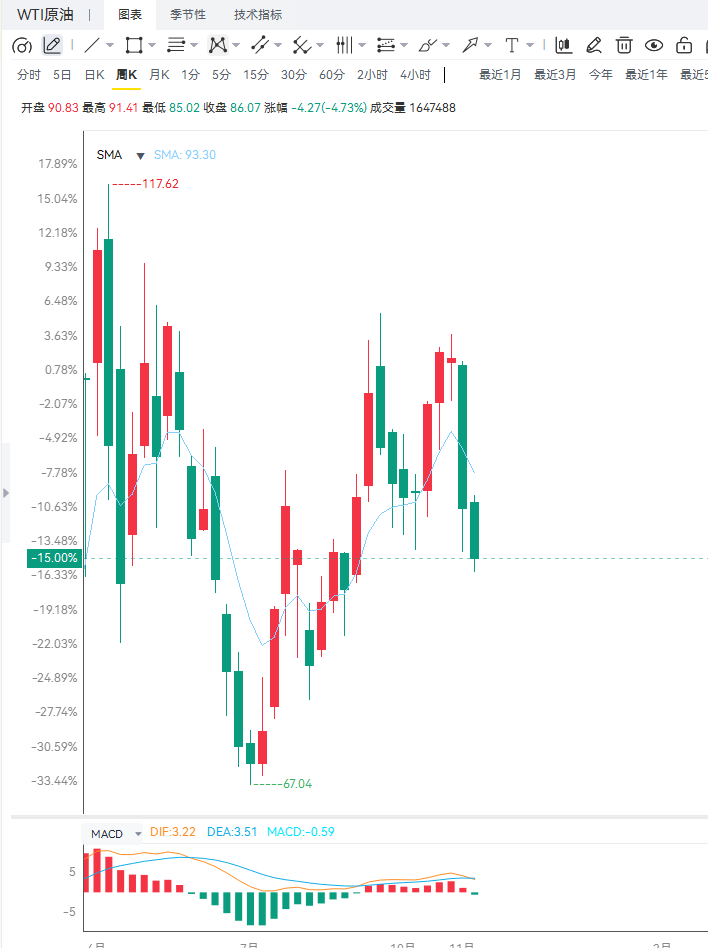 Editor's Summary: The core contradiction in WTI crude oil prices currently lies in the trade-off between "optimistic sentiment regarding US-Iran peace talks" and "the ongoing conflict and lingering shipping risks in the Gulf." The 100-day moving average at $86.40 is a short-term watershed, while $93 is a crucial threshold for determining whether the downtrend structure has been broken. In the medium term, if the Qatar-Pakistan proposal progresses and Iran signs an agreement, the geopolitical premium will be further cleared, and there is room for a downward shift in the oil price center, with $80 likely to be tested. If negotiations are protracted or Houthi attacks escalate, the supply risk premium may quickly return, and oil prices could potentially rebound above $93. Key factors to watch include Tuesday's API inventory data, the substantive progress of US-Iran negotiations, and the frequency and extent of damage to Saudi facilities from Houthi attacks.
A new Qatar-Pakistan proposal would allow Washington to approve Iran's enrichment of uranium to 3.67% on its territory, a ceiling Tehran has already agreed to. The initiative is part of efforts to restart negotiations between the two countries, with the US offering to release $6 billion to $9 billion worth of Iranian assets if an agreement is reached. TACenergy analysts noted, "This seems to have encouraged selling, even though the actual conflict has not subsided." Geopolitical risks have not completely subsided. The Houthi rebels claimed responsibility for Sunday's attack on Saudi Aramco's headquarters in the heart of Riyadh's financial district, and the Saudi Energy Ministry said debris from the failed attack shattered several windows. Commerzbank analysts noted that the oil market "remains volatile, with investors assessing whether a Democratic-controlled Congress would accelerate diplomatic efforts to end the US-Iran conflict"; the bank added, "Reports that Iran is reviewing its nuclear program proposals are somewhat encouraging, but with no comprehensive agreement announced and shipping risks in the Gulf remaining," market sentiment remains fragile. On the trading front, the market is preparing for the American Petroleum Institute (API) weekly crude oil inventory report to be released later on Tuesday, with inventory changes providing new clues about short-term supply and demand. Looking at the charts, bullish sentiment is clearly weak, with rebounds seen more as opportunities to sell on rallies than as signals of a trend reversal. Technically, WTI has broken below previous support levels on the daily chart and there is a possibility of a double-top pattern forming, maintaining a downward trend in the short term. The current price of $86.40 is precisely at the 100-day simple moving average (86.40) , and whether this level holds or fails to hold is a key level for short-term strength or weakness. The $93 level above is a significant resistance; if this level cannot be held, the bearish structure will remain unchanged. Data shows that the 100-day moving average at $86.40 and the lower Bollinger Band at $86.65 form a tight resistance cluster, while the upper Bollinger Band at $96.35 represents a more significant structural top. In terms of momentum, the 14-day Relative Strength Index (RSI) is around 34.73 , approaching oversold territory, suggesting continued downward pressure rather than a confirmed reversal. Regarding support, $80 is a key level; a break below this psychological level would open up further downside potential. Since the data doesn't provide a clear support level below $85.30, previous lows and psychological levels are the main references for observing demand. On the 4-hour chart, oil prices rebounded after breaking down, currently fluctuating around $86.40 against the 100-day moving average. However, the rebound has been limited, and the $93 level is still far away. Structurally, this remains a technical correction within a downtrend . If prices can hold above $86.40 and break through $86.65, the rebound could extend to higher levels, but before $93 is recovered, the rebound is more likely an opportunity to sell on rallies. If prices break below $85.30 again, the downside will accelerate, and $80 will come into focus. Editor's Summary: The core contradiction in WTI crude oil prices currently lies in the trade-off between "optimistic sentiment regarding US-Iran peace talks" and "the ongoing conflict and lingering shipping risks in the Gulf." The 100-day moving average at $86.40 is a short-term watershed, while $93 is a crucial threshold for determining whether the downtrend structure has been broken. In the medium term, if the Qatar-Pakistan proposal progresses and Iran signs an agreement, the geopolitical premium will be further cleared, and there is room for a downward shift in the oil price center, with $80 likely to be tested. If negotiations are protracted or Houthi attacks escalate, the supply risk premium may quickly return, and oil prices could potentially rebound above $93. Key factors to watch include Tuesday's API inventory data, the substantive progress of US-Iran negotiations, and the frequency and extent of damage to Saudi facilities from Houthi attacks.
- Risk Warning and Disclaimer
- The market involves risk, and trading may not be suitable for all investors. This article is for reference only and does not constitute personal investment advice, nor does it take into account certain users’ specific investment objectives, financial situation, or other needs. Any investment decisions made based on this information are at your own risk.