Gold Trading Alert: US Inflation Exceeds Expectations + Hawkish Fed Officials Cause Gold Prices to Plunge Nearly 3%, Is the $4,000 Level in Danger?
2026-11-11 07:46:29
Global gold markets experienced significant selling pressure on Tuesday, with spot gold plunging nearly 3% in a single day, breaking below the key psychological level of $4,100. It touched a low of $4,013.53 per ounce, a new low in nearly a week, before closing at $4,032.73 per ounce. US gold futures for December delivery fell 2.0%, settling at $4,030.20 per ounce. Market sentiment quickly shifted from relatively optimistic to cautious. The direct trigger was the higher-than-expected US October Consumer Price Index (CPI) data, coupled with signals from several Federal Reserve officials that a faster pace of interest rate hikes might be possible, pushing the US dollar index stronger and US Treasury yields higher. Gold's non-interest-bearing asset status came under rapid pressure against the backdrop of upward revisions in interest rate expectations. For gold, the $4,000 level has transformed from a "round number" into a crucial psychological defense line for both bulls and bears in the short term. On Wednesday (November 11) in Asian trading, spot gold traded in a narrow range, currently hovering around $4,036.29 per ounce. 
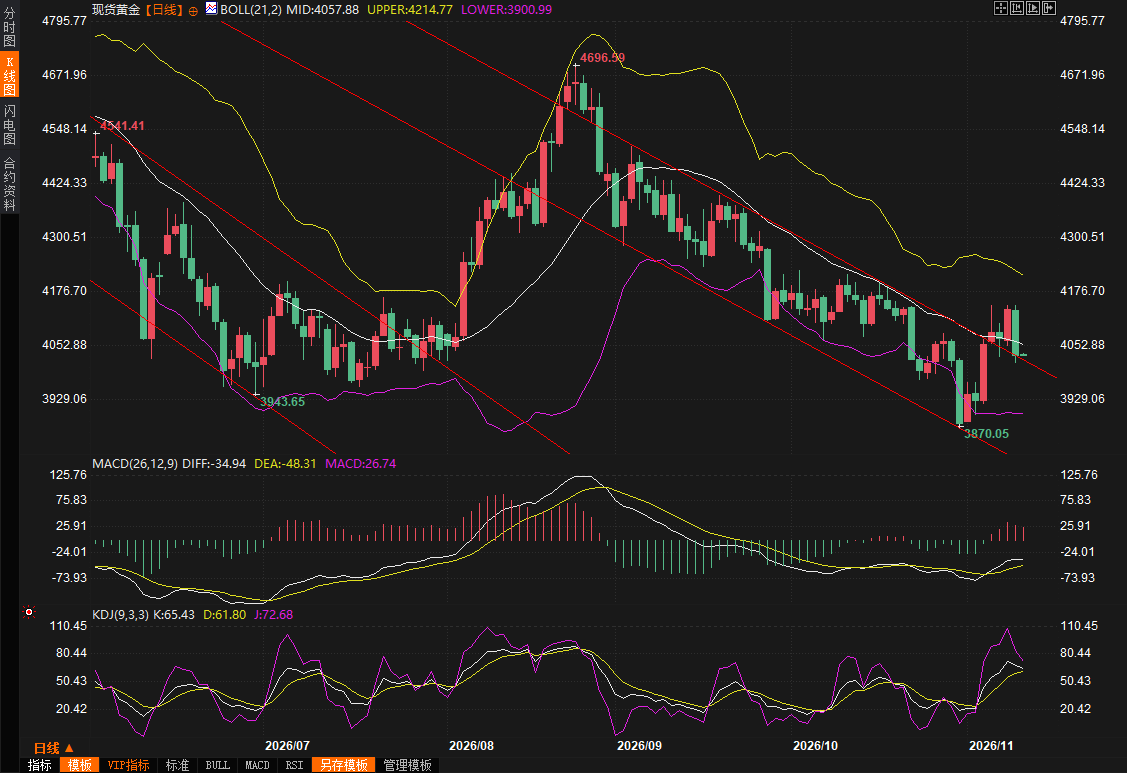 (Spot gold daily chart, source: FX678) At 07:40 Beijing time, spot gold is currently trading at $4035.34 per ounce.
Data exceeded expectations, and core inflation stickiness became the focus of the market.
Data released by the U.S. Bureau of Labor Statistics showed that the overall CPI rose 0.4% month-over-month in October, slightly lower than September's 0.6%, but significantly higher than economists' previous expectations of 0.3%. The core CPI, excluding food and energy, rose 0.3% month-over-month for the third consecutive month, also higher than the market expectation of 0.2%. Overall inflation cooled somewhat due to falling energy prices, but the continued rise in the core component indicates that price pressures are spreading to a wider range of goods and services, rather than being limited to a few highly volatile sub-items. This result quickly changed market expectations regarding the path of inflation. Before the inflation data was released, the market had priced in almost no 50-basis-point rate hike at the Fed's December meeting; after the data was released, the probability rose to the 10% to 15% range, while the expectation of at least a 25-basis-point rate hike was almost completely priced in. The yield on the two-year U.S. Treasury note surged 18.44 basis points to 4.731%, marking its largest single-day increase since early April 2025; the yield on the 10-year Treasury note rose 12.6 basis points to 4.99%, its highest level since October 29. The U.S. dollar index also strengthened, closing up 0.58% at 102.24, directly putting downward pressure on gold.Official statements and data resonate, leading to a significant upward revision of policy expectations.
The data itself was enough to shock the market, but statements from Federal Reserve officials amplified that impact. Prior to the data release, Fed Governor Waller explicitly stated that if core CPI rose 0.3% or more month-over-month, a more aggressive policy action, including a possible 50-basis-point rate hike, should be considered at the December meeting. He emphasized that with inflation still too high and price pressures showing signs of spreading, a small rate hike could damage the Fed's credibility in curbing inflation. Dallas Fed President Logan also pointed out that "faster action is possible" compared to the 25-basis-point rate hike in September, and believes that the current target range for the federal funds rate is still too low, exacerbating inflationary pressures. Kansas City Fed President Schmid stated bluntly that inflation remains his primary concern, and the current policy stance is "quite accommodative." These statements, coupled with the better-than-expected core inflation data, led to a significant upward revision in market pricing of the Fed's future policy path. Previously, the market had downplayed inflation risks due to other risk factors, but this data and official comments together remind investors that inflation stickiness remains a core constraint on policymaking, and the Federal Reserve is still far from truly shifting to an easing stance.Falling oil prices and geopolitical risks coexist, putting short-term pressure on gold, but the medium- to long-term logic remains unchanged.
In contrast to the decline in gold prices, oil prices also fell. International oil prices fell to a two-month low on Tuesday, mainly as US officials downplayed the need for further military action against Iran, easing market concerns about further supply disruptions in the Middle East. Both Brent and WTI crude oil recorded significant declines. Brent crude futures fell $1.08, or 1.2%, to settle at $91.49 a barrel; West Texas Intermediate crude fell 81 cents, or 0.9%, to settle at $86.04 a barrel. Both indices closed at their lowest levels since August 31 for the second consecutive trading day and are in technically oversold territory. While the decline in oil prices has somewhat alleviated concerns about the spillover of upward inflationary pressures, the actual risks in the Middle East have not completely subsided. Attacks on oil tankers, oil spills, and related infrastructure attacks near the Strait of Hormuz continue, and although geopolitical premiums have declined somewhat, they have not completely disappeared. For gold, upward revisions in short-term interest rate expectations and a stronger dollar are the main drags, while the decline in oil prices has weakened some of the inflation trading logic. Standard Chartered Bank and other institutions point out that while gold prices remain above the key $4,000 level, oil prices, inflation risks, and stock market movements will continue to dominate trading. Market focus has clearly shifted to expectations of a rate hike at the Federal Reserve's December meeting. In the short term, a technical correction in gold prices following data releases is a normal reaction, especially after a period of significant gains.Market Outlook: Short-term pressure is evident, but medium- to long-term support remains.
In summary, the core driver of this sharp drop in gold prices was the combination of unexpectedly sticky core inflation in the US and hawkish statements from Federal Reserve officials, which directly pushed up interest rate expectations and the US dollar, weakening the attractiveness of holding gold. In the short term, if subsequent inflation data continues to show stickiness, or if the Fed raises interest rates more significantly at its December meeting, gold prices may continue to face downward pressure. The rapid rise in the two-year US Treasury yield has already indicated that the market's repricing of the policy path is still underway. However, from a longer-term perspective, the supporting logic for gold has not fundamentally changed due to a single day's adjustment. Inflation has been above target for nearly six years, and signs of the core components spreading remind policymakers that they cannot be complacent; at the same time, although geopolitical risks in the Middle East have eased somewhat, supply disruptions and premium volatility may still recur. The market's pricing of the Fed's policy path is also volatile; once subsequent data or statements show signs of softening, the resilience of gold prices may reappear. For investors, at this stage, it is more important to focus on the dynamic interplay between data and policy expectations, rather than simply extrapolating a single day's decline linearly. The performance of gold prices near key psychological levels, as well as the subsequent trends of US Treasury yields and the US dollar index, will be important clues for judging short-term direction. Overall, inflation stickiness and policy uncertainty will continue to dominate gold trading, while gold's asset attributes as a hedge against inflation and geopolitical risks will remain supported in the medium to long term. It should be noted that Wednesday is Veterans Day in the US; the US stock market will be open as usual, and CME US Treasury futures will also trade normally, but the US spot bond market will be closed for the entire day. Investors should also pay attention to the meeting between the US, Russia, and Ukraine in Abu Dhabi from November 10th to 11th. (Spot gold daily chart, source: FX678) At 07:40 Beijing time, spot gold is currently trading at $4035.34 per ounce.
- Risk Warning and Disclaimer
- The market involves risk, and trading may not be suitable for all investors. This article is for reference only and does not constitute personal investment advice, nor does it take into account certain users’ specific investment objectives, financial situation, or other needs. Any investment decisions made based on this information are at your own risk.