Federal Reserve's Goolsby called the CPI "nearly disturbing," listing three major inflation concerns.
2026-11-11 09:06:30
On Wednesday (November 11) during Asian trading hours, the US dollar index fluctuated narrowly, currently trading around 102.22. Overnight, the dollar index rose by more than 0.5%. On Tuesday evening, data released by the US Bureau of Labor Statistics showed that the US Consumer Price Index (CPI) rose 0.4% month-on-month in October, compared to a forecast of 0.3% and a previous reading of 0.6%. The US core CPI rose 0.3% month-on-month in October, compared to a forecast of 0.2% and a previous reading of 0.3%. Chicago Fed President Goolsby called Tuesday's consumer price report "nearly disturbing" and warned in an interview that there is a real inflation problem in the US that policymakers will have to address. Goolsby stated that the most worrying aspect of the October data was that service inflation had not subsided. Service prices tend to reflect domestic demand and wage costs more than goods prices. The lack of progress in this area indicates that price pressures are becoming more entrenched rather than easing as one-off shocks subside. 
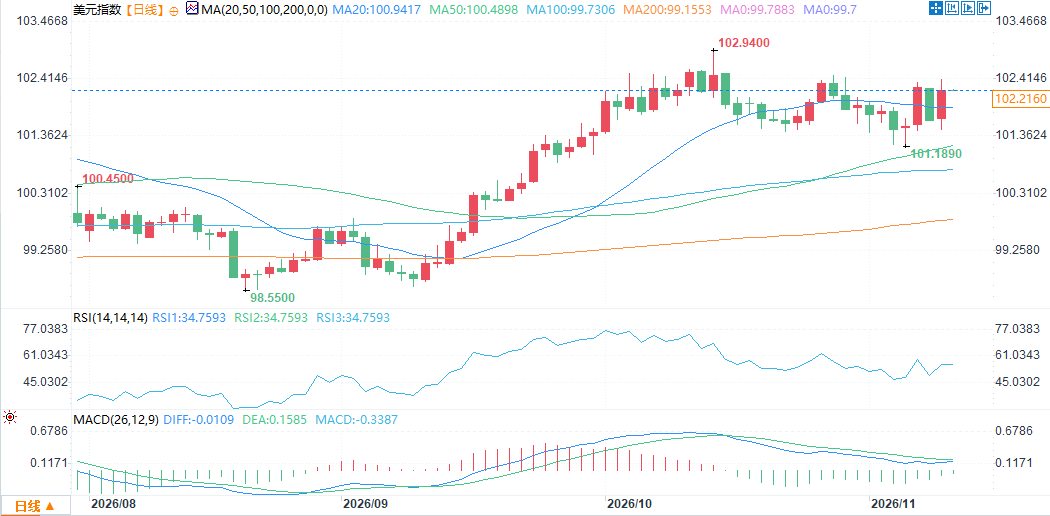 (US Dollar Index Daily Chart, Source: EasyForex) At 9:04 AM Beijing time, the US Dollar Index was at 102.24.
Three major concerns: sticky inflation, widespread overheating, and inflation embedded in expectations.
Goolsby described inflation as being driven by both the cost and demand sides. He said his concern was widespread price overheating, rather than a rise limited to a few categories. At the same time, he noted the labor market remained stable, removing a common argument against tightening policy. Goolsby stated a key concern would be inflation embedded in expectations, a reality the Fed would have to accept if price pressures persist. He also pointed to the impact of interest rates on business investment, suggesting he is weighing how higher borrowing costs will pass through to spending. He emphasized that all options are always on the table, and the Fed must bring inflation down to its target. Goolsby's focus on services and expectations points to concerns about "stubborn inflation" rather than "temporary shocks"—which increases the risk of a longer rate hike cycle.Hawks converge: Paulson supports gradual rate hikes, while Bowman shifts focus to inflation.
This interview adds weight to a series of hawkish comments from Federal Reserve officials following the unexpectedly strong October CPI figures. Earlier on Tuesday, Philadelphia Fed President Paulson stated that further gradual rate hikes seemed appropriate, while Vice Chair for Supervision Bowman indicated she was shifting her focus to inflation. The market is pricing in a high probability of a 25-basis-point rate hike at the Fed's December 8-9 meeting. Goolsby's remarks are not isolated but rather form a hawkish signal along with those of Paulson and Bowman—a growing consensus within the committee that "further tightening is needed" provides strong support for pricing in a December rate hike.The weight of the wording: from caution to vigilance, the market implications are clear.
Goolsby's choice of words was particularly striking for an official who typically adopts a more dovish tone. Against a backdrop of sticky inflation and a stable labor market, the December decision will show how far policymakers are prepared to go to prevent inflation from becoming stubborn. The continued stream of hawkish comments has reinforced pricing in a December rate hike, supporting the dollar and front-end Treasury yields, and creating headwinds for gold; as energy continues to push up inflation costs, oil prices will remain a key variable that may require the Fed to adopt a more hawkish stance.in conclusion
Goolsby described the October CPI as "nearly disturbing," indicating a real inflation problem in the US. His three main concerns—unrelenting service inflation, widespread price overheating, and inflation embedded in expectations—point to anxieties about persistent inflation rather than a temporary shock, increasing the risk of a longer rate hike cycle. This rhetoric, combined with Paulson's "further gradual rate hikes are appropriate" and Bowman's "shift in focus to inflation," forms a hawkish consensus, reinforcing the pricing of a rate hike at the December 8-9 meeting. For the market, this backdrop supports the dollar and front-end Treasury yields, while posing a headwind for gold; energy continues to push up costs, making oil prices a key variable that may require a more hawkish stance from the Fed. The December decision will show how far policymakers are prepared to go to prevent inflation from becoming entrenched—Goolsby's shift from caution to vigilance signals this resolve. (US Dollar Index Daily Chart, Source: EasyForex) At 9:04 AM Beijing time, the US Dollar Index was at 102.24.
- Risk Warning and Disclaimer
- The market involves risk, and trading may not be suitable for all investors. This article is for reference only and does not constitute personal investment advice, nor does it take into account certain users’ specific investment objectives, financial situation, or other needs. Any investment decisions made based on this information are at your own risk.