UK inflation won't return to target until 2030; does the Bank of England really only need to raise interest rates once more?
2026-11-11 08:24:28
On Wednesday (November 11) during Asian trading hours, the British pound fluctuated slightly higher against the US dollar, currently trading around 1.3345, almost unchanged for the day. The National Institute of Economic and Social Research (NIESR) predicted on Tuesday that UK inflation will exceed the Bank of England's 2% target for the next four years as the energy shock from the Iranian conflict passes to wages. The think tank also raised its growth forecast. The institution now expects inflation to peak at 4.4% in February 2027, higher than its July forecast of 3.8%. It expects inflation to remain above target throughout 2027, 2028, and 2029, only returning to 2% by the end of 2030 – a year later than previously anticipated. The second-round effect of wages is the main reason for this delay. 
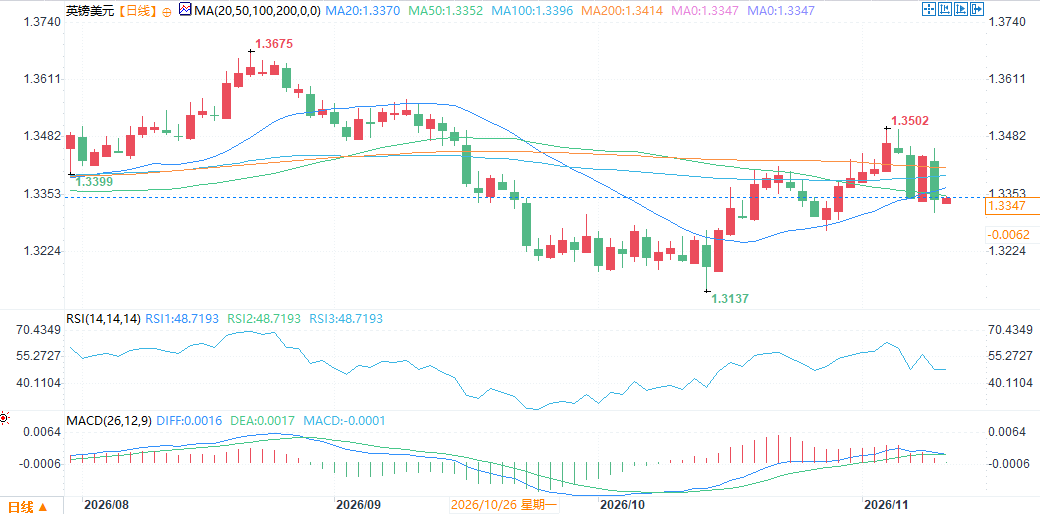 (GBP/USD daily chart, source: FX678) At 8:20 Beijing time, GBP/USD was trading at 1.3346/47.
Policy divergence: NIESR expects only one more rate hike, while the market is pricing in two to three.
The policy outlook is where the NIESR diverges from the market. Investors are currently pricing in two to three more 25-basis-point rate hikes by the end of next year, but the think tank expects the Bank of England to raise rates only once more, in February. The NIESR also stated that rates need to rise to around 5% to bring inflation back to its target in the medium term – suggesting it believes a single rate hike is insufficient to achieve the target on time. The Bank of England raised its interest rate from 3.75% to 4% last week, its first rate hike in over three years. If the NIESR's assessment is correct, the market's pricing in two to three rate hikes will be reduced, weakening the interest rate differential support for the pound; however, the institution's statement that rates need to rise to around 5% points to another possibility – if inflation is as stubborn as it anticipates, the Bank of England may ultimately be forced to raise rates more, not less.Fiscal criticism: The October budget offered limited improvement to public finances, and the borrowing plan lacked credibility.
On the fiscal front, NIESR stated that the Chancellor's October budget would have little effect on strengthening public finances. The agency noted that difficult decisions regarding taxation and spending were largely postponed, and plans to cut borrowing lacked credibility. The agency's director stated that while the economy has performed better than expected this year, it now faces the dual pressures of rising energy prices and increasing global borrowing costs; policy responses on both the monetary and fiscal fronts are domestic options, and decisions on both fronts are being delayed. The risk to fiscal credibility is compounded by inflation risks, and if borrowing plans continue to decline, longer-term UK government bonds could come under pressure—this is the agency's core criticism of the dual postponements of fiscal and monetary decisions.Growth and Employment: The 2026 forecast has been revised upward to 1.6%, with the unemployment rate peaking at 5.1% in 2031.
Growth is more resilient than expected. NIESR has revised its 2026 forecast upward to 1.6% from 1.1%, citing stronger government spending and business investment, partly driven by AI. The agency expects growth to slow to 1.1% in 2027 and 0.9% in 2028. The unemployment rate is projected to rise from 4.8% in 2026 to a peak of 5.1% in 2031, with wage growth averaging 3.9% over the next three years. This data implies a coexistence of upward revisions to short-term growth and expectations of a medium-term slowdown, with the 3.9% wage growth—higher than the 2% inflation level—providing a data basis for concerns about a second-round effect.Market implications: Energy prices and wage settlements are key indicators.
The gap between NIESR's single-rate-hike forecast and market pricing will be tested at the Bank of England's upcoming meeting, with energy prices and wage settlements being key data points to watch. Reports also indicate that Federal Reserve's Goolsbee called the CPI "almost disturbing" and listed three major inflation concerns—this transatlantic echo suggests that the transmission of energy shocks to core inflation is not unique to the UK. For UK assets, NIESR's forecast points to a combination of "longer inflation and fewer, but potentially later, rate hikes": if energy prices rise again, the risk of a second-round effect will increase, and UK government bond yields and the pound will remain sensitive to unexpected energy-driven data.Why does the pound lack unilateral momentum?
There's a chain between NIESR's forecasts and the GBP/USD exchange rate movement, which needs to be transmitted through interest rate differential expectations. The most direct implication for the pound is a divergence in policy paths: the market is pricing in two to three more rate hikes by the end of 2027, while NIESR only projects one. If subsequent data validates this assessment, the market will reduce its rate hike pricing, weakening the pound's interest rate differential support—a downside risk for the pound. However, the statement in the same forecast that "interest rates need to rise to around 5% to achieve the target" points in the opposite direction: if inflation is as stubborn as expected, the Bank of England may ultimately be forced to raise rates more rather than less, potentially revising interest rate differential expectations upwards. The fiscal dimension constitutes a second layer of tension. NIESR criticizes the October budget for its limited improvement in public finances and lack of credibility in its borrowing program. If the market prices this in, longer-term UK government bond yields will be under pressure, and rising yields have a two-way impact on the pound—it could attract capital inflows or be interpreted as an increase in fiscal risk premiums. The former supports the pound, the latter suppresses it, depending on which aspect the market is focusing on at the time. The combined pull of these two factors suggests that the pound/dollar exchange rate is more likely to remain range-bound in the short term rather than trend in one direction. A true directional breakout requires clearer signals from energy price and wage settlement data. If wage growth remains around 3.9% as predicted by the NIESR, the Bank of England's interest rate hike path may tilt towards "fewer but later" increases, making it difficult for the pound's interest rate advantage to widen. Conversely, if wages unexpectedly slow, the market's pricing in two to three interest rate hikes will be preserved, potentially providing support for the pound.in conclusion
NIESR predicts that UK inflation will peak at 4.4% in February 2027 and remain above the 2% target throughout 2027-2029, only declining at the end of 2030. This is a year later than previously forecast, mainly due to the second round of energy shocks from the Iranian conflict transmitting to wages. On the policy front, the institution expects the Bank of England to raise interest rates only once more, in February, while the market is pricing in two to three; however, it also states that rates need to rise to around 5% to achieve the target, suggesting that a single rate hike is insufficient—this combination of "fewer rate hikes but a higher endpoint" makes the gap between market pricing and think tank forecasts a key tension for UK assets. On the fiscal front, the institution criticizes the October budget for its limited improvement in public finances and the lack of credibility in the borrowing program; if borrowing continues to decline, longer-term government bonds may come under pressure. Growth forecasts have been revised upward to 1.6% in 2026, but are expected to slow to 1.1% in 2027 and 0.9% in 2028. The unemployment rate is projected to peak at 5.1% in 2031, with a three-year average wage growth of 3.9%—a level compatible with 2% inflation, providing the data basis for concerns about a second-round effect. Energy prices and wage settlements will be key variables in testing these forecasts. (GBP/USD daily chart, source: FX678) At 8:20 Beijing time, GBP/USD was trading at 1.3346/47.
- Risk Warning and Disclaimer
- The market involves risk, and trading may not be suitable for all investors. This article is for reference only and does not constitute personal investment advice, nor does it take into account certain users’ specific investment objectives, financial situation, or other needs. Any investment decisions made based on this information are at your own risk.