Following the peace talks, the US and Iran maintained their blockade without launching an attack, posing a short-term risk of a rebound in oil prices.
2026-11-11 16:34:31
On Wednesday (November 11th) during the Asian and European sessions, oil prices rebounded after hitting a low over the past two trading days, but the rebound was limited. The market was constantly pulled by two main themes: Qatar's mediation only secured a short-term buffer window of two weeks; the US-Iran standoff in the Middle East has entered a stalemate, with the US choosing economic pressure rather than large-scale military strikes, but the attacks on shipping routes in the Strait of Hormuz continue to suppress confidence in shipping lanes; on the other hand, Russia and Ukraine resumed trilateral talks after a nine-month hiatus, coupled with attacks on Baltic refined oil export hubs but a sharp drop in shipping rates and the stranding of Russian diesel ocean-going cargo ships, making disturbances in the refined oil sector a new focus of trading, and institutions have continued to raise their forward price forecasts for refined oil. In other words, the ceiling for oil price increases has been determined, but with no results from the negotiations, a short-term rebound in oil prices may occur. 
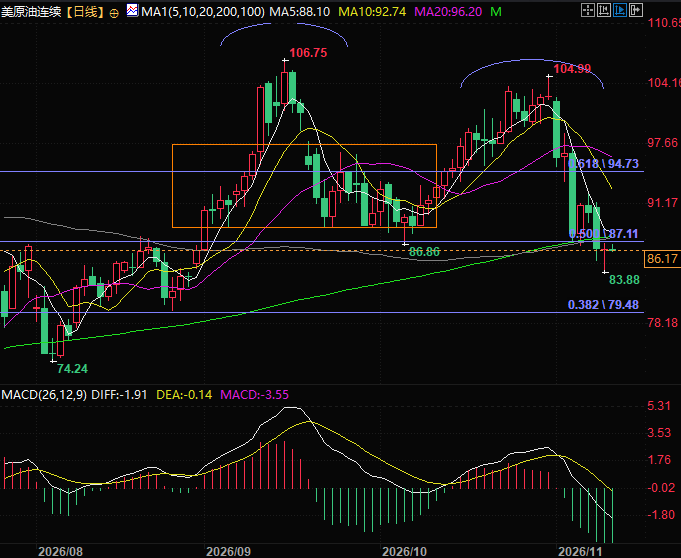 (WTI crude oil futures daily chart, source: FX678) At 16:26 Beijing time, WTI crude oil futures are currently trading at $86.24 per barrel.
The US-Iran rivalry: a blockade without initiating war, with diplomatic efforts only providing a short-term buffer.
The core of the current US-Iran rivalry is characterized by continued sanctions, a temporary halt to offensive actions, and significant differences in negotiations. At the G7 foreign ministers' meeting in Paris, US Secretary of State Marco Rubio explicitly presented a third option: neither reigniting large-scale war nor accepting a lenient peace agreement, but rather continuing to tighten sanctions and a maritime blockade to deplete Iran's financial resources and limit its external support and military reconstruction capabilities. This pressure strategy has no predetermined end date. Rubio also stated that the sanctions and maritime blockade have been very effective, and there is no immediate need for large-scale military action. While the US is not closing the door to a genuine agreement, it considers Iran's demands unrealistic, especially its demand for war reparations, which Trump has directly rejected. Market expectations for easing tensions mainly stem from Qatar's mediation. The Qatari Prime Minister informed the G7 foreign ministers in Paris that Doha had secured at least a two-week window to try and reach an understanding between the US and Iran, preventing another US military strike. However, the core differences between the two sides remain unresolved: there is no consensus on key issues such as the pace of lifting the maritime blockade, the nuclear issue, and the unfreezing of Iranian overseas assets. Iran went further, directly dampening market optimism. The secretary of Iran's Supreme National Security Council publicly stated that the US claims about continuing negotiations and the Qatar talks were lies, and that the US has yet to give a clear answer to Iran's conditions, making its responses deceptive.Shipping risks remain, and attacks on shipping continue to fuel geopolitical premiums.
Diplomatic buffers have not altered the real risks in the Strait of Hormuz. Iranian harassment and Houthi attacks on Saudi energy facilities continue, with geopolitical premiums repeatedly impacting the market. Statistics show that 37 ships were attacked in the Strait of Hormuz and surrounding waters in October, the highest monthly record since the start of this conflict. Ten more attacks occurred in early November. A Liberian-flagged supertanker was attacked, injuring four crew members. An ADNOC logistics vessel was also attacked in UAE territorial waters, and an oil tanker leaked, causing oil pollution near Fujairah, UAE. The Iranian Revolutionary Guard claims two oil tankers struck mines and caught fire on unauthorized routes. These conflicting accounts continue to create uncertainty regarding shipping safety. Price performance was mixed: international oil prices rebounded last night, but Murban spot crude oil fell sharply by 7.16%, reflecting significant differences in supply and demand structures across different regions. For regional markets like the UAE, benchmark oil prices are only one aspect; the pace at which costs are passed on to fuel, transportation, and imported goods is equally important to monitor. The recent decline in Ural crude oil freight rates on the Baltic route is a sign of this trend, but freight rates on the Strait of Hormuz route remain firm.Russia-Ukraine in-person negotiations resume; attacks on energy facilities disrupt refined oil supply chains.
Focus shifts to the Russia-Ukraine conflict, becoming the second key storyline in the oil market. On November 10th, Russia, the United States, and Ukraine resumed face-to-face talks in Abu Dhabi, marking the first in-person consultations in nine months since negotiations stalled in February. Ukraine presented a comprehensive set of demands during the talks, including a ceasefire, security guarantees, and a ceasefire plan specifically for the Black Sea and energy sectors. Ukraine also proposed a direct meeting between Zelensky and Putin, hoping to accelerate the resolution of the conflict. Zelensky stated that he was ready for a meeting but was uncertain about Russia's willingness. Russia has not yet given a clear response, while Rubio praised the talks as productive and proposed involving Europe in future negotiations. Meanwhile, Ukraine continues its attacks on key Russian energy export points. Ukrainian drones attacked the crucial Baltic export port of Ust-Luga, causing a fire and shutting down a substation. This port is a core hub for the export of Russian crude oil and refined petroleum products, and historical attacks have repeatedly disrupted oil exports. Another Russian diesel tanker carrying 40,000 tons of ultra-low sulfur diesel, originally bound for New York, is currently stranded in the North Atlantic, awaiting further instructions. The cargo has not yet been unloaded, and the market is closely watching its final destination, which will directly impact diesel inventories on the US East Coast. The disruptions to Middle Eastern shipping routes have also affected long-term contracts. Polish energy giant Orlen has terminated a long-term Qatari LNG contract citing force majeure, marking the first time a Qatari energy customer has taken such action.Institutional Forecasts: Tight Supply of Refined Oil Products Continues; EIA Raises Forecasts for Future Prices
Oil research suggests that even if the US and Iran reach an agreement, the recovery of shipping volume in the Strait of Hormuz will not be immediate. It will depend on the progress of mine clearance, shipping insurance quotes, and whether shipowners are willing to bear the risks of navigation. An agreement does not guarantee an immediate supply recovery. Analysts observe that as energy outflows from the Persian Gulf improve marginally, geopolitical premiums are slowly declining, and oil prices have fallen by more than 20% from their late October highs. OPEC's October production rebounded to 22.87 million barrels per day, approaching 90% of pre-war levels in February, which is a significant reason for the recent lack of upward momentum in oil prices. Global refined product supply constraints are becoming the main pricing theme in the medium to long term. The latest Short-Term Energy Outlook from the US EIA has raised its 2027 US retail price forecasts for gasoline and diesel, with diesel increasing by 12% and gasoline by 5%. The EIA predicts that the tight global refined product supply situation will continue until the end of 2027, and refined product crack spreads are expected to remain high, supporting high operating rates at US refineries. EIA price benchmark forecast: Brent crude oil is likely to remain around $100 per barrel for the remainder of this year, and the average price will fall to $77 per barrel in the fourth quarter of 2027 as global inventories gradually recover.Transaction summary and tracking highlights
In summary, the core framework of current crude oil trading remains that the election has already set a ceiling for oil price increases. However, if the US doesn't concede, Iran will continue to block the Strait of Hormuz and attack oil tankers, keeping shipping costs high. The logic remains the same: the US can afford to wait for lower oil prices, but Iran, seeking leverage in negotiations, will try to push prices up. Currently, oil prices have shifted from an upward trend to a downward trend, meaning that although the trend has changed, a rebound after a significant drop, stimulated by geopolitical events, is inevitable. Meanwhile, the strong performance of the US dollar index suggests that geopolitical risks have not been cleared, and a counterattack by oil bulls using geopolitical events is possible. The two-week window of opportunity provided by Qatar's mediation will bring short-term bullish expectations, but as long as the Strait of Hormuz attacks do not substantially cease, the geopolitical premium will not completely disappear. The Russia-Ukraine negotiations are a slow-moving variable, and a quick ceasefire is unlikely. Ukraine's continued attacks on Russian energy export facilities will continue to disrupt refined oil shipments. In trading, flexibility is needed, and continuous monitoring is crucial: data on ship attacks in the Strait of Hormuz, official statements from the US and Iran, and interpretations of the Abu Dhabi talks. Look for entry points where oil prices don't fall despite negative news, but avoid the mindset of a previous oil bull market when prices rebound. The biggest path for oil prices—the escalation of the US-Iran conflict—has almost disappeared. Technically, after breaking below the neckline, international oil prices formed a single-day bottom and are currently in a rebound phase within a downtrend. The overall downtrend is quite evident with a double top pattern. For oil prices to return to a bull market, significant fundamental changes and a price increase above $92 are needed; otherwise, the downtrend cannot be reversed. (WTI crude oil futures daily chart, source: FX678) At 16:26 Beijing time, WTI crude oil futures are currently trading at $86.24 per barrel.
- Risk Warning and Disclaimer
- The market involves risk, and trading may not be suitable for all investors. This article is for reference only and does not constitute personal investment advice, nor does it take into account certain users’ specific investment objectives, financial situation, or other needs. Any investment decisions made based on this information are at your own risk.