With expectations of a Fed rate hike surging, will Europe follow suit? ING analyzes the next moves for gold, oil, and forex.
2026-11-11 17:34:29
US October CPI rose more than expected, with core CPI increasing by 0.3% for the third consecutive month. Coupled with Fed official Waller's hints at a possible 50 basis point rate hike, the 10-year Treasury yield returned to near 5%, and the US dollar strengthened. Gold prices fell sharply by nearly 3%, while crude oil remained relatively stable due to support from easing energy prices. In the foreign exchange market, the US dollar strengthened against major currencies. Gold, crude oil, and forex traders should pay close attention to the divergence in interest rate paths and energy price movements.  Yesterday, the US October CPI data became the focus of the market: the overall CPI rose 0.4% month-on-month (expected 0.3%), and the core CPI rose 0.3% month-on-month (expected 0.2%), maintaining a high level for the third consecutive month. Before the data release, Federal Reserve Governor Christopher Waller had clearly stated that if the core CPI reached or exceeded 0.3%, he would consider supporting a 50 basis point rate hike at the December meeting, rather than the 25 basis point widely expected by the market. The data precisely hit the threshold, causing a sharp rise in short-term US Treasury yields. The 2-year yield saw a significant single-day increase, and the 10-year Treasury yield quickly returned to around 5%. The market's pricing of a December rate hike rose further from "almost certain 25 basis point," and the probability of a 50 basis point rate hike also increased significantly. This combination directly triggered a stronger dollar, a flattening of the US Treasury yield curve, and a chain reaction in the gold, oil, and foreign exchange markets. ING analysis pointed out that the stickiness of US inflation, coupled with the demand uncertainty brought about by AI investment, gives the market reason to remain cautious. Meanwhile, expectations of easing tensions in the Middle East are putting downward pressure on energy costs, with U.S. retail gasoline prices falling below $4 per gallon. This provides some buffer for subsequent inflation data, but November inflation data will not be released until after the December FOMC meeting, and the Fed will still need to rely on existing information for decision-making in the short term.
 Both technical and sentiment factors weakened simultaneously, forcing short-term bulls to reduce their positions. However, two points still need to be observed in the medium term: first, whether the decline in energy prices will eventually transmit to overall inflation, reducing the necessity for further significant tightening by the Fed; and second, whether global safe-haven demand will resurface due to geopolitical or economic uncertainties. In the current environment, gold traders should exercise caution, focusing on the key psychological level of $4,000 and the support below. On rebounds, they should consider reducing positions or hedging rather than blindly buying the dip. In an environment of a strong dollar and relatively high real interest rates, the upside potential for gold is limited in the short term.
Yesterday, the US October CPI data became the focus of the market: the overall CPI rose 0.4% month-on-month (expected 0.3%), and the core CPI rose 0.3% month-on-month (expected 0.2%), maintaining a high level for the third consecutive month. Before the data release, Federal Reserve Governor Christopher Waller had clearly stated that if the core CPI reached or exceeded 0.3%, he would consider supporting a 50 basis point rate hike at the December meeting, rather than the 25 basis point widely expected by the market. The data precisely hit the threshold, causing a sharp rise in short-term US Treasury yields. The 2-year yield saw a significant single-day increase, and the 10-year Treasury yield quickly returned to around 5%. The market's pricing of a December rate hike rose further from "almost certain 25 basis point," and the probability of a 50 basis point rate hike also increased significantly. This combination directly triggered a stronger dollar, a flattening of the US Treasury yield curve, and a chain reaction in the gold, oil, and foreign exchange markets. ING analysis pointed out that the stickiness of US inflation, coupled with the demand uncertainty brought about by AI investment, gives the market reason to remain cautious. Meanwhile, expectations of easing tensions in the Middle East are putting downward pressure on energy costs, with U.S. retail gasoline prices falling below $4 per gallon. This provides some buffer for subsequent inflation data, but November inflation data will not be released until after the December FOMC meeting, and the Fed will still need to rely on existing information for decision-making in the short term.Gold: Under pressure from both real interest rates and the US dollar, it faces significant short-term downturn.
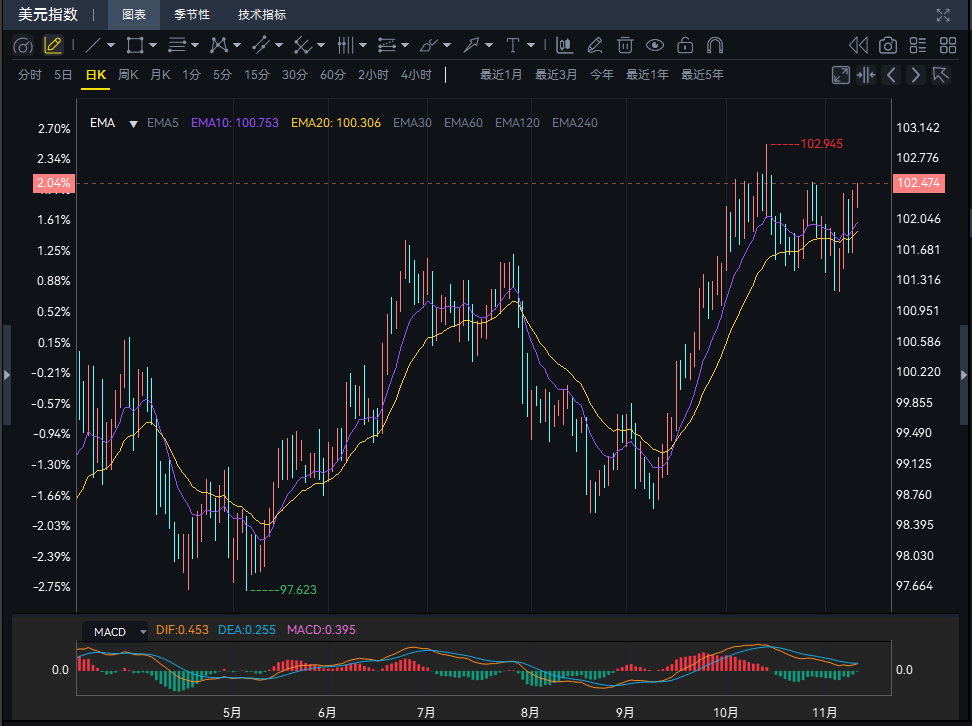
For gold traders, this is a classic bearish combination. Gold, a non-interest-bearing asset, is highly sensitive to real interest rates and the US dollar. The 10-year US Treasury yield has returned to near 5%, increasing the opportunity cost of holding gold; the US dollar index is approaching its year-to-date high and testing key resistance (ING mentioned that the DXY may retest the 102.85/103.00 area), further pressuring dollar-denominated gold. Data shows that gold prices fell sharply by nearly 3% after the data release, with spot gold prices retreating to the $4000-$4050 range, and even testing lower support levels at times. Both technical and sentiment factors weakened simultaneously, forcing short-term bulls to reduce their positions. However, two points still need to be observed in the medium term: first, whether the decline in energy prices will eventually transmit to overall inflation, reducing the necessity for further significant tightening by the Fed; and second, whether global safe-haven demand will resurface due to geopolitical or economic uncertainties. In the current environment, gold traders should exercise caution, focusing on the key psychological level of $4,000 and the support below. On rebounds, they should consider reducing positions or hedging rather than blindly buying the dip. In an environment of a strong dollar and relatively high real interest rates, the upside potential for gold is limited in the short term.Crude oil: Easing energy prices provide a buffer, but macro demand expectations are under pressure.
The crude oil market reaction has been relatively complex. ING points out that expectations of easing tensions in the Middle East are lowering energy costs, and declining US gasoline prices are helping to curb subsequent inflation. This is somewhat bearish for crude oil itself, as supply-side concerns have eased. At the same time, the Fed's hawkish stance implies tighter financial conditions, which could dampen global economic growth and crude oil demand expectations, particularly negatively impacting cyclical energy commodities. In the short term, crude oil is more driven by geopolitical and inventory data than simply following US Treasury yields. Traders need to closely monitor OPEC+ developments, US crude oil inventories, and actual developments in the Middle East. If energy prices remain low, it could help cool November inflation data, thus providing breathing room for the market after the December FOMC meeting; conversely, if oil prices rebound, it could strengthen the narrative of sticky inflation, further supporting the US dollar and US Treasury yields. Crude oil traders can combine technical levels and fundamentals, paying attention to whether demand has weakened significantly due to high interest rates.Foreign Exchange: The US dollar is dominant; the euro and pound should not blindly follow US Treasury bonds.
The foreign exchange market's reaction is most direct. ING's FX Daily analysis emphasizes that the US Treasury yield curve is flattening in a bear market (short-end gains exceeding long-end gains), which typically benefits the US dollar and harms pro-cyclical currencies. The Norwegian krone and Swedish krona are lagging, and the euro/dollar exchange rate is also under pressure near the key support level of 1.11. ING believes there are significant differences between the Eurozone and the US in their inflation paths and growth drivers—Europe is more affected by energy prices, while the US is more driven by AI-related growth. Therefore, European interest rates should not blindly follow the US hawkish repricing. Higher US interest rates have already had spillover effects on Europe through tighter financial conditions, and the ECB and the Bank of England may not need to be as aggressive as the market is currently pricing in. ING recommends focusing on domestic European inflation data rather than being led by US CPI. The euro/dollar exchange rate may remain in the 1.1140-1.1200 range in the short term; a break below 1.11 support could lead to further declines towards the lower edge of the 1.10 area. The dollar/yen exchange rate may continue to test the 159-160 resistance level, but there is an incentive to buy yen on rallies. For forex traders, the current main theme is "a strong US dollar + yield divergence." Short-term traders can trade long US dollars, but should be wary of lower liquidity due to the US holiday (Veterans Day) and potential secondary volatility from Friday's PPI data. Euro and pound traders should not over-price in a simultaneous significant tightening by the ECB/BOE.Today's and subsequent focus
Today's US market is thin due to the holiday. Speeches by several ECB officials (including Lagarde) and German and British bond auctions will be the focus. Friday's US PPI data may further reinforce or revise the inflation narrative. Overall, the market has shifted from a "soft landing + moderate rate hikes" to "sticky inflation + potentially more hawkish path." Gold faces dual pressure from interest rates and the US dollar, crude oil is more dependent on energy supply and demand, and the forex market revolves around the US dollar. Gold, crude oil, and forex traders should closely monitor changes in real interest rates, the resistance level of the US dollar index, and whether energy prices continue to decline. Short-term volatility may intensify; position management and stop-loss discipline are more important than directional predictions. ING's core reminder is worth remembering: different economies have different inflation and growth backgrounds; blindly following US data may lead to misjudgments.- Risk Warning and Disclaimer
- The market involves risk, and trading may not be suitable for all investors. This article is for reference only and does not constitute personal investment advice, nor does it take into account certain users’ specific investment objectives, financial situation, or other needs. Any investment decisions made based on this information are at your own risk.