Internal divisions within the Bank of Japan are widening, with the neutral interest rate becoming a key point of contention.
2026-11-12 15:36:30
On Thursday, November 12, the USD/JPY pair traded in a range near 160. Bank of Japan policy board member Toichiro Asada delivered a speech emphasizing that with inflation having largely reached the 2% target, further interest rate hikes should be carefully paced to avoid undermining underlying inflation progress. This statement contrasted with market pricing in a high probability of a December rate hike, highlighting the board's internal disagreement on the pace of policy normalization. 
Bank of Japan Board Disagreements and Judgment on Neutral Interest Rate
Toichiro Asada had previously opposed the two interest rate hikes in June and September, which pushed the policy rate to 1.25%. He pointed out that inflation had already reached approximately 2%, and the need to further push up prices was limited; further rate hikes might become necessary in the future, but should be implemented slowly. Japan's neutral interest rate may be slightly higher than the current policy rate, but there is no clearly defined endpoint rate. Policy decisions need to be made at each meeting by comprehensively assessing economic risks and financial conditions, and even after reaching a level consistent with the inflation target, interest rates may still be raised or lowered. Bank of Japan staff estimate the neutral interest rate range to be approximately 1.1% to 2.5%, and the current 1.25% has already entered that range. Asada emphasized that the impact of interest rate hikes on real activity may be greater than in the initial stages of policy implementation, especially given the lack of momentum in consumption; tightening too quickly could weaken underlying inflation. He did not oppose interest rate hikes themselves, nor did he consider proposing rate cuts, but he explicitly demanded that the pace be fully considered. This stance contrasts with the opinions of some committee members who advocated for faster interest rate hikes to address price pressures. The summary of opinions from the October meeting shows that some members believed that the next interest rate hike should be pushed forward in a timely manner when conditions permit, while others also pointed out the need to pay attention to weak consumption and the lagging effects of past interest rate hikes.Inflation data and the reality of domestic demand in Japan
Japan's core inflation in September was around 2.1%, and overall inflation was also close to the target range, marking a significant milestone in the Bank of Japan's years-long efforts to combat deflation. However, Asada pointed out that recent price increases were not entirely demand-driven; consumption remained largely flat, and growth lacked significant momentum. The year-on-year increase in the Producer Price Index (PPI) in October exceeded expectations, indicating that cost pressures on businesses persist, but the transmission to end-user demand has been limited. Real wages have turned positive this year, providing some support for consumption, but overall household spending momentum remains insufficient. Corporate profits are relatively robust, credit growth remains stable, and overall financial conditions remain loose. These factors collectively form the key context for the Bank of Japan's assessment of the impact of interest rate hikes: while core inflation has reached the target, its sustainability and the degree of demand-driven growth still need continuous verification. Bank of Japan Governor Kazuo Ueda recently stated that core inflation has reached 2%, but whether this equilibrium can be maintained in the long term remains uncertain, and policy will be flexibly adjusted based on subsequent data.Market pricing and cross-border interest rate environment
The interest rate swap market prices a roughly 70% to 80% probability of a 25 basis point rate hike by the Bank of Japan to 1.5% in December, and economist surveys also show that most expect action in December and a continuation of the quarterly pace. Some views point to a terminal interest rate of around 1.75% or 2%. This expectation contrasts with the current Federal Reserve policy rate, which remains in the 3.75% to 4% range, forming a significant interest rate differential and constituting one of the important background factors for the USD/JPY exchange rate movement. The Federal Reserve recently kept interest rates unchanged, and some officials remain concerned about the inflation path. The difference in policy paths between the Bank of Japan and the Federal Reserve, as well as market attention to possible exchange rate-related measures by the Japanese government, jointly influence the yen's performance. Asada clearly stated that the Bank of Japan does not directly control the exchange rate and did not specify an ideal level. The USD/JPY is currently trading near 160, with range-bound fluctuations reflecting the interplay of policy expectations and risk factors.Exchange Rate Range and Current Technical Indicators
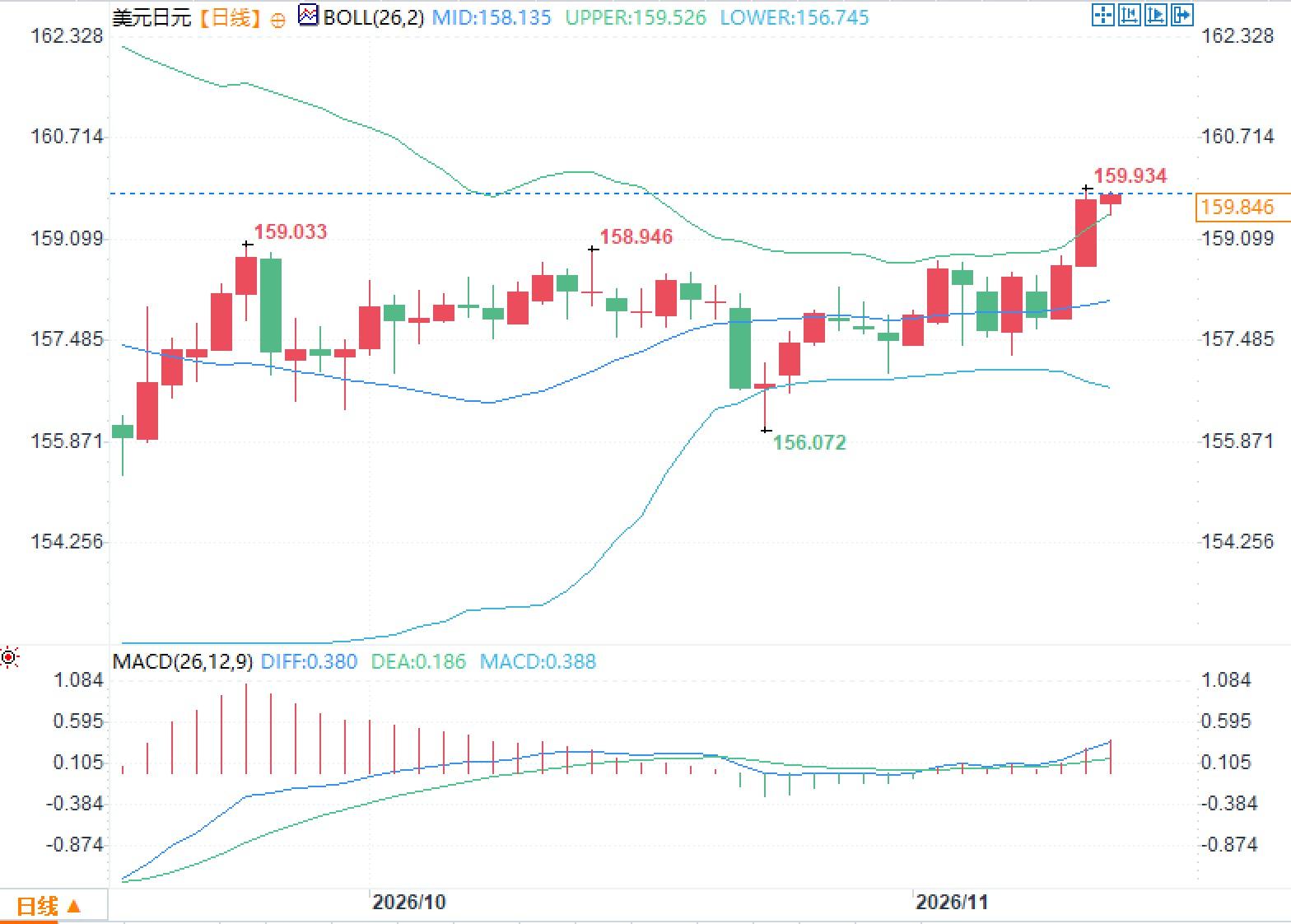
The USD/JPY pair has recently been fluctuating between 157 and 160, showing an overall upward bias since November, with recent highs approaching 160. The Bollinger Bands' middle band is around 158, the upper band around 159.5, and the lower band around 156.7; the price is currently trading near the upper band. The MACD indicator shows both the DIFF and DEA lines are positive, and the histogram is also positive, indicating that short-to-medium-term momentum is in positive territory, but without extreme expansion. Japanese officials have recently increased their focus on rapid price movements, which is related to the recent move near the 160 level.Frequently Asked Questions
Question 1: Did Toichiro Asada's cautious remarks change expectations for a December rate hike? Answer: His dovish stance is consistent with his previous opposition to rate hikes in June and September. The market's pricing in a December rate hike remains high, and a single committee member's opinion is unlikely to reverse the board's overall course. Policy ultimately depends on majority opinion and data verification. Question 2: What impact will the assessment of Japan's neutral interest rate have on the pace of subsequent policy? Answer: The current policy interest rate has entered the estimated neutral range. Asada believes that the potential impact of further rate hikes on the economy is increasing, emphasizing a slow and gradual approach with successive assessments. This continues to diverge from the views of some committee members who hope for a faster normalization. Question 3: What factors are driving the USD/JPY exchange rate near 160? Answer: Cross-border interest rate differential expectations, the difference in policy paths between the Bank of Japan and the Federal Reserve, and market attention to potential official exchange rate measures constitute the main background for the current exchange rate movement. The direct impact of Asada's remarks is relatively limited.- Risk Warning and Disclaimer
- The market involves risk, and trading may not be suitable for all investors. This article is for reference only and does not constitute personal investment advice, nor does it take into account certain users’ specific investment objectives, financial situation, or other needs. Any investment decisions made based on this information are at your own risk.