After consecutive gains, the USD/CAD pair is consolidating at high levels, awaiting a test of resistance near previous highs.
2026-11-13 13:34:29
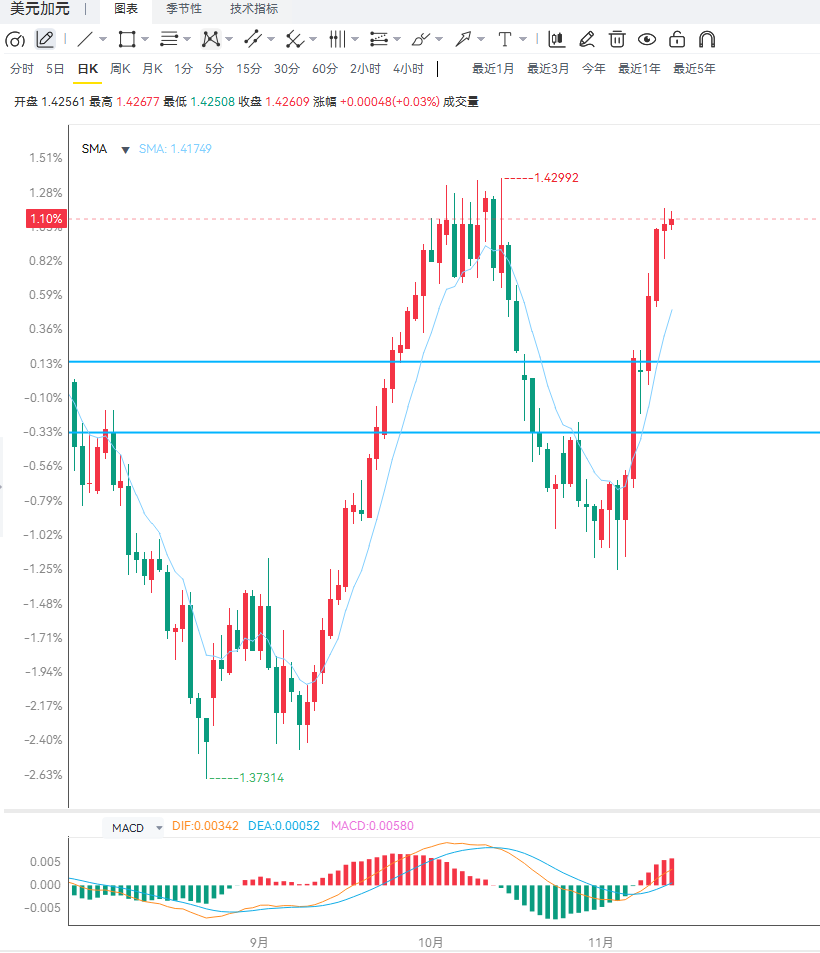
The USD/CAD pair has entered a consolidation phase at high levels after its previous rally, with bulls taking a temporary breather, but the fundamental support remains intact. The previously released US October CPI data was higher than market expectations, highlighting sticky inflation. Federal Reserve Governor Waller signaled a hawkish stance, stating that a 50 basis point rate hike in December should be considered if core inflation continues to rise. The CME FedWatch Tool shows the probability of a 50 basis point rate hike in December has risen to 14.5%, whereas it was almost zero before the inflation data release. The market will focus on the US PPI (Producer Price Index) to be released Friday evening. Market expectations are for a 6.6% year-on-year increase in PPI and a 5.0% year-on-year increase in core PPI. This data will further verify the strength of the inflation transmission chain, influencing the Fed's subsequent policy path and consequently affecting the strength of the US dollar.  As a typical commodity currency, the Canadian dollar's movements are highly correlated with oil prices. Last week's EIA inventory report showed a significant increase of 9 million barrels in US crude oil inventories for the week ending November 5th, a stark contrast to market expectations of destocking. This expectation of ample supply suppressed the upside potential of WTI crude oil, and the weakening oil prices indirectly reduced buying support for the Canadian dollar. TD Securities also favors a stronger USD/CAD pair. The institution believes the US dollar will have a relative advantage over currencies like the Canadian dollar and the Korean won in the short term. The continued divergence in US and Canadian employment data—with rising unemployment and slowing wage growth in Canada—has led the market to lower its expectations for a December rate hike by the Bank of Canada. Compared to the Federal Reserve's increasingly tightening pricing, the policy expectation gap between the US and Canadian central banks continues to widen, a fundamental factor supporting the USD/CAD pair holding above 1.40. On the daily chart, the USD/CAD pair has held above its medium-term moving average, maintaining a healthy uptrend. Currently, it is in a high-level consolidation phase after the recent rise. The 20-day Bollinger Band middle line continues to provide support, and the RSI remains in a neutral-to-strong range, not yet reaching extreme overbought levels, thus retaining upward potential. The first resistance level is at 1.4300, with a break above that targeting 1.4360, and a strong resistance zone at 1.4400. The first support level is at 1.4200, followed by 1.4120, with key support at 1.4045. As long as 1.4045 is not decisively broken, the medium-term bullish structure remains intact.
 Editor's Summary: The core driver of the USD/CAD exchange rate is the policy expectation gap between the Bank of the US and the Bank of Canada, coupled with the weakening of oil prices dragging down the Canadian dollar. In the short term, we need to be wary of a potential pullback in the US dollar due to weaker-than-expected PPI data, leading to a temporary decline in the exchange rate. If the PPI exceeds expectations again, further fueling hawkish expectations from the Federal Reserve, the exchange rate is likely to break out of its trading range.
As a typical commodity currency, the Canadian dollar's movements are highly correlated with oil prices. Last week's EIA inventory report showed a significant increase of 9 million barrels in US crude oil inventories for the week ending November 5th, a stark contrast to market expectations of destocking. This expectation of ample supply suppressed the upside potential of WTI crude oil, and the weakening oil prices indirectly reduced buying support for the Canadian dollar. TD Securities also favors a stronger USD/CAD pair. The institution believes the US dollar will have a relative advantage over currencies like the Canadian dollar and the Korean won in the short term. The continued divergence in US and Canadian employment data—with rising unemployment and slowing wage growth in Canada—has led the market to lower its expectations for a December rate hike by the Bank of Canada. Compared to the Federal Reserve's increasingly tightening pricing, the policy expectation gap between the US and Canadian central banks continues to widen, a fundamental factor supporting the USD/CAD pair holding above 1.40. On the daily chart, the USD/CAD pair has held above its medium-term moving average, maintaining a healthy uptrend. Currently, it is in a high-level consolidation phase after the recent rise. The 20-day Bollinger Band middle line continues to provide support, and the RSI remains in a neutral-to-strong range, not yet reaching extreme overbought levels, thus retaining upward potential. The first resistance level is at 1.4300, with a break above that targeting 1.4360, and a strong resistance zone at 1.4400. The first support level is at 1.4200, followed by 1.4120, with key support at 1.4045. As long as 1.4045 is not decisively broken, the medium-term bullish structure remains intact. Editor's Summary: The core driver of the USD/CAD exchange rate is the policy expectation gap between the Bank of the US and the Bank of Canada, coupled with the weakening of oil prices dragging down the Canadian dollar. In the short term, we need to be wary of a potential pullback in the US dollar due to weaker-than-expected PPI data, leading to a temporary decline in the exchange rate. If the PPI exceeds expectations again, further fueling hawkish expectations from the Federal Reserve, the exchange rate is likely to break out of its trading range.
- Risk Warning and Disclaimer
- The market involves risk, and trading may not be suitable for all investors. This article is for reference only and does not constitute personal investment advice, nor does it take into account certain users’ specific investment objectives, financial situation, or other needs. Any investment decisions made based on this information are at your own risk.