After three consecutive days of gains, the US dollar index has entered a period of consolidation, awaiting the release of PPI data.
2026-11-13 13:18:28
After a strong rally, the US dollar index has entered a period of consolidation, with profit-taking slowing the upward momentum, but the fundamental support framework remains intact. US October CPI inflation data exceeded market expectations, coupled with hawkish statements from several Federal Reserve officials, leading the market to further tighten its pricing in Fed monetary policy. The CME FedWatch Tool shows that a 25bp rate hike in December has been fully priced in, while the market has raised the probability of a one-off 50bp rate hike to approximately 13%. The rebound in oil prices has increased tail risks to inflation, supporting long-term US Treasury yields above 5%, and the interest rate differential continues to attract capital inflows into dollar assets.  RBC's view reinforces the tightening expectation logic. The institution believes that although US Treasury yields previously declined in October and November, the necessity for further US interest rate hikes is increasing. Rising core inflationary pressures, resilient economic growth in the third quarter, and a persistently tight labor market all point to the Federal Reserve needing to continue tightening policy to suppress stubborn inflation, providing macroeconomic support for the medium-term strength of the US dollar. Geopolitical factors have again provided a safe-haven premium for the US dollar. Trump issued a strong warning to Iran on Thursday, stating that he would not compromise with forces attacking US personnel and reiterating that the US is no longer seeking a deal with Iran. Attacks on Saudi energy facilities and oil tankers in the Strait of Hormuz have continued to pose shipping risks in the Persian Gulf, and market concerns about escalating conflict persist, leading safe-haven funds to continue choosing the US dollar as a safe-haven asset. In the short term, the market focus will shift to the US October PPI producer price index to be released later tonight, as this data can verify the strength of inflation transmission from the upstream supply chain. In addition, speeches by several FOMC officials and sudden news from the Middle East will continue to disrupt market expectations for Fed policy, causing intraday volatility in the dollar index. Before a strong catalyst materializes, the market is expected to mainly fluctuate at high levels, with the bullish trend structure remaining intact. On the daily chart, the dollar index has stabilized above the 200-day simple moving average, while the price has held above the 103.00 level, clearly indicating a short-term bullish bias. The 103.00 level has transformed from previous resistance into key psychological support; a decisive break below this level would target the 102.50–102.60 range, a previous resistance level that has now become a crucial support area. Currently, the moving averages are in a bullish alignment, and the trend structure remains constructive. Although there is overbought pressure after the continuous rise, no clear reversal signal has yet appeared, and the bulls still have room to test new highs. The first resistance level is 103.40, the second resistance level is 103.80, and the strong resistance level is 104.20; the first support level is 103.00, followed by 102.60, and the deep support level is 102.00.
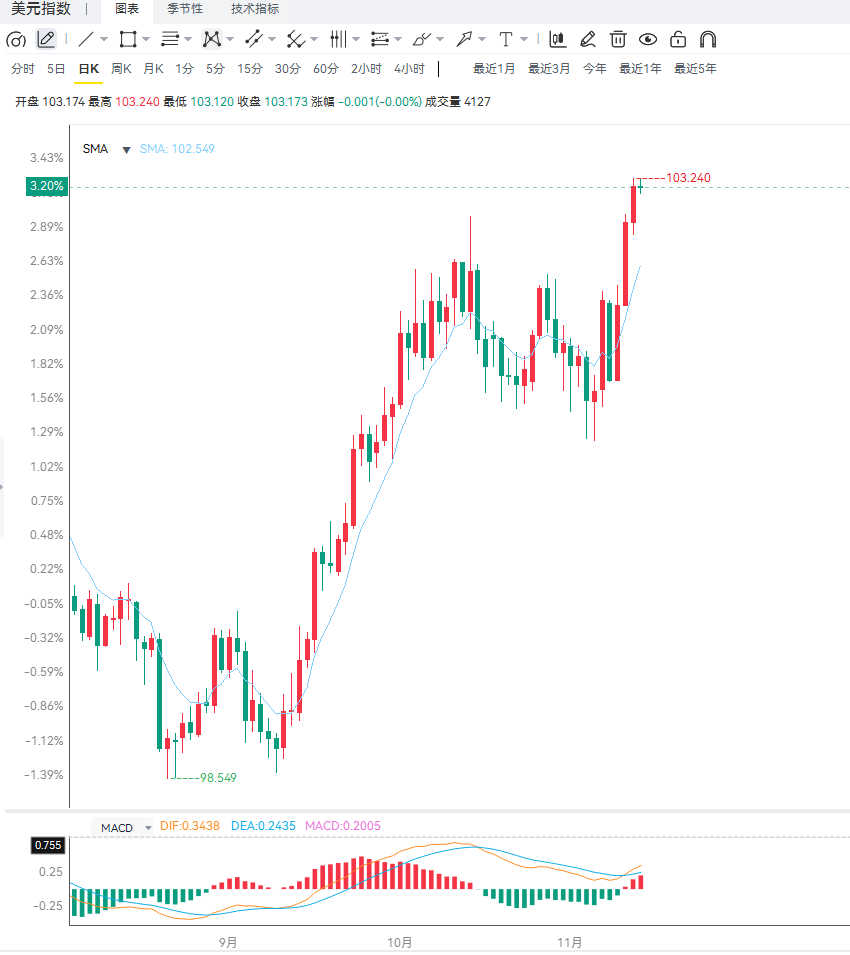 Editor's Summary: The US dollar index is currently in a consolidation phase within an upward trend, driven primarily by expectations of a Fed rate hike due to sticky inflation, coupled with geopolitical safe-haven demand in the Middle East. The risks are: if PPI data shows a significant cooling, the market will lower the probability of a substantial rate hike in December, leading to a temporary pullback in the dollar; conversely, if PPI continues to exceed expectations, hawkish expectations will intensify, potentially causing the dollar index to break out of its consolidation range and reach new highs.
RBC's view reinforces the tightening expectation logic. The institution believes that although US Treasury yields previously declined in October and November, the necessity for further US interest rate hikes is increasing. Rising core inflationary pressures, resilient economic growth in the third quarter, and a persistently tight labor market all point to the Federal Reserve needing to continue tightening policy to suppress stubborn inflation, providing macroeconomic support for the medium-term strength of the US dollar. Geopolitical factors have again provided a safe-haven premium for the US dollar. Trump issued a strong warning to Iran on Thursday, stating that he would not compromise with forces attacking US personnel and reiterating that the US is no longer seeking a deal with Iran. Attacks on Saudi energy facilities and oil tankers in the Strait of Hormuz have continued to pose shipping risks in the Persian Gulf, and market concerns about escalating conflict persist, leading safe-haven funds to continue choosing the US dollar as a safe-haven asset. In the short term, the market focus will shift to the US October PPI producer price index to be released later tonight, as this data can verify the strength of inflation transmission from the upstream supply chain. In addition, speeches by several FOMC officials and sudden news from the Middle East will continue to disrupt market expectations for Fed policy, causing intraday volatility in the dollar index. Before a strong catalyst materializes, the market is expected to mainly fluctuate at high levels, with the bullish trend structure remaining intact. On the daily chart, the dollar index has stabilized above the 200-day simple moving average, while the price has held above the 103.00 level, clearly indicating a short-term bullish bias. The 103.00 level has transformed from previous resistance into key psychological support; a decisive break below this level would target the 102.50–102.60 range, a previous resistance level that has now become a crucial support area. Currently, the moving averages are in a bullish alignment, and the trend structure remains constructive. Although there is overbought pressure after the continuous rise, no clear reversal signal has yet appeared, and the bulls still have room to test new highs. The first resistance level is 103.40, the second resistance level is 103.80, and the strong resistance level is 104.20; the first support level is 103.00, followed by 102.60, and the deep support level is 102.00. Editor's Summary: The US dollar index is currently in a consolidation phase within an upward trend, driven primarily by expectations of a Fed rate hike due to sticky inflation, coupled with geopolitical safe-haven demand in the Middle East. The risks are: if PPI data shows a significant cooling, the market will lower the probability of a substantial rate hike in December, leading to a temporary pullback in the dollar; conversely, if PPI continues to exceed expectations, hawkish expectations will intensify, potentially causing the dollar index to break out of its consolidation range and reach new highs.
- Risk Warning and Disclaimer
- The market involves risk, and trading may not be suitable for all investors. This article is for reference only and does not constitute personal investment advice, nor does it take into account certain users’ specific investment objectives, financial situation, or other needs. Any investment decisions made based on this information are at your own risk.