Japan's economy contracted for the first time, yet the yen refused to fall? A life-or-death struggle between bulls and bears has begun at the 160 level.
2026-11-16 11:17:30
Japan's GDP unexpectedly contracted by 0.1% annualized in the third quarter, marking the first decline in four quarters. Private consumption fell by 0.3% due to persistent inflation, with external demand dragging down the economy significantly, while capital expenditure grew more than expected. The market did not significantly lower its expectations for a December rate hike by the Bank of Japan, with most economists believing that weak consumption itself is a manifestation of high prices, thus reinforcing the rationale for continued tightening.  The USD/JPY pair is currently consolidating at a high level around 159.7–160, having tested the 160 level multiple times. For forex traders, the real determinant of the future direction is not a single GDP figure, but rather whether the USD/JPY interest rate differential will persist, whether Tokyo will intervene again near 160, and the order of the Fed and BOJ decisions in December. While short-term momentum has weakened somewhat, the interplay between interest rate differentials and intervention risks remains the main theme.
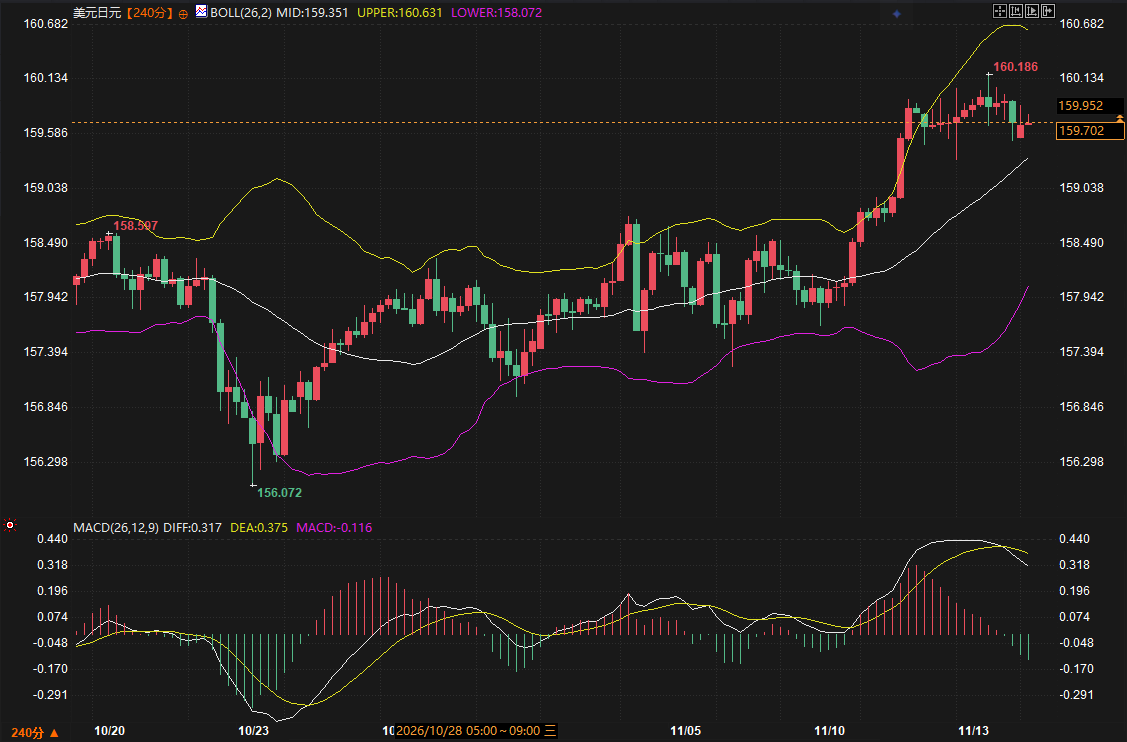
The USD/JPY pair is currently consolidating at a high level around 159.7–160, having tested the 160 level multiple times. For forex traders, the real determinant of the future direction is not a single GDP figure, but rather whether the USD/JPY interest rate differential will persist, whether Tokyo will intervene again near 160, and the order of the Fed and BOJ decisions in December. While short-term momentum has weakened somewhat, the interplay between interest rate differentials and intervention risks remains the main theme. GDP contraction has not shaken the austerity path.
Data released by Japan's Cabinet Office showed that real GDP contracted by 0.1% annualized in the third quarter, far below market expectations of +0.3%, marking the first decline in four quarters. The quarter-on-quarter figure was essentially flat. The drag came mainly from two aspects: a 0.3% decline in private consumption (accounting for more than half of GDP) and a -0.6 percentage point contribution from net exports. A rebound in energy imports and oil prices and supply chain costs due to the Middle East situation were important factors. Capital expenditure, however, grew by 1.6%, exceeding expectations, supported by investments in artificial intelligence and labor-saving technologies. Most economists interpreted the data hawkishly. Weak consumption was seen as a symptom of inflationary pressures, rather than a reason to pause interest rate hikes. The Bank of Japan had already raised interest rates in June and September, and the policy rate is currently around 1.25%, with the market still pricing in a possible further increase to 1.5% in December. The Minister of Economy emphasized that improved employment and income conditions could support a gradual recovery, while also highlighting Middle East risks. The real variable lies in whether the policy committee will further diverge: if subsequent consumption data continues to be weak, doves may gain more influence, thus delaying the pace of interest rate hikes. For traders, this means that the downside for the yen is limited by both "intervention and expectations of interest rate hikes," but any dovish signals could quickly push USD/JPY higher.The 160 mark remains a red line for Tokyo.
The USD/JPY pair rebounded from a low of around 156 in late October, accelerating its breakout above 160 in mid-November, reaching a high of approximately 160.19 before retreating to the 159.7–160 range. This marks the third significant test of 160 this year. Japan has intervened in the yen's purchases multiple times this year, totaling approximately 27 trillion yen, including a joint operation with the US during the summer. Finance Ministry officials recently issued another verbal warning, emphasizing that "it's not time to forget the summer." 160 is not just an ordinary psychological level, but a threshold repeatedly tested by the market and authorities. As long as the price remains near this level, short sellers (long USD/JPY) face the risk of a large-scale sell-off of the dollar; long sellers worry about a rapid pullback after a failed breakout. On the 4-hour chart, the price remains above the Bollinger Middle Band (around 159.35), and the overall upward structure remains intact, but the MACD histogram has turned negative, indicating weakening short-term upward momentum. Traders should pay more attention to the fact that interest rate differentials continue to support the dollar, while intervention and expectations of a December rate hike constitute resistance above. Historically, interventions have often only lasted for a few weeks, and if the interest rate spread does not narrow significantly, prices are likely to return to high levels.Core trading logic ahead of the December central bank decisions
The current market focus has shifted from a single GDP data release to the Federal Reserve meeting on December 9th and the Bank of Japan meeting on December 18th. The Fed's rate hike is largely anticipated due to strong inflation data; the Bank of Japan is likely to follow suit with a smaller increase. If both raise rates by 25 basis points, the interest rate differential will remain largely unchanged, and USD/JPY may continue to test above 160, forcing Tokyo to consider a third large-scale intervention. Only if the Fed hints at a more hawkish stance or the Bank of Japan releases a clearer path for future rate hikes can the yen gain more sustained support. Several practical constraints are more important: Intervention risk: Any accelerated upward movement near 160 could trigger verbal or actual intervention, instantly amplifying volatility. Event timing: Today's speech by Bank of Japan policy board member Hajime Takada, and subsequent CPI and employment data will all influence December pricing. Interest rate differential: As long as the USD/JPY interest rate differential remains high, the structural pressure on the yen will be difficult to eliminate quickly. The core of the yen issue has never been whether a single GDP figure falls short of expectations, but rather how much Tokyo is willing to pay for the exchange rate in a high-interest-rate environment, and when the USD/JPY interest rate differential will truly narrow. For active forex traders, this remains one of the most worthwhile instruments to keep track of.- Risk Warning and Disclaimer
- The market involves risk, and trading may not be suitable for all investors. This article is for reference only and does not constitute personal investment advice, nor does it take into account certain users’ specific investment objectives, financial situation, or other needs. Any investment decisions made based on this information are at your own risk.