The escalation of minefield activity in the Strait of Hormuz has plunged gold into a fierce struggle between expectations of interest rate hikes and geopolitical safe-haven demand.
2026-11-16 21:44:34
On November 16th, Baku reported that two more oil tankers struck mines in an unauthorized route in the southern Strait of Hormuz, exploding and catching fire. Combined with previous incidents overnight, six oil tankers have now been damaged and sunk by mines. Iran claims this is in retaliation for the US naval blockade, bringing energy transport through the strait to a near standstill. This geopolitical risk, coupled with expectations of a Federal Reserve interest rate hike, has created a strong counterbalancing effect, causing gold prices to fluctuate between bullish and bearish sentiment. 
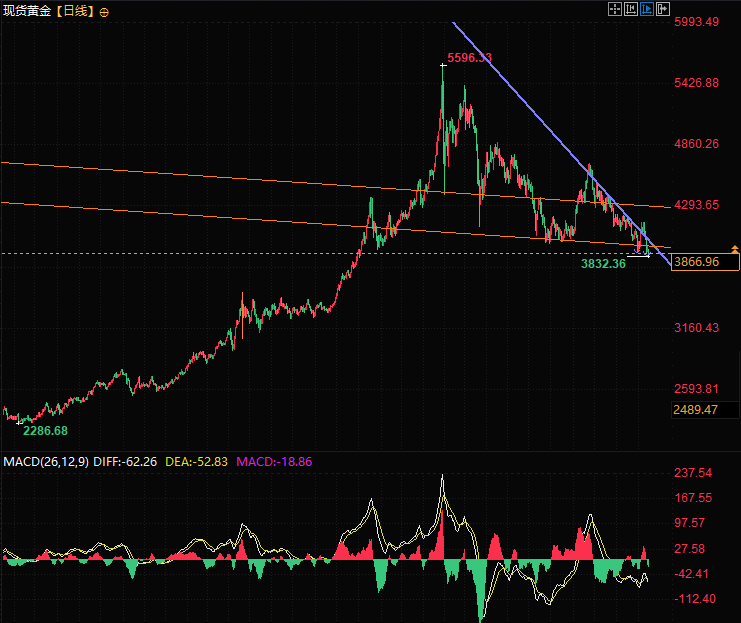 (Spot gold daily chart, source: EasyTrade) At 21:41 Beijing time, spot gold is currently trading at $3,867 per ounce.
The crisis in cross-strait shipping continues to escalate, bringing global energy corridors to a near standstill.
On November 16, Baku reported that two more oil tankers struck mines while attempting to enter the southern part of the Strait of Hormuz, an "unauthorized" route outside the designated area. The ships exploded and burst into flames. The Islamic Revolutionary Guard Corps issued a statement saying this incident followed another oil tanker explosion that occurred overnight. Since yesterday, six commercial oil tankers have struck mines, become disabled, or sunk in the strait. Iran stated that the mine-laying operation was a direct countermeasure to the US maritime blockade and illegal passage of ships, and formally warned ship owners and operators that mines had been laid in the southern route of the Strait of Hormuz. Since the renewed escalation of tensions between the US and Iran on July 8, the maritime security environment of this core global energy corridor has deteriorated sharply. On that day, the US launched airstrikes on Iranian soil in retaliation for shipping attacks, marking the first major military action since the breakdown of the bilateral memorandum of understanding. Following the airstrikes, Trump declared the ceasefire invalid. The subsequent military clashes, coupled with this mine-laying operation, have almost completely halted the transport of crude oil and LNG through the Strait of Hormuz, rapidly escalating global energy supply anxieties.Current fundamentals for gold: Interest rate hike expectations are suppressing prices, and gold prices face the prospect of a year-end decline.
Gold's appeal is waning, and it is currently heading for its first annual decline in four years. Market concerns that the Federal Reserve will raise interest rates to curb inflation, triggering capital outflows, are offsetting the support from continued gold purchases by global central banks. Spot gold was trading at $3,874 per ounce on Monday, nearing a one-year low. Gold prices have fallen by more than 9% this year, and if the weakness continues into the year, it will mark the largest annual drop since at least 2019. Gold has faced multiple headwinds throughout the year: hawkish comments from the Federal Reserve, a stronger dollar, and soaring oil prices. Better-than-expected US inflation data last month, coupled with recent signals from Federal Reserve Governor Christopher Waller, has led the market to price in a 50-basis-point rate hike at the December meeting, triggering a new round of selling. On Monday afternoon, the yield on the 10-year US Treasury note was 5.139%, a one-month high. CME data shows that interest rate traders are currently pricing in an 89% probability of a 25-basis-point rate hike next month and an 11% probability of a 50-basis-point hike. The US dollar index rose to 103.16, a 19-month high, reflecting market expectations of rising financing costs and a resilient US economy. Crude oil, a key variable in inflation expectations, has risen over 50% this year since the outbreak of the US-Iran conflict; Trump's statement that the US will no longer seek a deal with Iran has dimmed hopes for short-term diplomatic easing. A futures analyst stated, "As a non-interest-bearing asset, gold's attractiveness has significantly decreased against the backdrop of rising real interest rates."Multiple institutions have recently concluded that interest rates remain the main theme, while central bank gold purchases provide bottom support.
Goldman Sachs lowered its gold price target this month, reducing its year-end target by 11% to $4,150 per ounce and its year-end target for 2027 by the same 11% to $4,800, citing the impact of the Federal Reserve's hawkish policy shift. The US investment bank wrote in a report: "The Fed's recent hawkish shift, coupled with a December 2026 rate hike, will curb market concerns about currency devaluation. The current market landscape is increasingly resembling that of 2022: continued central bank gold purchases are creating strong structural buying, but rising interest rates are suppressing investor positions, resulting in limited upside potential for gold prices overall." Julius Baer, a Swiss private bank, pointed out that if gold prices effectively break below the $4,000 mark, it will trigger more selling, primarily from Western investors who maintain their positions. Kelly Chung, Chief Investment Officer for Multi-Assets at Value Partners, stated: "While continued central bank gold purchases continue to support gold prices, rising US Treasury yields and high oil prices are putting pressure on precious metals in the short term. High bond yields are likely to limit the short-term upside potential for gold." (Spot gold daily chart, source: EasyTrade) At 21:41 Beijing time, spot gold is currently trading at $3,867 per ounce.- Risk Warning and Disclaimer
- The market involves risk, and trading may not be suitable for all investors. This article is for reference only and does not constitute personal investment advice, nor does it take into account certain users’ specific investment objectives, financial situation, or other needs. Any investment decisions made based on this information are at your own risk.