Copper prices fell to a four-month low, breaking below the 200-day moving average.
2026-11-16 22:00:30
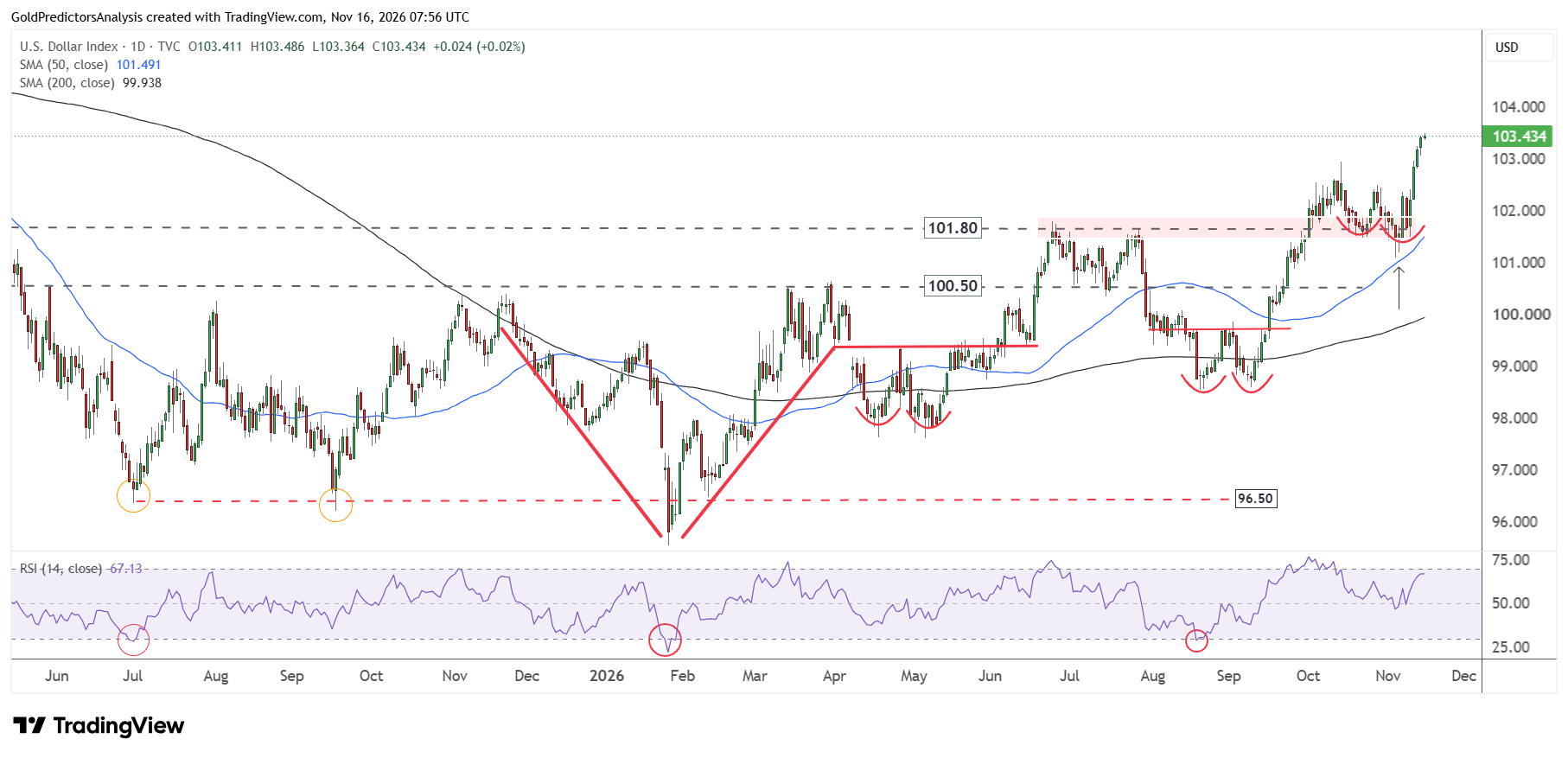
Copper prices continued to decline on Monday (November 16), hitting a more than four-month low. Since surging in September, copper prices have been under continuous pressure. Weak demand and another sell-off in technology stocks have jointly weighed on copper prices. Data showed that China's industrial output grew by 4.8% year-on-year in October, lower than September's 5.5% and also below market expectations of 5.3%.  The sluggish real estate market weakened demand for copper wire and other copper materials used in construction. However, the equipment manufacturing sector still grew by 10.6% year-on-year in October, providing some support for copper demand outside of construction. LME copper inventories increased by 3.9% last week to 329,100 tons; SHFE copper inventories decreased by 18.3% to 27,642 tons. The premium for imported copper in bonded warehouses rose to $290/ton. If domestic buyers begin restocking, the tight domestic spot supply is expected to support copper prices. A stronger dollar is suppressing copper prices, and the market is closely watching Nvidia's earnings report. The US Producer Price Index (PPI) rose 0.3% month-on-month in October, a significant decrease from the 1.4% increase in September; the PPI rose to 6.5% year-on-year, the highest since November 2022. The market expects a 92% probability of a Fed rate hike in December. Rising financing costs may postpone infrastructure and equipment purchases involving copper. On Monday, the US dollar index fluctuated around 103.40, maintaining its strength. The US dollar index previously showed a positive structure, forming a double bottom pattern at the 101.80 support level. In the short term, the strengthening dollar continues to suppress copper prices; even with low SHFE inventories, if the dollar continues to strengthen, copper prices will struggle to escape downward pressure.
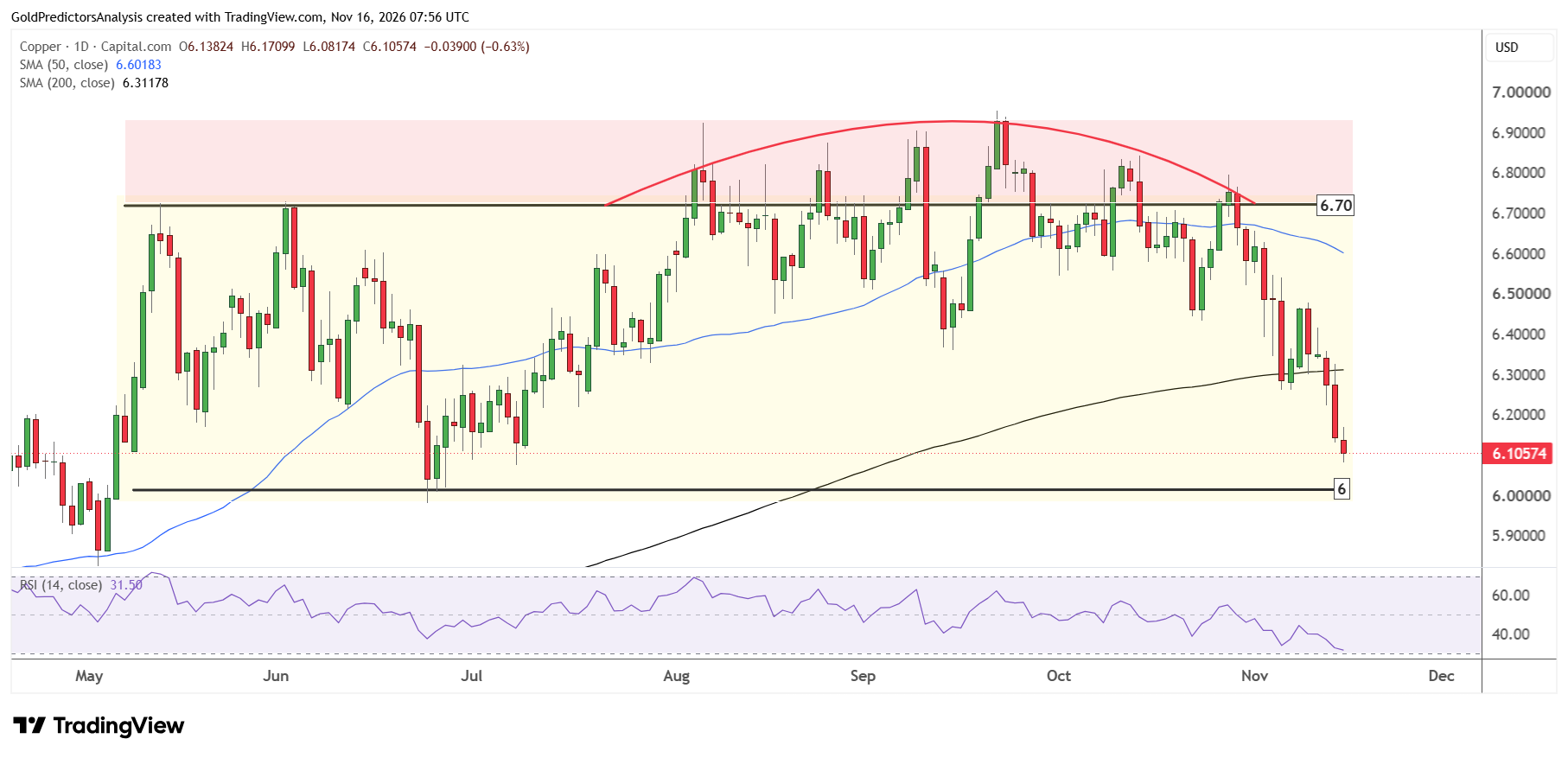
 Nvidia will release its earnings report this week. Copper is widely used in cabling and power equipment for AI data centers. One of the reasons for the recent copper price correction is market concerns about the demand outlook for AI data centers, triggering a sell-off in tech stocks. If the outlook for AI infrastructure is positive, it could drive a rebound in copper prices; conversely, if earnings guidance is weak, selling pressure on copper will intensify. Breaking below the 200-day moving average, copper prices are testing the $6 level . From a technical perspective, after breaking below the 200-day simple moving average, copper prices are approaching the lower support level around $6. This support range represents the lower boundary of a trading range formed since June 2026, during which time copper prices have generally traded between $6 and $6.95. A break below $6 would likely open up further downside potential. However, the Relative Strength Index (RSI) is approaching oversold territory, suggesting a possibility of a rebound from the $6 level.
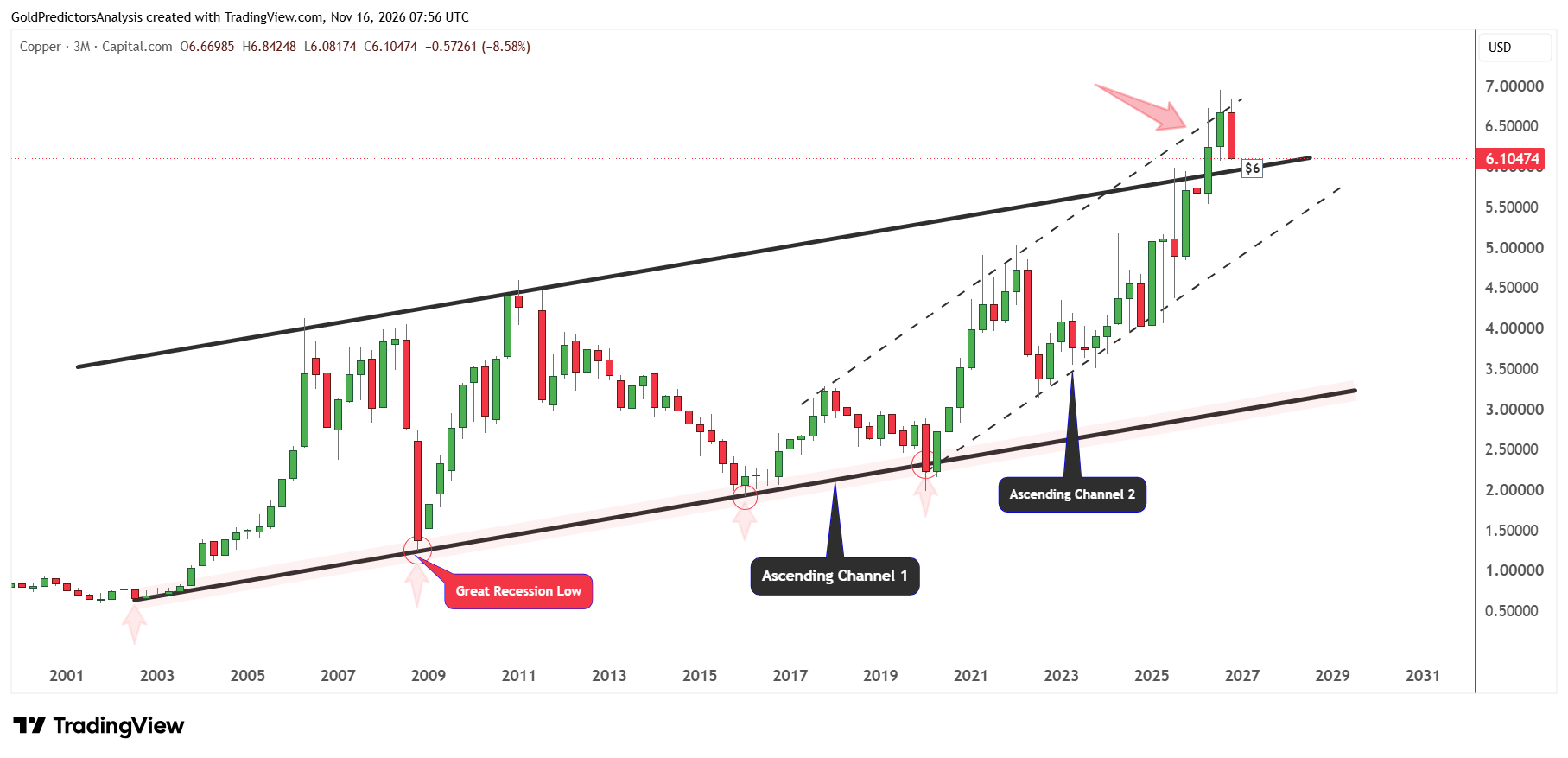
 The importance of $6 is also evident in the quarterly chart of copper prices: copper broke upwards through the ascending channel in the second quarter of 2026, reaching a high of $6.95 resistance. After encountering resistance at $6.95 within the second ascending channel, the price has currently retreated, retesting the previous breakout level of $6. If the $6 support holds, copper prices are expected to see a strong rebound; however, if it breaks down effectively, the price will target $5-$5.20, which is the support line of the second ascending channel.
 Summary Weakening demand in the manufacturing and construction sectors is putting downward pressure on copper prices in the short term. High oil prices, coupled with energy concerns, are fueling inflation worries. Markets are betting on a 25 basis point rate hike by the Federal Reserve in December, supporting a stronger dollar and higher US Treasury yields. The dollar index has stabilized above the key 100.50 level, with bullish momentum continuing. Copper prices have continued their decline after breaking below the 200-day moving average, currently facing key support at $6. If copper prices hold this level, coupled with optimistic earnings guidance from Nvidia, copper prices may see a recovery. However, a clear break below $6 support would target the $5.00–$5.20 support zone.
The sluggish real estate market weakened demand for copper wire and other copper materials used in construction. However, the equipment manufacturing sector still grew by 10.6% year-on-year in October, providing some support for copper demand outside of construction. LME copper inventories increased by 3.9% last week to 329,100 tons; SHFE copper inventories decreased by 18.3% to 27,642 tons. The premium for imported copper in bonded warehouses rose to $290/ton. If domestic buyers begin restocking, the tight domestic spot supply is expected to support copper prices. A stronger dollar is suppressing copper prices, and the market is closely watching Nvidia's earnings report. The US Producer Price Index (PPI) rose 0.3% month-on-month in October, a significant decrease from the 1.4% increase in September; the PPI rose to 6.5% year-on-year, the highest since November 2022. The market expects a 92% probability of a Fed rate hike in December. Rising financing costs may postpone infrastructure and equipment purchases involving copper. On Monday, the US dollar index fluctuated around 103.40, maintaining its strength. The US dollar index previously showed a positive structure, forming a double bottom pattern at the 101.80 support level. In the short term, the strengthening dollar continues to suppress copper prices; even with low SHFE inventories, if the dollar continues to strengthen, copper prices will struggle to escape downward pressure. Nvidia will release its earnings report this week. Copper is widely used in cabling and power equipment for AI data centers. One of the reasons for the recent copper price correction is market concerns about the demand outlook for AI data centers, triggering a sell-off in tech stocks. If the outlook for AI infrastructure is positive, it could drive a rebound in copper prices; conversely, if earnings guidance is weak, selling pressure on copper will intensify. Breaking below the 200-day moving average, copper prices are testing the $6 level . From a technical perspective, after breaking below the 200-day simple moving average, copper prices are approaching the lower support level around $6. This support range represents the lower boundary of a trading range formed since June 2026, during which time copper prices have generally traded between $6 and $6.95. A break below $6 would likely open up further downside potential. However, the Relative Strength Index (RSI) is approaching oversold territory, suggesting a possibility of a rebound from the $6 level. The importance of $6 is also evident in the quarterly chart of copper prices: copper broke upwards through the ascending channel in the second quarter of 2026, reaching a high of $6.95 resistance. After encountering resistance at $6.95 within the second ascending channel, the price has currently retreated, retesting the previous breakout level of $6. If the $6 support holds, copper prices are expected to see a strong rebound; however, if it breaks down effectively, the price will target $5-$5.20, which is the support line of the second ascending channel. Summary Weakening demand in the manufacturing and construction sectors is putting downward pressure on copper prices in the short term. High oil prices, coupled with energy concerns, are fueling inflation worries. Markets are betting on a 25 basis point rate hike by the Federal Reserve in December, supporting a stronger dollar and higher US Treasury yields. The dollar index has stabilized above the key 100.50 level, with bullish momentum continuing. Copper prices have continued their decline after breaking below the 200-day moving average, currently facing key support at $6. If copper prices hold this level, coupled with optimistic earnings guidance from Nvidia, copper prices may see a recovery. However, a clear break below $6 support would target the $5.00–$5.20 support zone.
- Risk Warning and Disclaimer
- The market involves risk, and trading may not be suitable for all investors. This article is for reference only and does not constitute personal investment advice, nor does it take into account certain users’ specific investment objectives, financial situation, or other needs. Any investment decisions made based on this information are at your own risk.