The Reserve Bank of Australia has ruled out a December rate hike, causing the Australian dollar to fall to a ten-month low against the US dollar.
2026-11-17 08:30:30
The Australian dollar fell to 0.6728 against the US dollar during Asian trading hours on Tuesday (November 17), hitting a new low since late January. Reserve Bank of Australia (RBA) Governor Bullock said on Tuesday that inflation risks remain skewed to the upside. Her comments came shortly before the release of the central bank's November meeting minutes. In a panel discussion at the ASIC annual forum in Sydney, Bullock stated that the committee's current view is that inflation risks remain skewed to the upside. This statement was brief but its timing was significant. Since the November decision, the market has priced in almost all the possibility of a December rate hike. Her comments suggest that the committee is not yet ready to announce the end of its tightening efforts. 
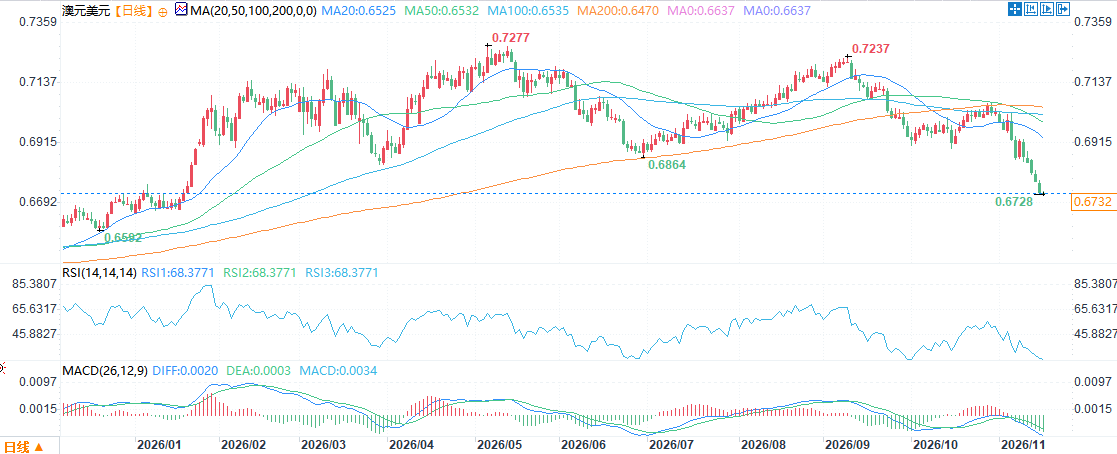 (Australian dollar against US dollar daily chart, source: EasyForex) At 8:17 Beijing time, the Australian dollar was trading at 0.6731/32 against the US dollar.
Background: The 6-3 vote and market assessment of "nearing the end of the cycle"
The Reserve Bank of Australia (RBA) raised the cash rate by 25 basis points to 4.85% on November 3, marking the fifth rate hike this year and the highest level since 2008. The vote was unusually divided: six members supported the rate hike, while three favored maintaining the rate at 4.60%. This disagreement led many analysts to conclude that the central bank is nearing the end of its cycle. The market's "cycle end" judgment is based on this voting disagreement, and Block's remarks are a mild rebuttal to this assessment—disagreement does not equate to an end, but merely indicates a higher threshold for further action.Key takeaways from the minutes: How to balance inflation and slowdown, the assessment of dissenters, and the threshold for further action.
The upcoming minutes should provide further insight into this debate. Analysts will be watching how the committee weighs inflation risks against a slowing economy, whether the three dissenters believe policy is already sufficiently restrictive, and how high the threshold for further action is now. The Reserve Bank of Australia's own assessment places the cash rate slightly above the upper end of its estimated neutral rate range; its forecasts indicate inflation will remain above 3% until the end of 2027. The value of the minutes lies in revealing the "nature of the disagreement"—if the three dissenters believe policy is already sufficiently restrictive, then the threshold for further rate hikes is high; if the disagreement is only about timing rather than direction, then the door to rate hikes remains open.The implication of Block's statement: a coexistence of a restrictive stance and reserved options.
Block's warning about upside risks coexists with this restrictive stance. The committee may determine that interest rates are currently high enough, but still wants to retain the option of further rate hikes in case inflation does not ease as expected. Block's statement is not a signal of an "imminent rate hike," but rather a reminder that a rate hike is not ruled out—it pushes back the market's pricing of an "almost complete exclusion of a December rate hike," but a single statement from a panel discussion is not enough to change pricing alone; the minutes will be a greater test.This week's schedule: Wage and employment data will test market sentiment.
The remainder of the week will be busy with domestic events. Third-quarter wage and price data will be released on Wednesday, and October employment data will be released on Thursday, with the unemployment rate expected to remain at 4.7%. Strong data from either source will test the market's belief that the Reserve Bank of Australia has completed its rate hike cycle. Block's comments have set a higher threshold for sensitivity to this week's data – strong wage or employment data would challenge market confidence in the "end of the cycle," potentially supporting the Australian dollar; weak data would see Block's warnings as a "hedging" rather than a "signal."in conclusion
Block indicated that inflation risks remain skewed to the upside. This statement came before the release of the November meeting minutes, which raised the cash rate to 4.85% by a 6-3 vote. The market had already priced in almost all of the possibility of a December rate hike, and Block's comments offered a mild reversal of that assessment—disagreement doesn't mean the end, it simply means the threshold for further action is higher. Key points to watch in the minutes include: how the committee weighed inflation against the slowdown, whether the three dissenters considered policy sufficiently restrictive, and the threshold for further action. The RBA's own assessment is that interest rates are slightly above the upper limit of the neutral range and inflation will remain above 3% until the end of 2027—Block's warning, coupled with this restrictive stance, suggests the committee may have determined that rates are already high enough but still retains the option to raise rates. This week's wage and employment data will test the market's belief in the "end of the cycle": strong data will challenge this belief and support the Australian dollar; weak data will render Block's warning a hedge. (Australian dollar against US dollar daily chart, source: EasyForex) At 8:17 Beijing time, the Australian dollar was trading at 0.6731/32 against the US dollar.
- Risk Warning and Disclaimer
- The market involves risk, and trading may not be suitable for all investors. This article is for reference only and does not constitute personal investment advice, nor does it take into account certain users’ specific investment objectives, financial situation, or other needs. Any investment decisions made based on this information are at your own risk.