Gold Trading Alert: Gold prices hit a one-year low as the dollar, US Treasury yields, and interest rate hike expectations exert triple downward pressure. Are the bulls' tough times just beginning?
2026-11-17 08:00:30
The gold market is undergoing a significant "stress test." As the US dollar index surged to its highest level since April 2025 and expectations for a December rate hike by the Federal Reserve continued to rise, gold prices fell to their lowest point in over a year on Monday (November 16). Spot gold briefly touched $3,832.36 per ounce, its lowest level since October 2025, before recovering to around $3,856.24. US gold futures for December delivery also fell 0.9% to $3,853. On the surface, this appears to be a normal correction driven by a stronger dollar and interest rate expectations; however, at a deeper level, persistent inflation, a hawkish stance from the Federal Reserve, high bond yields, and geopolitical risks are intertwined, reshaping the market's pricing logic for gold. On Tuesday (November 17) in early Asian trading, spot gold traded in a narrow range, currently hovering around $3,860 per ounce. 
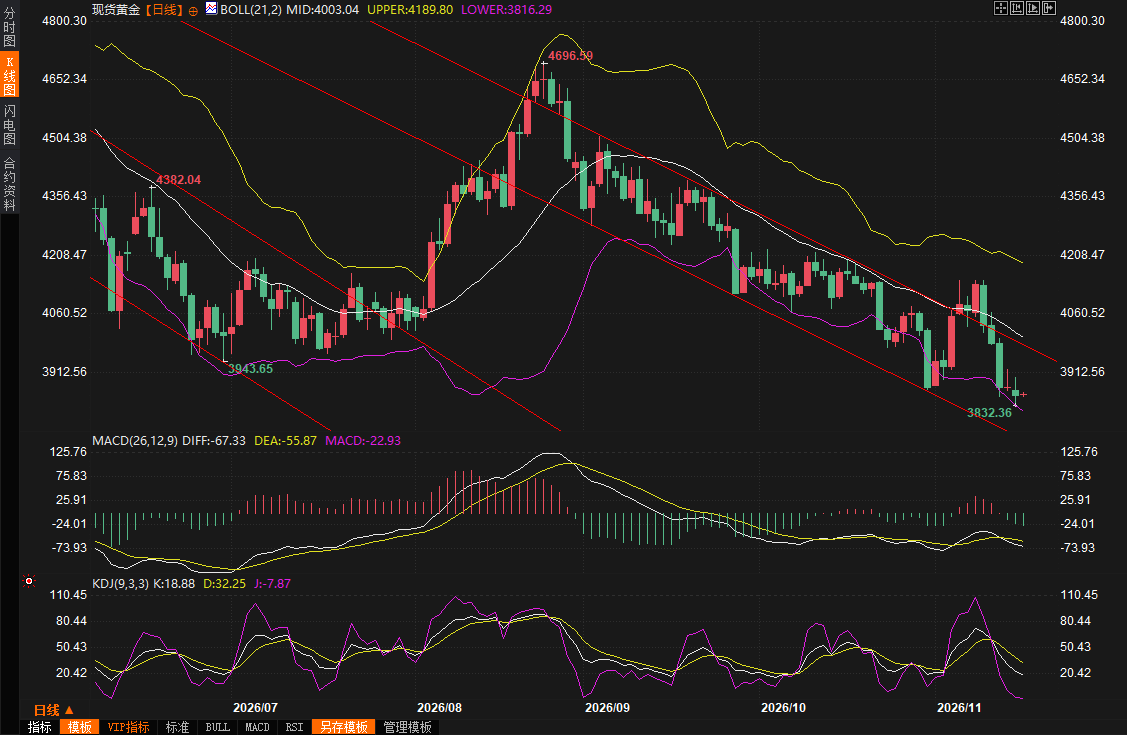 (Spot gold daily chart, source: FX678) At 07:55 Beijing time, spot gold is currently trading at $3863.54 per ounce.
I. Gold prices fall below a more than one-year low: The dollar and interest rates exert double pressure.
From a technical perspective, the recent decline in gold prices is not due to a single factor, but rather a result of the combined effects of the US dollar and interest rate expectations. Spot gold fell 0.6% on Monday, closing at $3856.24 per ounce, after hitting a low of $3832.36 during the session. This price level is not only the lowest since October 2025, but also signifies that the previously accumulated safe-haven premium in the market is being rapidly squeezed out. US gold futures also weakened, with the December contract closing down 0.9% at $3853 per ounce. The simultaneous decline in both futures and spot prices indicates that the selling pressure is not a localized technical adjustment, but rather a result of macroeconomic pricing logic at work. Peter Grant, Vice President and Senior Precious Metals Strategist at Zaner Metals, points out the core contradiction: last week's inflation data reflected that inflation levels remained high, which exacerbated market expectations of a December rate hike, thereby pushing up bond yields and the dollar exchange rate. All these factors combined put pressure on gold. Gold itself does not generate interest; when bond yields rise and the dollar strengthens, the opportunity cost of holding gold increases significantly. For non-dollar investors, a stronger dollar will directly increase the cost of holding gold, further weakening demand. Therefore, the recent drop in gold prices to a more than one-year low is essentially a concentrated suppression of non-interest-bearing assets by a strong dollar and high interest rate expectations.II. Stubborn Inflation and the Fed's Hawkish Stance: How December Rate Hike Expectations Were Suppressing Gold Prices
The immediate trigger for this round of gold price declines was the strengthening market bets on a December rate hike by the Federal Reserve. Last week's release of stronger-than-expected US October consumer price inflation further solidified market expectations for a Fed rate hike next month. According to the CME Group's FedWatch tool, traders now expect a 100% probability of a December rate hike, with a 95.7% probability of a 25 basis point hike and a 4.3% probability of a 50 basis point hike. This means the market has almost already priced in the baseline scenario of a 25 basis point rate hike in December, making it difficult for gold to attract sustained buying interest under such expectations. More importantly, hawkish statements from Fed officials continue to reinforce this expectation. Kansas City Fed President Schmid stated on Sunday that inflation remains too high and more measures are needed to curb price pressures; San Francisco Fed President Daly recently pointed out that persistent service sector inflation is a reason to support further rate hikes; Cleveland Fed President Hammark, while reiterating that the Fed is not yet ready to shift to a more aggressive rate hike path, also acknowledged the increasing inflationary pressures. The overall signal from officials is that inflation has not yet returned to a reassuring level, and monetary policy needs to remain restrictive. For gold, this means that real interest rate expectations are unlikely to decline, and real interest rates are one of the most important anchors in gold's medium- to long-term pricing. The market had expected Fed Chairman Warsh's speech to provide a clearer signal on the interest rate path, but Warsh on Monday focused more on the significant impact of emerging technologies on the economy, pointing out that they could either accelerate economic growth and benefit a wide range of people, or lead to increased unemployment, or even trigger an economic slowdown if expected investment returns are disappointing. Such statements did not provide clear "dovish reassurance" for gold, so market attention shifted to the minutes of the Fed's October 27-28 policy meeting released on Wednesday, hoping to find more clues about the future interest rate path. Before the release of the minutes, gold bulls clearly lacked sufficient catalysts.III. The US Dollar Index hits its highest level since April 2025: a double whammy of holding costs and capital flows.
The US dollar has been an undeniable amplifier in the recent decline in gold prices. The dollar index rose 0.17% to 103.58 on Monday, briefly touching 103.68, its highest level since April 2, 2025. The background to the dollar's strength is not complicated: robust US economic growth and strong stock market performance have restored some of the attractiveness of US assets; while high inflation data last week and market bets on further interest rate hikes by the Federal Reserve have continued to boost the dollar in recent trading days. Previously, after US President Trump announced the "Liberation Day" tariffs last April, the market was initially concerned about a decline in the attractiveness of US assets, causing a sharp drop in the dollar. However, the resilience of the US economy and stock market subsequently propelled the dollar's recovery, and now the dollar has returned to a strong position. The dollar's strength puts downward pressure on gold on two levels. The first level is the pricing effect: gold is priced in US dollars, and a stronger dollar increases the purchasing costs for holders of other currencies, thus suppressing some physical and investment demand. The second level is capital flows: when the yield on dollar assets increases and the dollar itself is in a strong cycle, global funds tend to flow into interest-bearing assets such as dollar deposits and US Treasury bonds, rather than holding non-interest-bearing gold. Macro Hive researcher Benjamin Ford noted that given inflation remains at uncomfortable levels and the possibility of a surprisingly hawkish stance from the Federal Reserve in 2027, it seems possible for the euro to reach 1.08 against the dollar by the end of the year. This expectation of a continued strong dollar means that gold still faces headwinds in terms of exchange rates.IV. Signals from the Bond and Oil Markets: Why Did Falling Yields Failing to Save Gold?
U.S. Treasury yields fell on Monday, which should have provided support for gold, but the reality was more complex. The 10-year Treasury yield fell 3.2 basis points to 5.121%, the 30-year yield fell 1.5 basis points to 5.466%, and the 2-year Treasury yield, which typically moves in tandem with the Federal Reserve's interest rate expectations, fell 5.1 basis points to 4.823%. One reason for the yield decline was that a drop of more than 3% in oil prices somewhat eased inflation concerns. Signs of a recovery in oil shipments through the Strait of Hormuz boosted market expectations of oversupply, and the International Energy Agency also stated last Friday that the global oil market would return to a state of oversupply in the fourth quarter of this year. However, the problem is that Monday's yield decline does not change the fact that yields remain high overall after last week's sharp rise. Last week, bond yields surged as traders increased their belief that the Federal Reserve might raise rates by an unusually large 50 basis points in December, or by 25 basis points each at the next three meetings, with the 2-year Treasury yield even recording its largest weekly increase in two years. For gold, what truly matters is not a few basis points drop in daily yields, but whether the central yield level has risen. As long as 2-year and 10-year yields remain high, the opportunity cost of holding gold remains high, making it difficult for gold prices to achieve a sustained valuation recovery. Furthermore, the bond market has seen some "safe haven" or "seeking quality assets" trends, with clients buying bonds and the decline in the US stock market providing slight support for the bond market through safe-haven buying. This indicates that when geopolitical risks and uncertainty in the US stock market rise, funds prioritize US Treasuries and the US dollar over gold. Gold's safe-haven function has not failed, but in a high-interest-rate environment, interest-bearing assets are more attractive to safe-haven funds, temporarily relegating gold to a lower position in the safe-haven ranking.V. Escalating Geopolitical Risks: Why Safe-Haven Buying Fails to Overcome Macroeconomic Pressures
The current geopolitical situation is far from calm, and could even be described as fraught with risk events. Regarding the Strait of Hormuz, the UK's Office for Maritime Trade Operations received reports that an oil tanker transiting the Strait of Hormuz was attacked, losing power and experiencing a fire in its engine room. The crew has been confirmed safe, but the extent of the damage and the environmental impact are still unclear. Regarding the Russia-Ukraine conflict, Ukraine launched its largest drone attack against Russia since the outbreak of the full-scale war in 2022. The Russian Ministry of Defense stated that it shot down 1,336 Ukrainian drones in 16 regions, exceeding the 1,254 drones shot down on October 29th. The mayor of Moscow stated that approximately 600 drones flew towards the Moscow region, of which 191 were shot down. The Crimean Bridge was also among the targets, with Russia stating that the damage to the bridge was minor. Fires broke out at four industrial sites in Azov, Rostov region, and at an industrial facility in Ilyskyi, Krasnodar region. Debris from a fallen drone injured six people, including children. Two industry sources also indicated that Ukraine's renewed drone attacks on Russian oil refineries have reduced Russian refining capacity by approximately 30%. Traditionally, these geopolitical risks should have triggered safe-haven buying of gold. However, gold prices fell on Monday, indicating that the dominant market driver is not geopolitical risks, but rather the US dollar and interest rates. Geopolitical conflicts can indeed push up oil prices and exacerbate inflation concerns, which in turn strengthen expectations of Fed rate hikes, ultimately suppressing gold through the interest rate channel. In other words, the positive impact of geopolitical risks on gold is impulsive and emotional, while the suppression of gold by the US dollar and interest rates is trend-based and structural. Unless geopolitical conflicts escalate to a level sufficient to alter global risk appetite and the Fed's policy path, gold is unlikely to reverse its weakness solely based on safe-haven demand.VI. Market Outlook: Three Key Factors – Speeches by Federal Reserve Officials, Meeting Minutes, and Risk Appetite
The gold market needs to focus on several key clues going forward. The first is the Federal Reserve's policy signals, including subsequent speeches by Fed officials and the minutes of the Fed's October 27-28 policy meeting released on Wednesday. The market hopes to glean more clues about the interest rate path from these documents. If the minutes are hawkish, further strengthening expectations of a December rate hike and even subsequent hikes, gold prices may continue to be under pressure, potentially retesting the lows around $3830. Conversely, if the minutes or official statements show a marginally dovish stance, a decline in the dollar and yields could provide a technical rebound opportunity for gold. The second key factor is inflation and oil prices. While a more than 3% drop in oil prices has temporarily eased inflation concerns, the attack on oil tankers in the Strait of Hormuz reminds the market that supply risks have not disappeared. If oil prices rebound, inflation and rate hike expectations may rise again, leading to a more complex game for gold. The third factor is risk appetite. Traders will be watching Nvidia's third-quarter results released on Tuesday and Anthropic's listing this week for clues about investor risk appetite. Safe-haven buying driven by the decline in US stocks is currently flowing more into bonds. Whether gold can regain favor among safe-haven funds if stock market volatility intensifies remains to be seen, depending on whether the US dollar weakens in tandem.In summary, gold prices will continue to be pressured by a strong dollar and high interest rates in the short term.
In summary, the drop in gold prices to a more than one-year low is a result of the combined effects of persistent inflation, a hawkish Federal Reserve, a strong dollar, and high bond yields. While geopolitical risks are numerous—the attacks on oil tankers in the Strait of Hormuz and the large-scale drone strikes in Ukraine serve as reminders of lingering market uncertainty—under the current pricing framework, safe-haven demand cannot withstand the pressure of a strong dollar and high interest rates. Gold's medium- to long-term safe-haven and allocation value has not disappeared, but in the short term, it remains in an unfavorable environment of a strong dollar, high interest rates, and persistently high expectations of rate hikes. If the dollar index continues to hold above 103, the upside potential for gold prices is likely to be limited; if the FOMC minutes are hawkish or retail sales data are strong, gold prices may retest the support level around $3830; only if the dollar weakens, inflation expectations cool, or the Fed's signals become more dovish can gold expect a significant recovery. For the market, the real focus now is not on a single geopolitical headline, but on the triangular relationship between the dollar index, the 2-year US Treasury yield, and expectations of a December rate hike. These three factors will determine whether gold can truly recover from its more than one-year low. (Spot gold daily chart, source: FX678) At 07:55 Beijing time, spot gold is currently trading at $3863.54 per ounce.
- Risk Warning and Disclaimer
- The market involves risk, and trading may not be suitable for all investors. This article is for reference only and does not constitute personal investment advice, nor does it take into account certain users’ specific investment objectives, financial situation, or other needs. Any investment decisions made based on this information are at your own risk.