Bank of America issues warning! The rapidly strengthening US dollar is becoming a disruptor; AI and energy structure are supporting the dollar.
2026-11-17 20:32:32
The US dollar has been surging recently, reaching its strongest level in a year and a half, and this accelerated rise has alarmed many investors. The core drivers of this dollar strength, besides the persistent geopolitical energy inflation, include the relative resilience of the US economy and the continued inflow of overseas funds into the US market driven by the AI capital boom. However, concerns are also growing – Bank of America strategists warn that if the dollar continues its rapid rise, it could become a "disruptive ball" in the market, bringing even greater volatility to the already volatile stock market. According to FactSet data, the ICE Dollar Index (DXY) rose above 103 on Monday, reaching its highest intraday level since April 2, 2025. Emily Roland, co-chief investment strategist at Manulife Investments, pointed out that the Fed's continued interest rate hike expectations and the significantly stronger US economic fundamentals compared to overseas markets are the two pillars supporting the dollar's rise. The strengthening dollar essentially corresponds to higher global financing costs, putting downward pressure on most risk assets. 
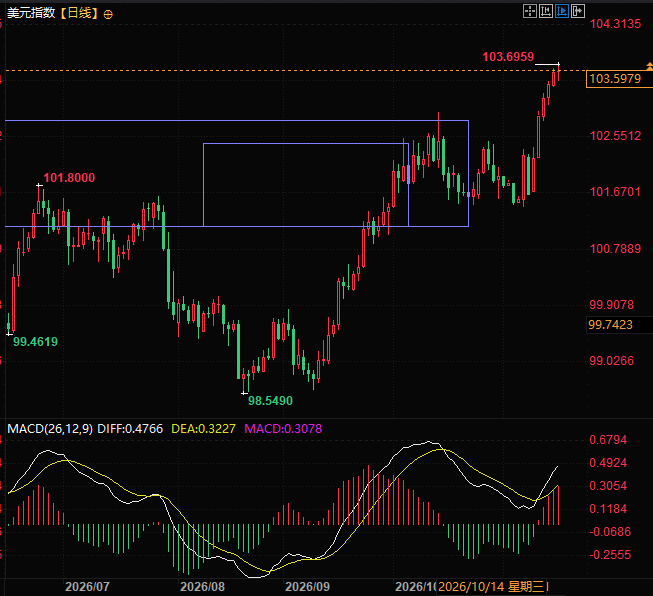 (US Dollar Index Daily Chart, Source: FX678) At 20:29 Beijing time, the US Dollar Index is currently at 103.58.
Economic divergence under energy inflation: the US is naturally more resilient to shocks
Energy inflation is impacting the world indiscriminately. Rising oil prices increase production costs in importing countries and squeeze real incomes. Europe, Japan, South Korea, and many emerging markets, constrained by energy imports, will face rapidly amplified growth pressures. Research from the Dallas Federal Reserve indicates that a similar oil price shock would only drag down US real GDP by one-sixth of that in other economies, far lower than levels seen in the 1980s. Thanks to its unique industrial and energy structure, the drag on US economic growth is relatively limited. On one hand, the shale revolution has made the US a net energy exporter; high oil prices increase profits for domestic oil and gas companies. Capital expenditures and export revenues in the energy sector can offset some of the pressure on consumption. Goldman Sachs also notes that the profits from rising oil prices remain with domestic producers and investors, rather than flowing outwards. On the other hand, the US economy is shifting towards asset-light sectors such as technology, services, and finance, with energy consumption per unit of GDP far lower than in traditional industrial economies, and energy costs representing a smaller proportion of overall corporate costs. This shift in energy structure has reshaped the transmission logic of oil prices and exchange rates, further widening the growth gap under energy shocks and attracting continuous capital inflows into the US, becoming one of the underlying supports for the appreciation of the US dollar.Asset allocation patterns in a strong dollar environment
Manulife's team reviewed the long-term correlation between the US dollar and various assets, and the conclusion is clear: most assets are negatively correlated with the US dollar, and these assets tend to weaken when the dollar rises. Crude oil and the energy sector are among the few assets with a weak positive correlation to the dollar. In terms of asset allocation, Roland's view is clear: during a period of dollar strength, US stocks outperform overseas markets. In an environment of tightening financial conditions, high-quality large-cap US stocks with solid balance sheets are more resilient to risk. At the same time, a strong dollar will increase the debt burden of overseas companies on dollar-denominated bonds, and economies with depreciating currencies will face significantly increased debt repayment pressure. Goldman Sachs' strategy team also observed a new feature: the correlation between the dollar's performance and AI sector stock prices has significantly increased; regardless of market conditions, the correlation between the two persists. Capital inflows into the AI industry have become a new main driver influencing the strength of the US dollar.US Dollar Trend Outlook and Potential Turning Point
In terms of time comparison, the US dollar index weakened significantly in 2025, recording one of its worst years in history; while this year, the market reversed course, with the AI boom coupled with rising US interest rates jointly boosting the dollar's attractiveness. Goldman Sachs predicts that the dollar's appreciation trend is likely to continue until 2027, although the rate of increase will gradually slow down. AI is a key engine of this round of dollar appreciation. Roland mentioned that if the pace of data center construction slows down, the dollar's upward momentum will also weaken. Tom Essaye of Sevens Report Research added that expectations of further interest rate hikes by the Federal Reserve will continue to support the dollar. Currently, US stocks have not been significantly impacted, but there are clear risk thresholds in the market. Essaye believes that once the dollar index stabilizes above 105, the negative effects of a strong dollar will begin to appear, thus suppressing the US stock market. Whether the dollar will continue to rise moderately or accelerate its rise and become a market disruptor, the DXY105 level will be a crucial observation point. (US Dollar Index Daily Chart, Source: FX678) At 20:29 Beijing time, the US Dollar Index is currently at 103.58.
- Risk Warning and Disclaimer
- The market involves risk, and trading may not be suitable for all investors. This article is for reference only and does not constitute personal investment advice, nor does it take into account certain users’ specific investment objectives, financial situation, or other needs. Any investment decisions made based on this information are at your own risk.