With a Fed rate hike almost certain and easing seemingly a distant prospect, where is the bottom for gold?
2026-11-18 08:30:33
Spot gold traded slightly lower in early Asian trading on Wednesday, currently hovering around $3,830 per ounce. The precious metal remained on a downward trend after falling to a one-year low the previous day, pressured by a stronger dollar and rising US Treasury yields. Traders await the release of the Federal Reserve's October meeting minutes later on Wednesday for clues about the size and timing of expected interest rate hikes. 
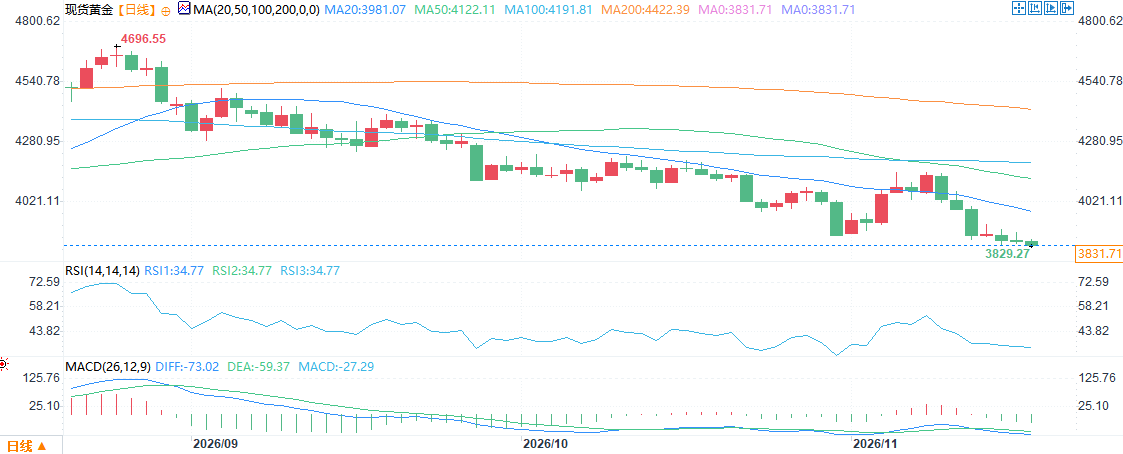 (Spot gold daily chart, source: FX678) At 8:26 Beijing time, spot gold was trading at $3,833.24 per ounce.
Interest Rate Expectations: 95.7% probability of a 25 basis point rate hike in December; officials support multiple rate hikes.
The dollar edged lower but remained near a 19-month high, while the benchmark 10-year Treasury yield climbed on expectations of more aggressive rate hikes. St. Louis Fed President Musaleem said on Tuesday he supports multiple rate hikes in the coming months; Cleveland Fed President Hammark said she prefers small, steady rate hikes, but the central bank may need to consider larger actions if inflation worsens. According to the CME FedWatch tool, the market is currently pricing in a near 95.7% probability of a 25 basis point rate hike in December and a 4.3% probability of a 50 basis point hike. The rate hike has shifted from "whether" to "almost certain," and the 95.7% pricing means gold has already fully priced in a December action—the remaining variables are "whether there will be a larger hike" and "the subsequent path," not December itself; higher interest rates are generally detrimental to gold, which does not pay interest.Institutional View: Precious metals remain biased to the downside, with the Shanghai Futures Exchange adding additional selling pressure.
An analyst wrote in a report, "Precious metals remain biased to the downside as further tightening by the Federal Reserve is priced in," adding that gold is facing more near-term selling pressure from traders on the Shanghai Futures Exchange. The decline in gold is driven not only by macroeconomic factors such as "interest rate expectations" but also by microeconomic factors such as "positioning and geography"—the selling by Shanghai Futures Exchange traders indicates that the selling pressure originates from multiple sources, rather than a single channel of the US dollar or yield.ING Analysis: Slight rebound rather than a reversal; weakness in technology stocks also drags down gold.
ING analysts noted that gold "rose slightly this morning after falling to its lowest close since September 2025 in the previous session," rebounding only slightly after a "sharp sell-off" driven by "stubborn US inflation, rising US Treasury yields, and expectations that the Fed will maintain tightening for longer." They added that "attention is now turning to the Fed's October meeting minutes for further clues about the interest rate outlook," with policy signals likely to shape gold's near-term movement. The bank also pointed out that "weakness in tech stocks has recently dragged down gold as investors reduced their positions to cover other losses," while emphasizing that "the prospect of further tightening by the Fed remains a headwind for precious metals." Overall, the bank expects "gold to remain volatile in the near term, with the direction of US Treasury yields and the dollar likely to remain key drivers." Gold's current rebound lacks fundamental support—it is more of a technical correction after overselling than a trend reversal; the weakness in tech stocks dragged down gold through the "liquidity channel" (investors selling gold to cover other losses), contrary to the traditional safe-haven logic of "stocks falling, gold rising."Williams' speech: Hawkish but said no "dramatic action" needed.
New York Fed President Williams emphasized that the economy is "strong and strengthening," while "inflation is not moving in the right direction" and is "stubbornly high." Coupled with statements about the spillover effects of tariffs and energy shocks onto broader inflation data, this points to a tendency towards further tightening or at least an extension of the restrictive stance. However, his statement that the situation does not require "dramatic policy action" softened the hawkish signal—suggesting incremental action or an extension of the current stance rather than a radical shift, a context that typically supports the dollar against lower-yielding currencies. Williams' "no dramatic action" sets an upper limit on hawkish signals—it means the Fed is more likely to "tighten gradually" rather than "raise rates sharply," which makes the downward pressure on gold gradual rather than precipitous, but also means the timing of easing is further away.in conclusion
Gold is currently trading around $3,840, continuing its downward trend after falling to a one-year low the previous day, pressured by a stronger dollar and rising US Treasury yields. The probability of a 25 basis point rate hike in December is approximately 95.7%. Musalaim supports multiple rate hikes in the coming months, while Hammark prefers small, stable rate hikes but stated that a larger hike might be considered if inflation worsens. Some institutions point out that as further tightening by the Fed is priced in, precious metals remain biased downwards, with Shanghai Futures Exchange traders adding additional selling pressure. Another institution states that gold has only seen a slight rebound rather than a reversal, with weakness in tech stocks dragging down gold through "loss-cutting," and yields and the dollar remaining key drivers. Williams' hawkish remarks, while not mentioning the need for "dramatic action," set an upper limit for hawkish signals: the Fed is more likely to tighten gradually rather than raise rates sharply, making the downward pressure on gold gradual rather than precipitous, but the timing of easing is further away. The focus now shifts to Wednesday's FOMC meeting minutes—policy signals will determine whether gold can stabilize around $3,850 or test lower levels. (Spot gold daily chart, source: FX678) At 8:26 Beijing time, spot gold was trading at $3,833.24 per ounce.
- Risk Warning and Disclaimer
- The market involves risk, and trading may not be suitable for all investors. This article is for reference only and does not constitute personal investment advice, nor does it take into account certain users’ specific investment objectives, financial situation, or other needs. Any investment decisions made based on this information are at your own risk.