Gold Trading Alert: The Fed's hawkish stance makes a December rate hike almost a certainty! Will gold prices fall further? Pay attention to the meeting minutes.
2026-11-18 08:02:33
Spot gold struggled to break free of its low-level consolidation pattern throughout Tuesday's (November 17th) trading session, fluctuating within a narrow range of $3837 to $3890, failing to mount a significant rebound and ultimately closing down only 0.18% at $3849.17 per ounce. February-delivery gold futures in New York also performed modestly, rising 0.2% to settle at $3864.2. On the surface, gold prices seem to have halted their downward trend; however, a deeper analysis reveals that the dollar is near a 19-month high, the 10-year US Treasury yield remains firmly above 5%, and the probability of a Fed rate hike in December is as high as 100%. These three forces are suppressing the non-yielding gold price, making it difficult for it to rise. In early Asian trading on Wednesday (November 18th), spot gold traded in a narrow range, currently hovering around $3850 per ounce. 
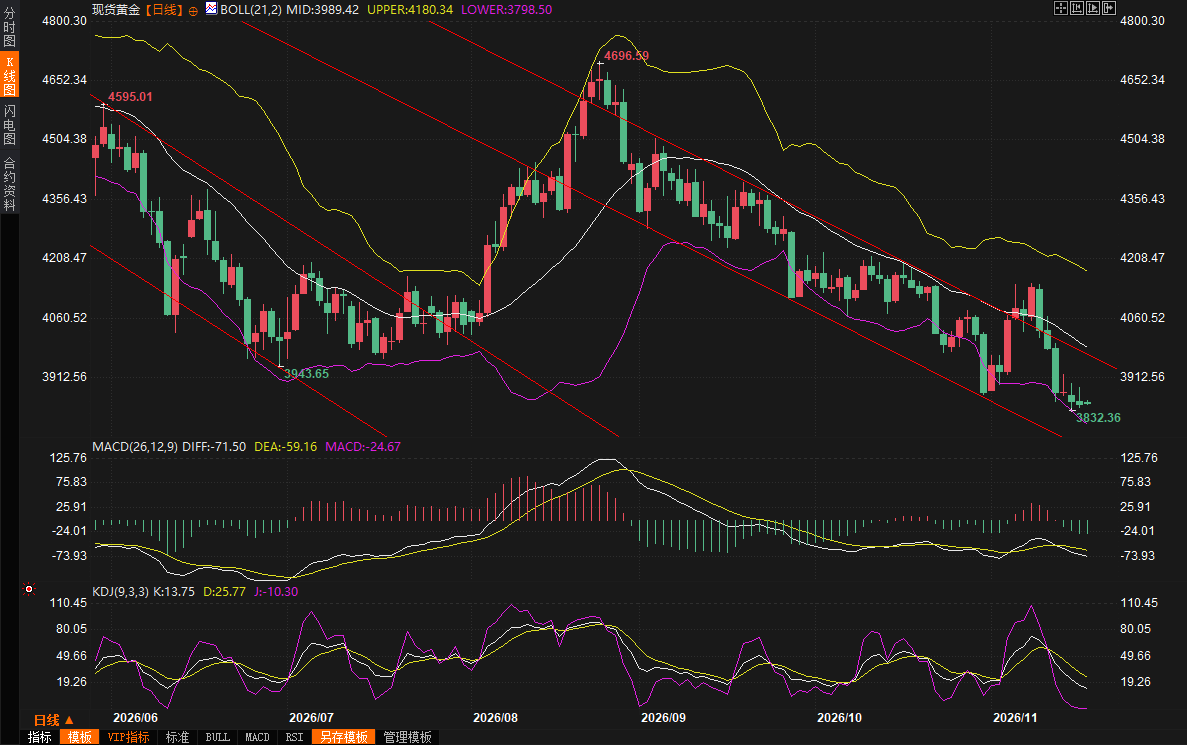 (Spot gold daily chart, source: FX678) At 07:58 Beijing time, spot gold is currently trading at $3852.06 per ounce.
With risk-free rates soaring, gold's "value for money" has been completely overshadowed.
The core logic supporting the long-term weakness in gold prices is actually not complicated. The 10-year US Treasury yield has firmly held above 5.1%, and although it slightly retreated to around 5.103% on Tuesday due to the weakness in the stock market, it is still at a high level overall. At the same time, the US dollar index, after hitting a 19-month high, has retreated somewhat but still holds above 103.5, just a step away from its peak since April 2025. Faced with a risk-free rate of return close to or even higher, gold, which does not generate any interest, has almost no advantage in asset allocation. CMS Prime COO Terry-Lee Bennett put it bluntly: when the market can easily obtain a certain return of more than 5%, gold, as a zero-interest asset, has no chance of winning. To make matters worse, the recent sharp sell-off in artificial intelligence concept stocks has further exacerbated the pressure. When investors rush to cash out, they often prioritize liquidating the most liquid assets, thus turning gold into "liquidable collateral," and its safe-haven attributes are temporarily shelved.With Federal Reserve officials making a flurry of statements, a December rate hike is almost a certainty.
The market is closely watching the upcoming release of the Federal Reserve's October meeting minutes for further clues about the pace and magnitude of interest rate hikes. Currently, the CME Group's FedWatch tool shows approximately a 96% probability of a 25 basis point rate hike in December and about a 4% probability of a 50 basis point hike. Officials' statements have further reinforced this expectation. St. Louis Fed President Musaleem explicitly stated that to truly control persistently high inflation, the Fed may need to raise rates multiple times and should act quickly to prevent the problem from worsening. New York Fed President Williams took a more dovish stance, acknowledging that inflation remains stubborn, the economy is resilient, and the job market remains robust, therefore further rate hikes may still be necessary. However, he emphasized that "drastic action" is not currently needed, and the policy path over the past few months has worked well. Cleveland Fed President Hamak offered a different perspective, calling on the Fed to establish principles in advance so that it can intervene in the Treasury market temporarily and in a targeted manner when market pressures arise, learning from the lessons of the turmoil in 2020 and 2025. These statements all point in the same direction: the Federal Reserve will maintain a hawkish stance in the short term, and the upside risk to policy rates has not completely subsided.Economic data is mixed, with both resilient consumption and sticky inflation.
U.S. retail sales data released Tuesday showed an overall month-on-month increase of only 0.2%, in line with market expectations. However, core retail sales, excluding items such as automobiles, grew by 0.6%, and September's data was significantly revised upwards. This indicates that although high inflation is eroding the purchasing power of low- and middle-income households, consumers are still maintaining a certain level of consumption by adjusting their spending patterns. Meanwhile, import prices rose by 1.1%, significantly exceeding expectations, further confirming that inflationary pressures have not truly eased. Manufacturing output grew by 0.3% for the second consecutive month, with significant contributions from artificial intelligence-related sectors. These data show that the U.S. economy maintains some momentum at the beginning of the fourth quarter, and also reinforce the market's belief that the Federal Reserve is unlikely to shift to easing in the short term. Goldman Sachs even accordingly raised its fourth-quarter GDP growth forecast. The coexistence of resilient consumption and sticky inflation makes it difficult for interest rate expectations to fall quickly, thus continuing to suppress gold prices.Geopolitical conflicts continue to escalate, but the demand for safe-haven assets has not been effectively released.
The situation in the Middle East remains volatile. The US and Iran exchanged attacks again on Tuesday, with Iran claiming to have attacked a US radar system in Bahrain, while the US retaliated by striking an Iranian missile launch site. Increased attacks on oil tankers near the Strait of Hormuz have supported oil prices. Despite talks between Iran and mediators including Qatar and Oman, significant differences remain between the two sides, and the conflict, which has lasted nearly nine months, shows little sign of a substantial easing in the short term. Normally, this level of geopolitical risk should support demand for gold as a safe-haven asset. However, the reality is that geopolitical tensions are supporting oil prices, increasing inflation concerns and supporting expectations of a Federal Reserve rate hike. The strength of the US dollar and high US Treasury yields have completely overshadowed the safe-haven premium. Gold, in the current environment, appears to be a "trapped" asset—risk events exist, but funds are more inclined to flow to the US dollar and US Treasuries than to metals.Focus on technology stocks
Artificial intelligence (AI) and technology stocks have recently been sold off, impacted by the sudden departure of Nvidia's CEO, the Democratic Party's landslide victory in the US midterm elections, and market concerns about debt-driven AI infrastructure expansion. This has dampened risk appetite and made investors nervous. Further market volatility could see investors seeking safe havens, potentially benefiting the US dollar in the short term; however, a more lasting impact on the AI trade that dominates the US market could weaken demand for the dollar. Corpay's Schamotta stated, "AI trades have been one of the main magnets attracting foreign capital inflows into US assets. If this trade slowly recedes over time, investors will no longer be asking 'Where should I go for safety?' but rather 'Why am I so heavily overweight in US assets?'" Following Nvidia's conference call on Tuesday, Nvidia shares rose more than 4% in after-hours trading, driving up US stock index futures. S&P 500 futures rose 0.7%, and Nasdaq futures rose 1.33%, potentially weakening safe-haven demand for the dollar in the short term and providing an opportunity for a rebound in gold prices.There may be a short-term technical rebound, but the trend has not yet reversed.
Looking ahead, gold prices are likely to remain range-bound in the short term. If the Federal Reserve meeting minutes released on Wednesday show that concerns about economic growth are just as strong as concerns about inflation within the committee, the market may lower its expectations for a significant interest rate hike, putting some pressure on the dollar and triggering a technical rebound in gold prices. However, as long as the 10-year US Treasury yield remains above 5% and the dollar index continues to approach its highs, gold prices will find it difficult to truly break free from this pressure. The current bottoming process is more like a patient war of attrition, and bulls need to wait for clearer signs of easing in the macroeconomic environment before they can regain the initiative. (Spot gold daily chart, source: FX678) At 07:58 Beijing time, spot gold is currently trading at $3852.06 per ounce.- Risk Warning and Disclaimer
- The market involves risk, and trading may not be suitable for all investors. This article is for reference only and does not constitute personal investment advice, nor does it take into account certain users’ specific investment objectives, financial situation, or other needs. Any investment decisions made based on this information are at your own risk.