Institutions: The UK economy is under short-term pressure and slowing down, but is expected to accelerate and strengthen again in the second half of next year.
2026-11-18 11:26:30
The UK economy outperformed economists in 2026, but will face multiple headwinds in the coming months. Goldman Sachs research predicts that, driven by strong business investment, improved productivity, and lower energy prices, UK GDP growth will accelerate again in the second half of 2027, with full-year growth still exceeding market expectations.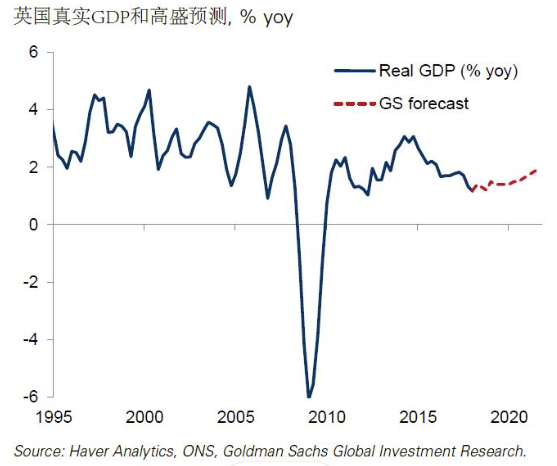
The growth pace initially slowed but then rebounded, with the full-year growth rate exceeding market consensus expectations.
In a report, Goldman Sachs' senior UK economist James Moberly and chief European economist Jari Stehn stated that there are ample reasons to be optimistic about the UK economic outlook for 2027. The institutions predict that UK real GDP growth in the fourth quarter of 2027 will be 1.4%, a slight decrease from the 1.6% forecast for 2026, but higher than the consensus forecast of 1.2% among market economists. The UK economy demonstrated unexpected resilience in 2026; even as the energy shock pushed up inflation, forcing the Bank of England to shift from interest rate cuts to rate hikes, economic growth continued to rise, the job market recovered simultaneously, the unemployment rate fell, employment-related indicators improved, and the new government steadily advanced its fiscal consolidation plan despite fiscal pressures.Multiple headwinds are weighing on the short-term economy, resulting in weak growth in the first half of the year.
Two economists stated that the economic environment will be more challenging in the coming quarters, with economic growth expected to fall below trend levels in the fourth quarter of 2026 and the first half of 2027. Winter energy shocks will continue to erode household finances, resulting in weak growth in real disposable income and dragging down consumption. Against the backdrop of rising inflation, Goldman Sachs predicts that the Bank of England is highly likely to raise interest rates by 25 basis points in February of the following year, bringing the policy rate to 4.25%. Concentrated mortgage repricing leading to higher monthly payments and tightening financial conditions will also suppress economic activity. Coupled with greater fiscal consolidation in 2027 than this year, the drag on growth from fiscal policy will become more apparent. The job market will also gradually weaken, with the unemployment rate expected to rise from 4.7% to 5% by mid-2027.Medium- to long-term positive factors are accumulating momentum, and a recovery is expected in the second half of the year.
While facing short-term cyclical pressures, several positive factors will support a UK economic recovery in the second half of 2027. Corporate capital expenditure, which drove growth in 2026, is expected to be sustained in the long term. Continued expansion in investment in information and communications technology (ICT) and utilities will drive steady growth in technology services output, while the application of artificial intelligence (AI) technologies will generate related demand. Output per worker will increase significantly, and productivity will continue to improve. The worst of the economic negative impacts of Brexit is likely over, and the benefits of AI implementation are beginning to slightly boost economic growth. Combined with declining energy prices, this will drive a renewed acceleration in the economy in the second half of the year. A looser labor market and declining wage inflation will alleviate upward pressure on service sector inflation.The central bank's interest rate hikes are relatively moderate, but there are many positive long-term growth prospects.
Regarding monetary policy, Goldman Sachs believes the second round of inflation caused by the energy shock will be limited, and the Bank of England will raise interest rates fewer times than the market has priced in. After raising rates to 4.25% in February, the Bank of England will maintain the rate unchanged for the rest of the year, while the market had originally priced in two more rate hikes. On the fiscal front, the UK will further reduce its fiscal deficit in 2027, and its continued debt reduction will be relatively prominent among developed economies, helping to lower financing costs. In the long term, the UK has advantages in high-value-added services, making it easier to capitalize on the AI boom. Its life sciences sector is also strong, and further improvements in trade relations with the EU will unlock additional growth potential.Conclusion
The UK economy is showing a pattern of initial weakness followed by strength. Short-term pressures on consumption, mortgages, fiscal policy, and employment are unlikely to dissipate quickly, but long-term positive factors such as AI-driven growth, productivity improvements, and declining energy costs are gradually taking effect, supporting an economic recovery in the second half of 2027. The Bank of England's subsequent policy moves and the progress of UK-EU trade relations will be key variables influencing economic expectations.- Risk Warning and Disclaimer
- The market involves risk, and trading may not be suitable for all investors. This article is for reference only and does not constitute personal investment advice, nor does it take into account certain users’ specific investment objectives, financial situation, or other needs. Any investment decisions made based on this information are at your own risk.