Is the fair value above 170? Morgan Stanley is bullish on USD/JPY; how to gamble on the 160 intervention threshold?
2026-11-18 11:28:30
On Wednesday (November 18) during the Asian session, the USD/JPY pair rose slightly before falling back, reaching a high of around 159.65 before currently trading around 159.40, essentially unchanged for the day. Morgan Stanley lists going long on USD/JPY as a top pick, with its model calculating a fair value above 170 and predicting it will reach 162 in the fourth quarter of 2027. 
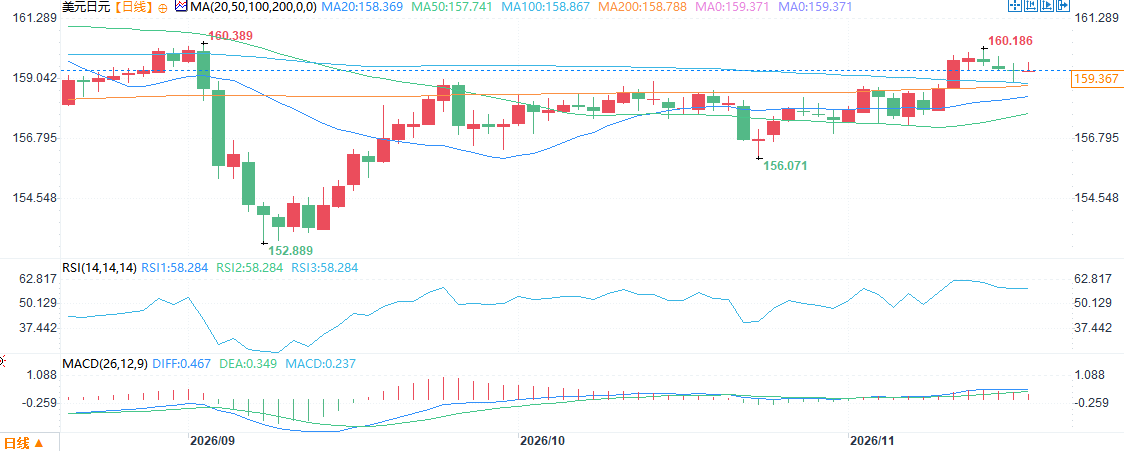 (USD/JPY daily chart, source: FX678) At 11:26 Beijing time, USD/JPY was trading at 159.37/38.
Our core assessment: We are bullish on USD/JPY, with a fair value target above 170.
Morgan Stanley has identified a long position in USD/JPY as its preferred forex trade. According to its valuation model, the fair value of USD/JPY is above 170, representing significant upside potential from the current price of around 159.5. Strategists predict that USD/JPY will weaken to 162 in the fourth quarter of 2027. The report points out that the yen is the most sensitive G10 currency to rising global yields; the Bank of Japan is unlikely to issue hawkish signals exceeding market expectations, and the continued rise in US Treasury yields driven by expectations of Fed rate hikes will continue to benefit USD/JPY. The driving logic is that strong global risk appetite, improved Japanese terms of trade, and the attractiveness of carry trades will collectively outweigh the short-term support for the yen from the narrowing USD/JPY interest rate differential. It is worth noting that Goldman Sachs has given a contrarian outlook on the yen, highlighting the increased difficulty in predicting the yen's exchange rate. The market is still repricing the Fed's policy path, and the relative attractiveness of dollar assets is expected to continue supporting the exchange rate in the medium term. Investors need to closely monitor the correlation between the yield curve and risk appetite.Japan's December rate hike is unlikely to reverse the downward trend; Federal Reserve policy remains dominant.
The market widely expects the Bank of Japan to raise its policy rate from 1.25% in December. However, Morgan Stanley believes that this rate hike, already fully priced in by the market, is insufficient to reverse the yen's weakness. For the yen to see a trend reversal, at least one of two scenarios needs to occur: the Federal Reserve stops raising rates, or the Bank of Japan implements a much faster-than-expected tightening. Currently, the market is mainly driven by the repricing of expectations for Fed rate hikes. Unless Japan intervenes, US economic data and Fed officials' speeches will have a far greater impact on the USD/JPY exchange rate than domestic Japanese policy statements. Even if the Bank of Japan successfully implements a rate hike, if the magnitude is largely in line with market expectations, its actual effect on narrowing the interest rate differential will be limited, and it will be difficult to change the overall trend of capital flowing into dollar assets. Historical experience shows that when the Fed is in a tightening cycle, the yen often cannot achieve a trend reversal through a single domestic policy action; the external interest rate environment remains the core variable determining the exchange rate direction.Biggest risk: With the 160 mark approaching, exchange rate intervention poses an asymmetric risk.
The USD/JPY pair is currently hovering below 160, a level repeatedly warned of by Japanese authorities as a red line for intervention, posing a core risk to this long position. The exchange rate exhibits asymmetric characteristics: it can rise slowly driven by interest rate differentials, but a sharp drop could occur in a single day should Japan intervene in the foreign exchange market. Historically, the last round of official intervention pushed the USD/JPY pair from 164 to 155 within a week. Mitsubishi UFJ predicts the intervention window will most likely fall between the current price level and the year's high of 164. Institutions warn that crowded long positions will amplify the impact of liquidation after intervention. The market needs to be wary of the interplay between short-term technical breakouts and policy responses; if the exchange rate approaches or touches the 160 level, the escalating expectation of intervention itself could trigger increased volatility. Investors should fully consider tail risks when establishing long positions, reasonably control position size, and set stop-loss orders to avoid excessive drawdowns during asymmetric shocks.Summarize
Morgan Stanley is bullish on USD/JPY, believing that even with a Japanese rate hike in December, the yen will remain under pressure amid continued tightening by the Federal Reserve, targeting 162 by the end of 2027, with a fair value model above 170. Japanese intervention near 160 is the primary risk, with the market exhibiting an asymmetric pattern of slow upward movement followed by a sharp decline after intervention. Goldman Sachs holds the opposite view, with significant divergence in their outlook for the yen. (USD/JPY daily chart, source: FX678) At 11:26 Beijing time, USD/JPY was trading at 159.37/38.
- Risk Warning and Disclaimer
- The market involves risk, and trading may not be suitable for all investors. This article is for reference only and does not constitute personal investment advice, nor does it take into account certain users’ specific investment objectives, financial situation, or other needs. Any investment decisions made based on this information are at your own risk.