The US dollar hit a new high against the Canadian dollar, with bulls awaiting guidance from the FOMC meeting minutes.
2026-11-18 15:34:30
USD/CAD rose after a slight decline the previous day, trading around 1.4310 in Asian trading on Wednesday. This marks the first time the pair has broken above 1.43 since March 2025 , signifying a valid break above the previously observed upper Bollinger Band at 1.4205. The pair strengthened as the dollar received support from hawkish comments from Federal Reserve officials, and traders are now focused on the release of the FOMC October meeting minutes later in the day.  On Tuesday, St. Louis Federal Reserve President Alberto Musalem stated that the Fed may need to implement multiple interest rate hikes to curb high inflation and urged immediate action to prevent the problem from worsening. This hawkish sentiment was reinforced by strong economic data from the U.S. Census Bureau: October retail sales rose 0.2% month-over-month, in line with market expectations. The underlying data was even stronger: sales excluding automobiles climbed 0.6% , exceeding the expected 0.4%; and the retail sales control group, a key input for calculating consumer spending, rose 0.6% after a 0.1% increase last month. Therefore, the CME FedWatch tool shows that traders are currently pricing in a 95.7% probability of a 25 basis point rate hike in December, and a 4.3% probability of a 50 basis point hike. This means the market has fully priced in the "certain December rate hike," with the only remaining disagreement being the magnitude. Furthermore, the tail probability of a 50 basis point rate hike has narrowed significantly from 12.7% on November 12th to 4.3%, indicating that market concerns have shifted from "the rate hike being too large" to the established fact that "the rate hike is certain." According to Elias Haddad, Global Head of Market Strategy at Brown Brothers Harriman's FX team, the recent dollar rally may appear excessive as other major central banks' tightening has narrowed the policy divergence with the Fed. However, he points out that the resilience of US economic growth, a favorable labor market, and persistent underlying inflation still give the broader bias for the dollar an upward bias. However, the upside for USD/CAD may be limited, as the Canadian dollar may find support from rising oil prices. WTI rose as attacks in the Middle East continue to threaten shipping in the region. US military officials said on Tuesday that US warplanes carried out new strikes targeting an Iranian launch site on Qeshm Island. The official stated that the strikes on Revolutionary Guard facilities were a response to Iranian aggression against U.S. personnel and assets, noting that U.S. Central Command remains "highly vigilant and fully deployed to protect Americans throughout the region." Norman Libke of Commerzbank noted that Canadian inflation "unexpectedly improved yesterday, falling short of expectations," with the overall CPI "remaining unchanged at 3.1% (instead of 3.2%)," while the core interest rate fell from 2.1% to 1.8% . He pointed out that this softer data immediately pressured the Canadian dollar, "weakening against the US dollar, with USD/CAD breaking above 1.43 for the first time since March 2025." Technically, on the daily chart, 1.4205 has been effectively broken, providing substantial confirmation of this upward trend: on November 11th, the price was only 15 points away from that level at 1.4190, and now 1.4310 has broken through by approximately 100 points. According to the Bollinger Band structure, a break above the upper band opens up further upside potential, rather than an immediate reversal. The short-term trend remains bullish. On the 4-hour chart, the price rose continuously from 1.4190 on November 11th to 1.4310, a cumulative increase of approximately 120 points . The subsequent movement after breaking through the upper resistance level of 1.4205 aligns perfectly with previous predictions. However, the driving logic has shifted from "oil price pressure on the Canadian dollar" to a two-way tug-of-war between "inflation data pressure on the Canadian dollar and geopolitical support for oil prices." Be wary of wide-range fluctuations after the new high.
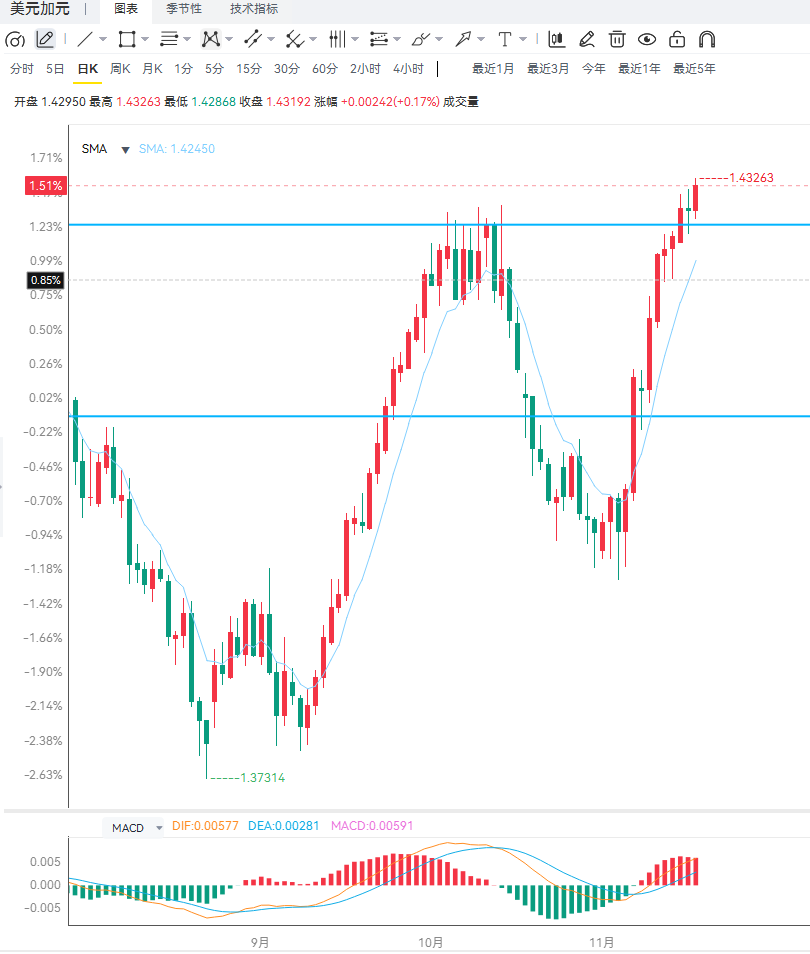 The current USD/CAD pair has a clear bullish/bearish structure, but the overall trend is bullish. Three bullish factors support this: stronger-than-expected US retail sales data , Fed officials advocating for multiple rate hikes , and lower-than-expected Canadian inflation reducing expectations of a BoC rate hike. The only bearish factor is the US military strike on Iran, which pushes up oil prices and provides support for the Canadian dollar from the commodity side. The previous upper Bollinger Band at 1.4205 has now become support, and the 1.43 level is a recently breached psychological level . In the medium term, if the FOMC minutes are hawkish and Canadian data continues to weaken, USD/CAD is expected to extend upwards and test higher psychological levels; if the escalation of the Middle East conflict drives a significant rise in oil prices, or if the Fed's stance becomes more dovish, the Canadian dollar is expected to recover 1.43. Key events to watch include the FOMC October meeting minutes, subsequent Canadian inflation and employment data, the transmission of the Middle East situation to oil prices, and the further convergence in pricing of the December rate hike.
On Tuesday, St. Louis Federal Reserve President Alberto Musalem stated that the Fed may need to implement multiple interest rate hikes to curb high inflation and urged immediate action to prevent the problem from worsening. This hawkish sentiment was reinforced by strong economic data from the U.S. Census Bureau: October retail sales rose 0.2% month-over-month, in line with market expectations. The underlying data was even stronger: sales excluding automobiles climbed 0.6% , exceeding the expected 0.4%; and the retail sales control group, a key input for calculating consumer spending, rose 0.6% after a 0.1% increase last month. Therefore, the CME FedWatch tool shows that traders are currently pricing in a 95.7% probability of a 25 basis point rate hike in December, and a 4.3% probability of a 50 basis point hike. This means the market has fully priced in the "certain December rate hike," with the only remaining disagreement being the magnitude. Furthermore, the tail probability of a 50 basis point rate hike has narrowed significantly from 12.7% on November 12th to 4.3%, indicating that market concerns have shifted from "the rate hike being too large" to the established fact that "the rate hike is certain." According to Elias Haddad, Global Head of Market Strategy at Brown Brothers Harriman's FX team, the recent dollar rally may appear excessive as other major central banks' tightening has narrowed the policy divergence with the Fed. However, he points out that the resilience of US economic growth, a favorable labor market, and persistent underlying inflation still give the broader bias for the dollar an upward bias. However, the upside for USD/CAD may be limited, as the Canadian dollar may find support from rising oil prices. WTI rose as attacks in the Middle East continue to threaten shipping in the region. US military officials said on Tuesday that US warplanes carried out new strikes targeting an Iranian launch site on Qeshm Island. The official stated that the strikes on Revolutionary Guard facilities were a response to Iranian aggression against U.S. personnel and assets, noting that U.S. Central Command remains "highly vigilant and fully deployed to protect Americans throughout the region." Norman Libke of Commerzbank noted that Canadian inflation "unexpectedly improved yesterday, falling short of expectations," with the overall CPI "remaining unchanged at 3.1% (instead of 3.2%)," while the core interest rate fell from 2.1% to 1.8% . He pointed out that this softer data immediately pressured the Canadian dollar, "weakening against the US dollar, with USD/CAD breaking above 1.43 for the first time since March 2025." Technically, on the daily chart, 1.4205 has been effectively broken, providing substantial confirmation of this upward trend: on November 11th, the price was only 15 points away from that level at 1.4190, and now 1.4310 has broken through by approximately 100 points. According to the Bollinger Band structure, a break above the upper band opens up further upside potential, rather than an immediate reversal. The short-term trend remains bullish. On the 4-hour chart, the price rose continuously from 1.4190 on November 11th to 1.4310, a cumulative increase of approximately 120 points . The subsequent movement after breaking through the upper resistance level of 1.4205 aligns perfectly with previous predictions. However, the driving logic has shifted from "oil price pressure on the Canadian dollar" to a two-way tug-of-war between "inflation data pressure on the Canadian dollar and geopolitical support for oil prices." Be wary of wide-range fluctuations after the new high. The current USD/CAD pair has a clear bullish/bearish structure, but the overall trend is bullish. Three bullish factors support this: stronger-than-expected US retail sales data , Fed officials advocating for multiple rate hikes , and lower-than-expected Canadian inflation reducing expectations of a BoC rate hike. The only bearish factor is the US military strike on Iran, which pushes up oil prices and provides support for the Canadian dollar from the commodity side. The previous upper Bollinger Band at 1.4205 has now become support, and the 1.43 level is a recently breached psychological level . In the medium term, if the FOMC minutes are hawkish and Canadian data continues to weaken, USD/CAD is expected to extend upwards and test higher psychological levels; if the escalation of the Middle East conflict drives a significant rise in oil prices, or if the Fed's stance becomes more dovish, the Canadian dollar is expected to recover 1.43. Key events to watch include the FOMC October meeting minutes, subsequent Canadian inflation and employment data, the transmission of the Middle East situation to oil prices, and the further convergence in pricing of the December rate hike.
- Risk Warning and Disclaimer
- The market involves risk, and trading may not be suitable for all investors. This article is for reference only and does not constitute personal investment advice, nor does it take into account certain users’ specific investment objectives, financial situation, or other needs. Any investment decisions made based on this information are at your own risk.