The Fed's renewed independence boosted the dollar, and negative factors for gold were gradually priced in.
2026-11-19 17:28:30
On Thursday (November 19th) during the Asian and European sessions, international gold prices opened higher but then fell sharply before recovering to trade in positive territory, indicating that both buyers and sellers had their own intentions, with buyers having the upper hand. Currently, gold is trading around $3738, as previously mentioned in previous articles. While there has been a lot of negative news recently, there's no need to panic excessively. The short-term correction may have already ended, but conditions for a reversal are not yet present. 
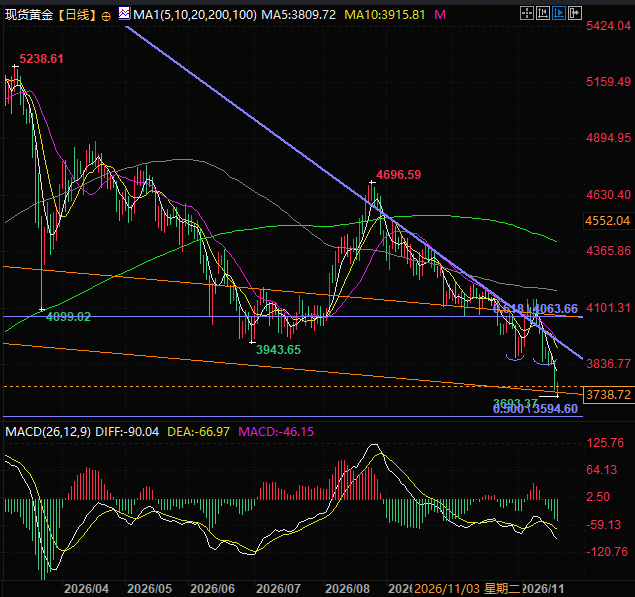 (Spot gold daily chart, source: FX678) At 17:26 Beijing time, spot gold is currently trading at $3,727 per ounce.
Review of previous market movements: Gold experienced a brief rebound after the midterm elections, followed by a sustained decline.
Rewinding to the period surrounding the US midterm elections, the market bet on a de-escalation of geopolitical conflicts in the Middle East , leading to a rebound in gold prices. The core narrative at the time was that with the election results settled and the White House losing both houses of Congress, the probability of the US escalating into a large-scale war decreased, the tail risk of energy inflation eased, and geopolitical premiums were withdrawn from gold prices, driving a temporary recovery. However, this rebound was merely a short-lived surge, and gold prices subsequently entered a sustained downward trend. The key clues behind this lie in the recently released minutes of the Federal Reserve's October policy meeting.Policy landscape shift: The Federal Reserve's independence has clearly returned after the midterm elections.
The minutes clearly reveal a shift in the internal structure of the Federal Reserve: Prior to the midterm elections, the Fed's policy decisions were significantly constrained by White House political factors. The minutes of the October 27-28 Fed meeting show that, aside from Lisa Cook, whom Trump repeatedly mentioned, and the consistently hawkish Hammark, and with the midterm elections on November 3rd, most officials were relatively restrained, indicating a wait-and-see approach to policy. However, after the midterm elections, the Democrats' unexpected victory in both houses of Congress led to a significant return to the Fed's policy independence. Officials were no longer constrained by political pressure, instead focusing entirely on hard data such as inflation and employment. Inflation consistently exceeding 3% and falling less than expected allowed previously suppressed hawkish expectations to be fully realized, and the market repriced the path of continued interest rate hikes. Essentially, the market was correcting for the pricing discrepancy caused by external intervention in the Fed's pricing before the elections.The US dollar's strength has broken away from the sole logic of safe-haven appeal, supported by both fundamental factors and interest rate differentials.
This also explains the unexpected resilience of the US dollar: many traders had previously bet on a weaker dollar, but the narrative of shorting the dollar failed to materialize. At that time, the US Treasury was planning to buy back bonds, Trump was printing money, and US debt continued to rise. However, currently, considering both the fundamental advantages of the US economy brought about by the AI industry and the rigid demand from the petrodollar settlement system, global market demand for the dollar remains solid. A particularly noteworthy phenomenon is that the dollar's strength has moved beyond a purely safe-haven framework: when geopolitical conflicts escalate, the dollar is a safe-haven asset; even as the intensity of geopolitical conflicts such as those between the US and Iran, and Russia and Ukraine, subsides, the dollar remains strong due to the fundamentals of the US economy and cross-market interest rate differentials. Recent hawkish remarks from officials like Waller have further amplified tightening expectations, with the market currently pricing in a 25bp rate hike in December as the primary scenario, while also incorporating a 10% probability of a 50bp rate hike; New York Fed President Williams' remarks were relatively moderate, acknowledging persistent inflation but not currently supporting extremely aggressive rate hikes, and internal disagreements among officials also leave room for volatility in future expectations.Middle East geopolitical logic reshaping: Risks drive up inflation, which in turn suppresses gold prices.
In the Middle East, the situation remains tense: Iran continues its attacks on US facilities in Kuwait and Bahrain, oil tankers have caught fire after hitting mines in the Strait of Hormuz, and the US has introduced new regulations restricting related shipping and trade. However, a new transmission chain has formed in the market—Middle East tensions are pushing up energy prices and raising inflation expectations, which in turn is forcing the Federal Reserve to maintain its tightening policy. This inflationary concern is ultimately becoming a force suppressing gold prices, rather than providing traditional safe-haven support.Summary and Technical Analysis:
From the current perspective, this round of gold price decline has largely priced in the negative factors of the Federal Reserve's restoration of independence and a stronger dollar, and there are signs that these negative factors are gradually being priced in. However, this does not mean an immediate reversal; the market still needs to wait for a new turning point. This is because gold's price movements are primarily anchored to the quantitative easing actions of global central banks and extreme geopolitical risks. The possibility of a weakening global economy without quantitative easing cannot be ruled out. From a long-term perspective, it is difficult for the US to maintain extremely high interest rate differentials indefinitely, and the market's assessment of the resilience of the US economy will continue to be tested by data. When inflationary pressures ease and the US economy weakens, the Federal Reserve's policy cycle may shift towards easing, and gold will naturally see opportunities during such easing cycles. Gold itself is a hard currency with long-term value, and its attractiveness as a portfolio gradually increases during a sustained price decline. In the short term, it is necessary to continue to closely monitor speeches by Federal Reserve officials and inflation data, waiting for signals that interest rate hike expectations have peaked; from a medium- to long-term perspective, the continued decline is actually slowly opening up opportunities for gold investment. Technical Analysis: Spot gold has touched the lower trendline of the descending channel and has a need for a rebound. It is also very close to the 0.5 Fibonacci retracement level of 3600. However, the overall trend is bearish, and rebounds are generally weaker than previous ones unless there are strong fundamental factors supporting the price action. (Spot gold daily chart, source: FX678) At 17:26 Beijing time, spot gold is currently trading at $3,727 per ounce.- Risk Warning and Disclaimer
- The market involves risk, and trading may not be suitable for all investors. This article is for reference only and does not constitute personal investment advice, nor does it take into account certain users’ specific investment objectives, financial situation, or other needs. Any investment decisions made based on this information are at your own risk.