A mix of the latest UK data raises the question of whether the pound's decline reflects cooling policy expectations.
2026-11-19 21:20:30
On Thursday, November 19th, recent data from the UK Office for National Statistics on October's inflation and labor market reports triggered a reassessment of the Bank of England's policy path in December. The Bank of England had previously raised its policy rate by 25 basis points to 4% on November 5th, with a vote of 8 to 1, indicating a majority of committee members supporting the move; one member advocated for a 50 basis point increase. This week's data presented a mixed picture: overall inflation rose slightly, wage growth slowed, the unemployment rate fell, while the conflict in the Middle East entered its ninth month, continuing to push up global energy prices. In a recent speech, Bank of England Governor Bailey pointed out that monetary policy is not predetermined, and the committee will closely monitor the transmission of energy prices to other prices. 
Analysis of the latest inflation and labor market data
The UK's Consumer Price Index (CPI) rose 3.6% year-on-year in October, a slight increase from 3.5% in September. Core inflation remained around 2.8%, while service price inflation was relatively stable. This result was slightly lower than some of the Bank of England's November forecast, indicating that the direct impact of energy prices has not yet significantly spread to broader consumer sectors. In the labor market, the unemployment rate fell to 4.6% from July to September, the employment rate rose to 75.4%, and the number of job vacancies fell to 690,000, the lowest level since 2021. Average weekly wage growth (excluding bonuses) slowed to 3.5%, while growth including bonuses was 3.6%, and private sector wage growth was around 3.1%. Bank of England policymaker Green previously stated that survey data suggests wage growth next year may remain at least 3.5%. These data indicate that there is still some slack in the matching of domestic demand and supply in the UK, and the secondary effects are not yet significant, but wage levels remain above the target range.Data dependence on policy path and committee statements
Most Bank of England members have indicated at least one more rate hike, but the timing will depend on subsequent data. Bailey emphasized that there is no predetermined policy path, and the committee needs to assess the impact of persistently high energy prices on broader price formation. Green pointed out that proactively addressing uncertainty could reduce the risk of policy mistakes given that inflation has been above target for an extended period. Market pricing indicates that the probability of a December rate hike has fallen from its earlier highs to around 80%, with some analysts believing that the latest data is insufficient to fully resolve the choice between December and February. Further rate hikes will require stronger or more sustained second-party effects, a threshold that has not yet been met. The committee will receive more information on inflation and the labor market before its December 17 meeting, and its decisions will be highly dependent on this updated data.Assessment of energy price shocks and secondary effects
The conflict in the Middle East has pushed up global energy prices, and the Bank of England expects overall inflation to rise to around 5% by mid-next year, before falling back as the energy base effect diminishes. Currently, evidence of indirect transmission and secondary effects is limited, with businesses buffering some of the shock through cost reductions, hedging, and fixed-price contracts. Some market analysts point out that if energy prices substantially ease, further adjustments in February next year may no longer be necessary, and additional tightening space is limited and increasingly dependent on energy trajectories and incoming data. Bailey also warned that the longer the conflict lasts and the higher energy prices are, the greater the likelihood of a persistent inflationary effect, requiring a corresponding increase in the level of policy rates. Within this framework, the Committee focuses on the size and duration of the shock and its propagation through wage and price-setting mechanisms, rather than pre-set actions in one direction.Current market performance of GBP/USD
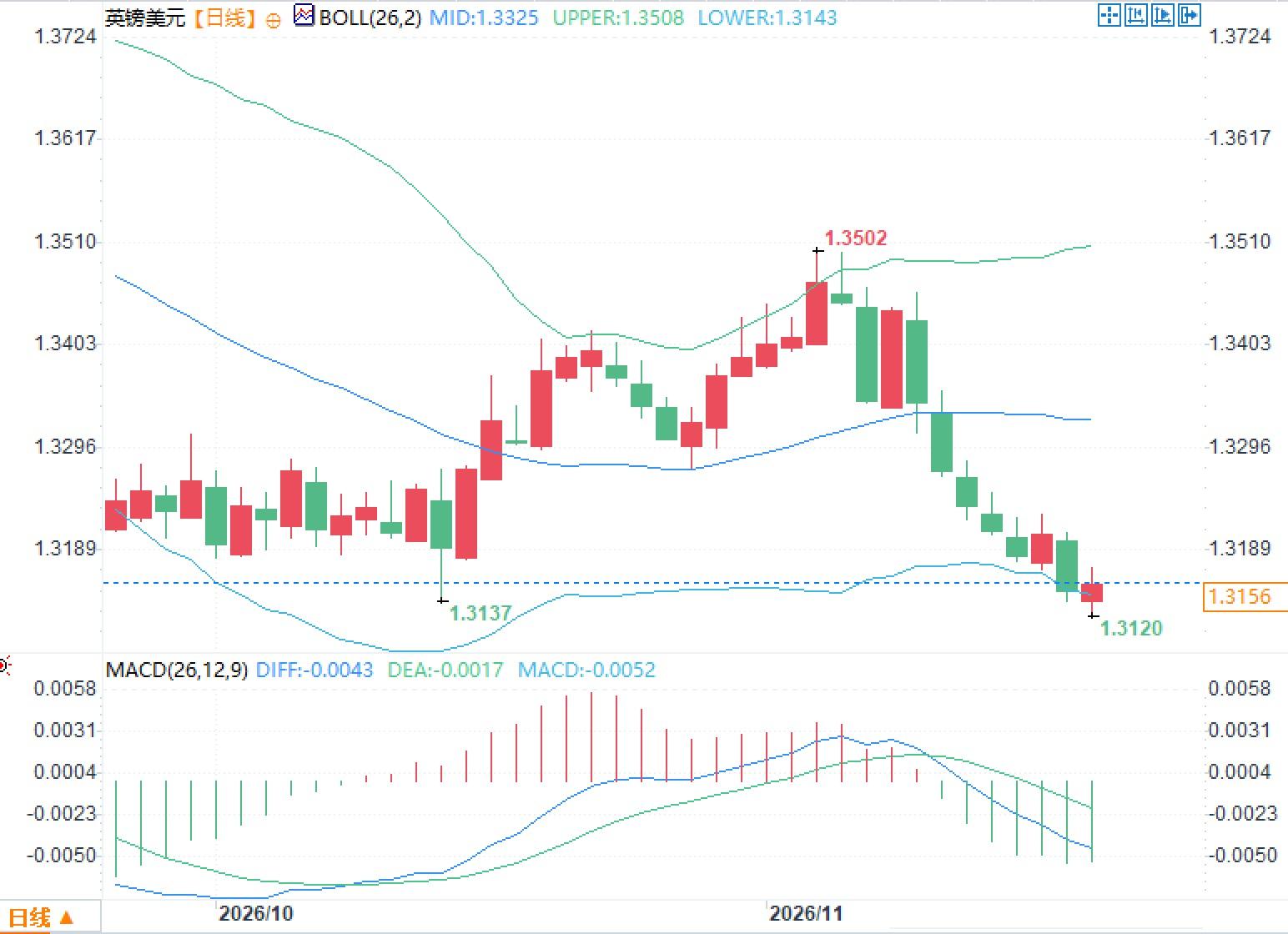
The pound has recently retreated from its level near 1.35 earlier this month and is currently trading around 1.3150 against the dollar. The daily chart shows the price trading below the middle Bollinger Band, with momentum indicators showing negative values. This correction is related to the market's repricing of the relative policy path following this week's UK data releases, and also reflects the impact of global energy price volatility and communication among major central banks. The Bank of England, in its November Monetary Policy Report, projected that under market curve conditions, the policy rate path will gradually rise and then stabilize. The current exchange rate level reflects uncertainty under a data-dependent model, and market participants continue to monitor subsequent developments in inflation, wages, and energy prices to assess the actual effectiveness of policy transmission.Frequently Asked Questions
Question 1: Did the UK's October inflation rise to 3.6% change the Bank of England's assessment of the second-degree effects? Answer: The figure was slightly higher and slightly below some forecasts, while core and services inflation remained relatively stable, indicating that the direct energy shock has not yet spread widely. The Bank of England still believes that evidence of a second-degree effect is limited, but will continue to monitor wage and price setting behavior. Question 2: How will UK labor market data affect policy timing? Answer: The unemployment rate falling to 4.6%, wage growth slowing to 3.5%, and vacancy declines indicate some easing. Most members have indicated that there will be one more rate hike, but the choice between December and February next year still depends on more data. Question 3: Where does the key role of energy prices play in the Bank of England's subsequent policy space? Answer: The conflict has pushed up energy prices, and inflation is expected to rise to around 5% by mid-next year. If energy prices ease, the need for further tightening may decrease; if they remain high, the risk of a lasting effect increases, and policy will need to be adjusted accordingly.- Risk Warning and Disclaimer
- The market involves risk, and trading may not be suitable for all investors. This article is for reference only and does not constitute personal investment advice, nor does it take into account certain users’ specific investment objectives, financial situation, or other needs. Any investment decisions made based on this information are at your own risk.