With inflation remaining at 3.1%, the Canadian dollar faces a critical window for interest rate repricing.
2026-11-19 21:30:31
On Thursday, November 19th, the USD/CAD exchange rate was trading around 1.43, with the Canadian dollar ranking in the lower-middle range among G10 currencies this year. The Bank of Canada raised its policy rate by 25 basis points to 2.5% on October 28th, its first rate hike since 2023. Canada's October Consumer Price Index (CPI) remained at 3.1% year-on-year, with core indicators (median and trimmed mean) still close to 2%. The market prices approximately 50% for a rate hike at the Bank of Canada's December 9th meeting, and has priced in about 2.7 further rate hikes by the end of October 2027. The Federal Reserve's target range for the federal funds rate remains at 3.75% to 4.00%, with an effective rate of approximately 3.88%, and the market is pricing in further rate hikes by the end of next year. 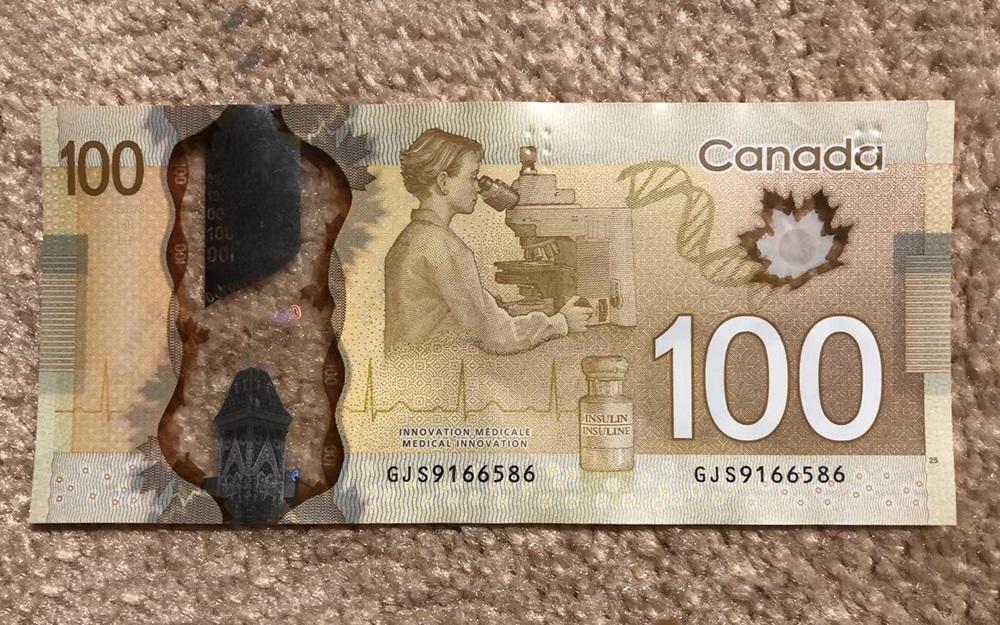
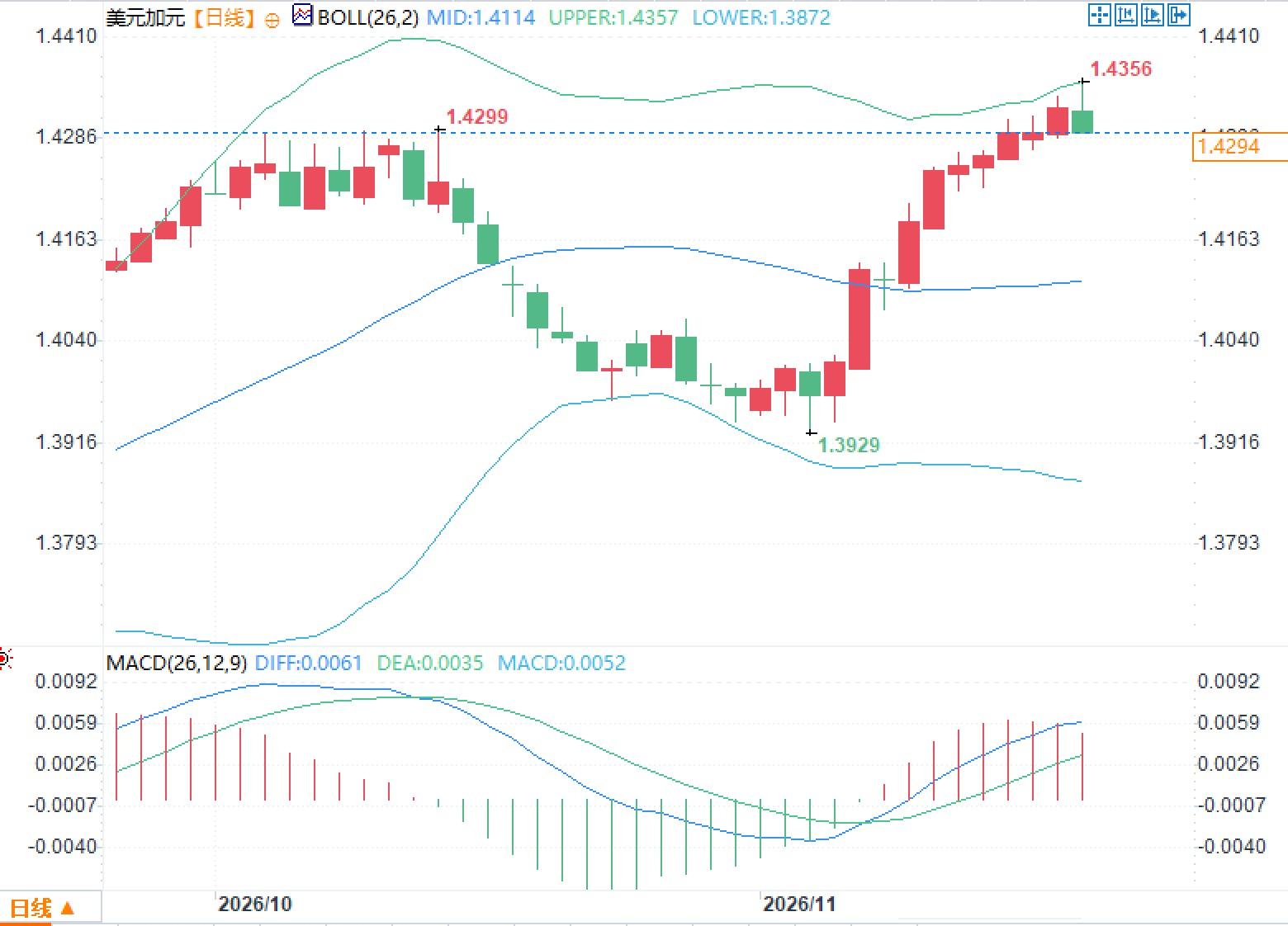
Recent Price Characteristics and Indicators of USD/CAD
From a daily chart perspective, the price is trading above the Bollinger Band's middle band (approximately 1.4114), near the upper band (approximately 1.4357), with the lower band at approximately 1.3872. The price recently touched around 1.4356 before pulling back and is currently consolidating around 1.430. The MACD indicator shows the DIFF at 0.0061, the DEA at 0.0035, and the histogram above the zero line. These characteristics reflect price fluctuations in a relatively high range, with short-term volatility influenced by both energy prices and interest rate expectations. The Canadian dollar has been generally weak this year, related to Canada's export environment and global energy costs, rather than being driven by a single factor.Bank of Canada Policy Stance and Inflation Dynamics
In his October policy statement and subsequent remarks, Bank of Canada Governor Tiff Macklem noted that persistently high energy prices were increasing inflation risks, and the Governing Council deemed further interest rate hikes necessary, but would proceed cautiously based on uncertainty. Following the release of November inflation data, expectations for a December rate hike initially declined, but the market probability subsequently returned to around 50%. Core inflation did not accelerate significantly, providing some buffer for policy, but the energy component (gasoline prices rising by over 30% year-on-year) still poses a major pressure. The Bank of Canada projects economic growth of around 1% in 2026, rebounding to around 2% in 2027. Macklem has announced he will not seek re-election, and his term will end in June 2027, making policy continuity a key focus for the market.The impact of external factors on the performance of the Canadian dollar
US trade policy and the political landscape constitute the main external variables. The current trade conflict persists, and the market is focused on the possibility of a Democratic-led Congress in the US, which could potentially ease trade tensions, but uncertainty remains high. The AI-related investment cycle has a phased impact on US stocks and dollar demand, with the USD/CAD exchange rate being particularly sensitive to this. Regarding the Federal Reserve, the market is currently pricing in approximately three further rate hikes by the end of next year, while some institutions expect only two; this discrepancy could affect the interest rate differential path. High energy prices support Canada's current account as an energy exporter, but also increase global inflationary pressures, leading both central banks to adopt a cautious approach.Institutional Views and Medium-Term Fundamental Analysis
Commerzbank analyst Norman Libke points out that after a relatively weak performance in 2026, the Canadian dollar is expected to see a modest recovery against the US dollar in 2027. Supporting factors include the Bank of Canada's continued hawkish stance, persistently high inflation, and room for further interest rate hikes. Libke believes that an easing of trade tensions would support the Canadian dollar; simultaneously, a partial decline in market expectations for Federal Reserve rate hikes could also improve the Canadian dollar's relative performance. By the end of October 2027, the market is still pricing in approximately 2.7 cumulative rate hikes by the Bank of Canada, a path consistent with persistently above-target inflation. Overall, interest rate differentials, energy prices, and trade policy will continue to dominate medium-term fundamentals, rather than a single factor determining the exchange rate path.Frequently Asked Questions
Question 1: Why did the Bank of Canada raise interest rates when its core inflation indicator was close to 2%? Answer: Primarily due to persistently high energy prices, the Board of Governors was concerned that cost transmission would extend to other goods and services, creating more persistent inflationary pressures. Therefore, it chose to adjust policy ahead of schedule to maintain confidence in price stability. Question 2: Why is the market pricing in multiple interest rate hikes from the Bank of Canada in 2027? Answer: Inflation is expected to remain around 3% for most of 2027. Energy and supply chain factors are unlikely to subside quickly, and coupled with a recovery in economic growth, this provides room for further tightening, leading the market to adjust its interest rate path accordingly. Question 3: How do trade and AI-related factors affect the USD/CAD exchange rate? Answer: Easing trade conflicts may improve Canada's export environment, supporting the Canadian dollar; the AI investment cycle, by influencing the US stock market and dollar demand, indirectly changes interest rate differentials and capital flows, becoming an important external variable for exchange rate fluctuations.- Risk Warning and Disclaimer
- The market involves risk, and trading may not be suitable for all investors. This article is for reference only and does not constitute personal investment advice, nor does it take into account certain users’ specific investment objectives, financial situation, or other needs. Any investment decisions made based on this information are at your own risk.