Gold Trading Alert: Expectations of a Fed rate hike have fueled a continued surge in the US dollar, pushing gold prices to a 14-month low and briefly falling below the $3600 mark.
2026-11-20 07:44:30
On Thursday (November 19), spot gold fell 2.66% to settle at $3,625.33 per ounce, after hitting a low of $3,620 during the session, its lowest level since September 2025. US December gold futures also fell 1.5%, settling at $3,685.50. The Federal Reserve meeting minutes and hawkish comments from officials strengthened bets on a December and subsequent rate hikes, pushing the dollar index to a 19-month high and putting continued pressure on gold prices. On Friday (November 20) in early Asian trading, spot gold continued its decline, falling as much as 0.96% to a low of $3,590.69 per ounce, its lowest point since September 8, 2025. 
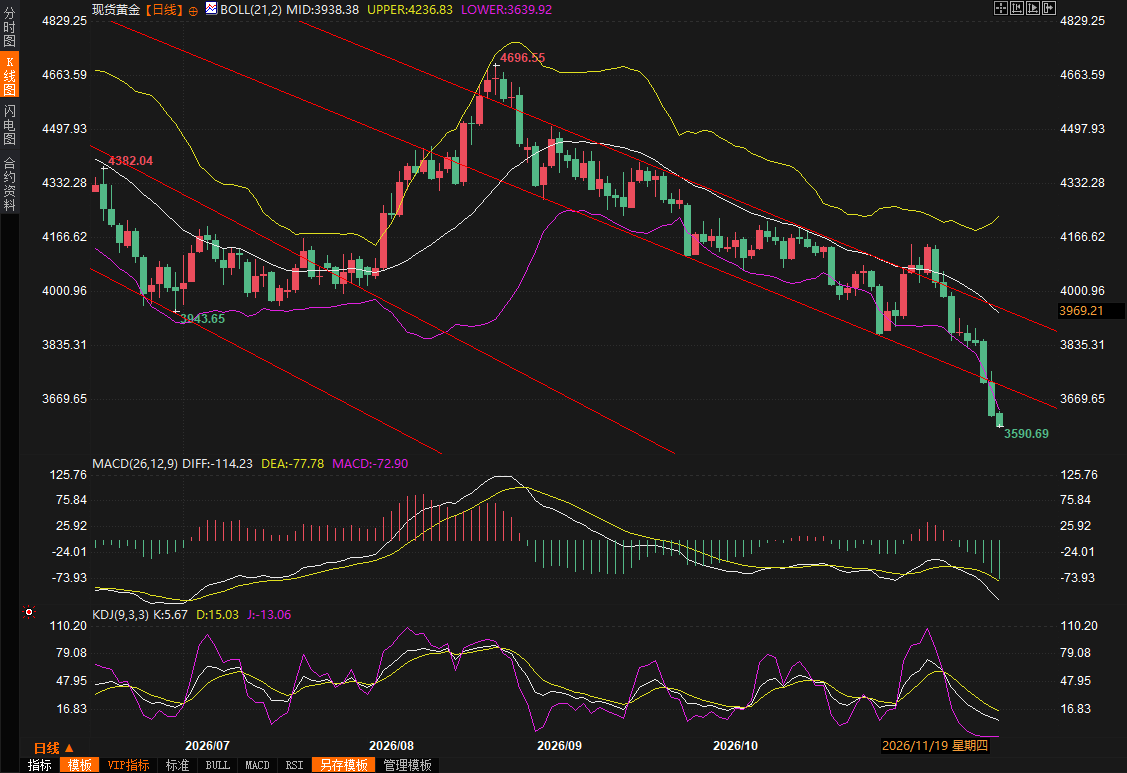 (Spot gold daily chart, source: EasyTrade) At 07:42 Beijing time, spot gold is currently trading at $3597.47 per ounce.
I. The Overwhelming Pressure of the US Dollar: A Curtain-Free Exchange Rate Suppression
The most obvious driving force behind this round of gold price decline is clearly and directly reflected in the US dollar index chart. This week, the US dollar index climbed to its highest level since April 2025, closing at 103.93 in New York, having reached a high of 103.97 during the session, a new 19-month high. Chris Gaffney, Global Head of Markets at EverBank, succinctly stated that interest rate expectations and a stronger dollar were the two main factors that suppressed gold prices that day. For gold priced in US dollars, the strength of the dollar is never just a fluctuation in exchange rates, but directly determines the actual purchase cost for overseas buyers. When the US dollar index was pushed to its highest level in nearly a year and a half, gold priced in other currencies became more expensive for most global buyers, thus suppressing physical demand and investment intentions. A deeper change occurred in capital flows: as global financial conditions tightened, emerging markets experienced severe competition for dollar liquidity, with the MSCI Latin America stock index falling by about 2% in a single day. High-risk currencies were subject to concentrated selling, and the return of funds to dollar assets itself was draining marginal buying power from the gold market. The strength of the US dollar is not an isolated event; it is a projection of a whole macroeconomic narrative onto exchange rates, and the source of this narrative points to the Federal Reserve.II. The "Nuclear Button" of Interest Rate Hike Expectations: A Dangerous Leap from "Whether to Hike" to "How Fast to Hike"
If the strengthening dollar was the first layer of weight weighing on gold prices, then the shift in expectations regarding Federal Reserve policy was the real trigger for this decline. The market's pricing focus has undergone a crucial leap in the past few weeks: the focus has quickly shifted from "whether there will be a rate hike in December" to "how quickly will tightening continue after December." This leap was catalyzed by two almost simultaneous hawkish signals. The first was the release of the minutes from the Fed's October 27-28 meeting. The minutes showed that almost all policymakers believed that further rate hikes would be necessary if the economy performed as expected; two policymakers even explicitly mentioned the possibility of a one-off 50 basis point rate hike if subsequent inflation data was unfavorable. The second was the public statements made by Fed Governor Waller before and after the release of the minutes. Waller stated bluntly that the Fed needs to take tougher measures to address inflation, with options either a direct 50 basis point rate hike at the December meeting or a clear policy guidance indicating an accelerated pace of rate hikes in 2027. Another board member, Barr, similarly stated that he favors tightening monetary policy given the ongoing inflationary pressures on the economy. The interest rate futures market reacted almost reflexively to this. The CME FedWatch tool showed traders pricing in a 96.4% probability of a 25 basis point rate hike in December, while the probability of a 50 basis point hike, though still limited, is no longer a marginal scenario. Adding to the unease of gold bulls, JPMorgan Chase further revised its path forecast upwards during the same period, predicting that in addition to the December hike, the Fed will raise rates by 25 basis points in January and March of next year; Deutsche Bank has already predicted a "triple hike." For gold, which does not generate any interest income, every increase in the expectation of a rate hike directly increases the opportunity cost of holding it. When risk-free US Treasury bonds can offer coupon rates above 5%, holding zero-interest gold becomes an increasingly expensive financial choice.III. The "Invisible Hand" of Real Interest Rates: Why 5% is More Lethal Than Artillery Fire
In the short-term pricing equation for gold, the truly decisive variable is not the nominal interest rate itself, but the real interest rate after adjusting for inflation expectations. While the 10-year US Treasury yield slightly declined to 5.044% on November 19th due to safe-haven buying in the stock market, it remained firmly above the 5% mark throughout the week. Meanwhile, the implied break-even yield of 10-year Treasury Inflation-Protected Securities (TIPS) was approximately 2.185%, meaning the market's expectation of average annual inflation over the next ten years was roughly anchored around 2.2%. Subtracting the two, the 10-year real interest rate remained at an historically high level. This is the key to understanding the recent decline in gold prices. The situation in the Middle East did escalate during the same period: after the US airstrike on Iran's Qeshm Island, Iranian forces launched more attacks on US military facilities belonging to regional allies, and shipping safety in the Strait of Hormuz continued to be disrupted. However, in an environment where real interest rates were pushed to their highest levels in over a decade, the safe-haven premium provided by geopolitical risks was ruthlessly swallowed up by interest rate costs. The choice facing investors has become exceptionally clear: hold a US Treasury bond with an annualized coupon rate exceeding 5%, or hold a metal that generates no cash flow, while simultaneously bearing the double headwinds of a appreciating dollar and rising interest rates. The answer is written in every sell order. Gold's traditional safe-haven narrative has temporarily given way to the hard constraint of "real interest rates plus the dollar" in this round of pricing. This is also the underlying reason why gold prices and US stocks have experienced a rare simultaneous decline on some trading days—when liquidity tightens, gold, as an easily convertible asset, becomes a source of cash rather than a safe haven for funds.IV. The Overlooked Underlying Factor: The "Structural Underlying Force" Created by Central Bank Gold Purchases
However, focusing solely on the short-term storms of interest rates and the US dollar would miss the most intriguing dichotomy in the current gold market. While gold prices have been declining, a massive, price-insensitive demand force is continuously entering the market. A report released by the World Gold Council in early November showed that global central banks and other official institutions' gold reserves increased by a net 321 tons in the third quarter of 2026, a year-on-year increase of 42%, marking a new quarterly high since the fourth quarter of 2024; cumulative purchases since the beginning of the year reached 675 tons, a 6% increase compared to the same period last year. Reserve diversification and risk management are listed as the core driving factors for central bank gold purchases. More notably, after gold prices entered a correction window in October, the pace of purchases by many central banks did not slow down. A major Asian country purchased 26 tons of gold that month, bringing its reserves close to those of France; China's gold reserves recorded their 24th consecutive month of increase. There is a fundamental gap between central bank behavior and short-term trading funds. Hedge funds and ETFs are highly sensitive to marginal changes in real interest rates and can drastically adjust their positions within days. Central banks, on the other hand, make reserve allocation decisions on a yearly or even decadely scale, considering the long-term evolution of the monetary and credit landscape rather than the holding costs of a single quarter. EverBank's Gaffney, in analyzing the conditions for a gold price rebound, specifically pointed out that the market needs to see increased gold demand from both consumers and central banks. The current divergence lies in the fact that while central banks, acting as a "slow line," are steadily buying, providing structural support for the gold price center, consumer demand and demand for jewelry and bars, acting as a "fast line," are significantly cooling due to price volatility and the interest rate environment—global jewelry consumption fell by 17% year-on-year in the third quarter, and demand for gold bars and coins fell by 19%. These two forces pull against each other, creating the inherent tension that causes gold prices to fluctuate repeatedly in the bottom range.In summary: the short term is a prisoner of interest rates, while the long term is a hedge against credit volatility.
The direct trigger chain for gold prices hitting a 14-month low is clearly identifiable: persistent inflation data locked in expectations of interest rate hikes; the collective hawkish statements from Federal Reserve officials and the strong wording in the meeting minutes pushed this expectation towards "continuous tightening" in pricing; the dollar index subsequently hit a 19-month high; and real interest rates were pushed to an expensive level that constrains the valuation of non-interest-bearing assets. Ultimately, even with ongoing geopolitical risks in the Middle East, safe-haven buying of gold retreated in the face of interest rate pressures. This was a decline driven by interest rate logic overriding safe-haven logic, rather than a fundamental disproving of gold's long-term value. Looking ahead, for gold prices to escape their current low-level predicament in the short term, what is needed is not more geopolitical noise, but a clear signal of a fundamental shift: either inflation data shows a substantial cooling that would allow the Fed to slow the pace of interest rate hikes, leading to a decline in real interest rates from their high levels; or the dollar's strength shows a trend of easing, alleviating the downward pressure on gold prices from the pricing currency. Before these signals appear, any bottom-fishing impulse based on the idea that "after a significant drop, a rebound is inevitable" lacks support from a macroeconomic logic. However, it's equally important not to forget that the 5% real interest rate benchmark weighing on gold prices is a short-term constraint, not a long-term death sentence. In the short term, watch whether the $3600 level can hold. The 50% retracement level of the rally from $1615 in 2022 to the current high of $5596 is around $3607, a key level for investors to monitor. A decisive break below this level could lead to a further decline towards the $3500 mark, which represents dual support from the April 22, 2025 high and the psychological level. (Spot gold daily chart, source: EasyTrade) At 07:42 Beijing time, spot gold is currently trading at $3597.47 per ounce.
- Risk Warning and Disclaimer
- The market involves risk, and trading may not be suitable for all investors. This article is for reference only and does not constitute personal investment advice, nor does it take into account certain users’ specific investment objectives, financial situation, or other needs. Any investment decisions made based on this information are at your own risk.