Energy shocks and US stock market valuation corrections: Why is the US dollar the best hedging tool?
2026-11-20 16:52:30
In traditional market conditions, gold is often the preferred safe-haven asset when stocks plummet and geopolitical risks escalate. However, this round is unique: energy inflation, the bursting of AI valuation bubbles triggering a correction in US stocks, and simultaneous sell-offs of gold have led to a strong, independent performance of the US dollar, making it the preferred hedging vehicle for market funds. The core issue is not that gold has lost its safe-haven properties, but rather that the type of risk in this round has directly rewritten the ranking of safe-haven assets. 
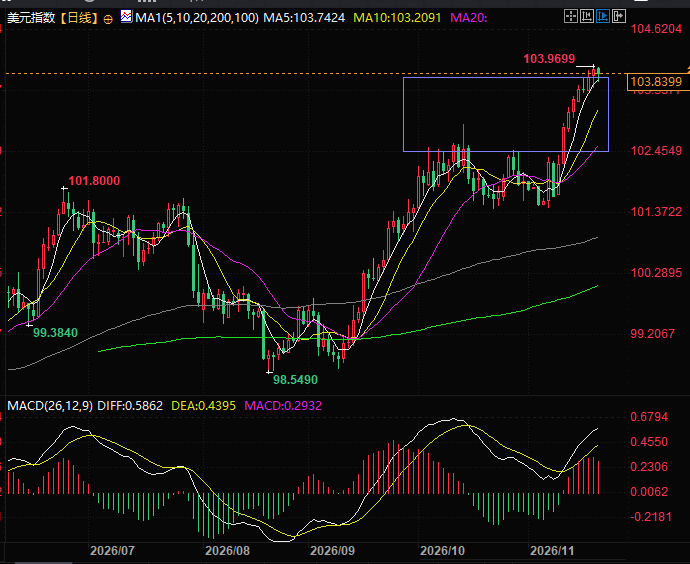 (US Dollar Index Daily Chart, Source: FX678) At 16:49 Beijing time, the US Dollar Index is currently at 103.85.
Underlying context: This is a "stagflation risk," not a recession or deflation risk.
Typical recession fears involve collapsing demand, falling inflation, and market trading in expectations of interest rate cuts, leading to a strengthening of gold and US Treasury bonds. However, the current shock originates from energy supply disruptions: the US-Iran conflict has driven up oil prices. Under the petrodollar system, global oil purchases require dollar settlements, directly increasing global demand for the dollar. Oil prices have increased inflation stickiness; the market is not trading in a recession, but rather in the narrative of persistent inflation, forcing central banks to maintain high interest rates, or even continue raising them. In this environment, gold's inherent weakness is exposed: gold does not generate interest. Under the pricing of "higher and longer" interest rates, the real yield on US Treasury bonds is rising, and the opportunity cost of holding gold continues to increase. The benefits brought by geopolitical premiums cannot outweigh the suppression of rising real interest rates; gold is no longer a good safe-haven option, but instead becomes a liquidity pool for institutions to liquidate assets and replenish margin.Liquidity stampede: Gold is the source of liquidity, the US dollar is the destination.
The revaluation of the AI sector has led to significant unrealized losses in numerous accounts, triggering margin calls. Institutional investors' operational sequence is clear: sell risky assets first, then dump the most liquid standardized assets for cash—gold being one of them. This has resulted in the unusual phenomenon we observe: as the stock market falls, gold is also sold off, with both stocks and gold declining in tandem. The US dollar is the settlement currency of the entire global financial system; all margin calls, redemptions, and cross-border fund transfers ultimately convert to US dollar cash. What everyone is scrambling for isn't a safe-haven asset, but the liquidity of the US dollar itself. During the deleveraging and margin call phase, US dollar cash is the only asset that can be directly used for fulfillment without being subject to additional valuation discounts.Interest rate differential advantage: The US dollar is currently a "yielding safe haven," while gold is a non-interest-bearing asset.
In the past, in many risk-averse scenarios, the US dollar was simply safe, but offered no returns. Now, things are different: with the Fed's hawkish expectations persisting and US Treasury yields remaining high, dollar assets possess two attributes simultaneously: safety and interest. In comparison: most non-US currencies—economy groups like the Euro, UK, Australia, and South Africa—are either economically weak or experiencing passive inflation, limiting central bank policy space and causing their interest rate differentials to lag behind those of the US. The US dollar and US Treasury bonds can satisfy the needs of funds seeking safe haven and cash storage while also providing stable coupon income. This is the most crucial difference in this round: funds want more than just "avoiding risk"; they want to avoid opportunity costs while avoiding risk, and even potentially generate returns. Dollar assets perfectly match this demand.The relative resilience of the US economy has reinforced the "the strong get stronger" pricing strategy.
The impact of energy shocks on different economies is entirely asymmetrical. Economies heavily reliant on oil imports, such as Europe, Japan, and South Africa, are severely impacted by rising energy costs, leading to inflation, weakening economies, and a stagflation dilemma. The United States, with its buffered domestic energy supply and stronger economic resilience, has fostered a "US exceptionalism" trading theme in the market. Faced with similar energy shocks, the market believes the US can withstand high interest rates, while other economies cannot. Capital will proactively withdraw from non-US assets and flow back into US dollar assets, further amplifying the dollar's hedging effect.A reminder: The hedging advantage of the US dollar only holds true within the current narrative.
The US dollar is not a perpetual panacea for safe-haven assets; its strength rests on specific preconditions: persistently sticky inflation, a hawkish Federal Reserve stance, global liquidity tightening, and a deleveraging cycle. Once the narrative shifts—with oil prices continuing to fall, inflation rapidly declining, and US employment data showing significant weakness—the market will reprice the interest rate cut cycle, and the landscape will reverse. At that point, as high-interest-rate expectations subside, the yield advantage of the dollar and US Treasuries disappears, and gold's safe-haven and credit risk mitigation value will return, causing funds to flow back towards gold. In short, the core of this round of risk is imported inflation from energy sources + high-interest-rate expectations + global deleveraging. Within this framework, gold's safe-haven logic is suppressed by interest rates, and it may even be used as a cash withdrawal target during liquidity crises; the dollar, with its triple advantages of essential oil settlement needs, US Treasury coupon yields, and being the ultimate global liquidity vehicle, naturally becomes the best hedging tool in the eyes of investors. (US Dollar Index Daily Chart, Source: FX678) At 16:49 Beijing time, the US Dollar Index is currently at 103.85.
- Risk Warning and Disclaimer
- The market involves risk, and trading may not be suitable for all investors. This article is for reference only and does not constitute personal investment advice, nor does it take into account certain users’ specific investment objectives, financial situation, or other needs. Any investment decisions made based on this information are at your own risk.