Gold Trading Alert: Trump hints at no further attacks on Iran this year; gold prices rebound more than 1% from a 14-month low. This week's focus is on PCE data.
2026-11-23 08:00:31
Gold prices fell to $3,502.73 per ounce on Friday (November 20) due to hawkish interest rate expectations and selling pressure on AI-related stocks, closing at $3,534.64 per ounce, a weekly decline of 8.9%, marking its worst weekly performance in eight months. However, on Monday (November 23) in early Asian trading, spot gold gapped up by more than $40, rising as much as 1.5% to $3,588.13 per ounce, as Trump stated over the weekend that he would be inclined to resume strikes against Iran after the New Year if no agreement could be reached. Meanwhile, Iran's indication of a willingness to continue down the diplomatic path cooled market expectations of a deteriorating Middle East situation, slightly easing concerns about inflation. Market expectations for maintaining interest rates unchanged in December rebounded, attracting bargain hunters and supporting a gold price rebound. This week will see the release of the US October PCE data, which investors should pay close attention to. In addition, this week will be Thanksgiving, which may limit market trading. As the end of the month approaches, investors should also be aware of brokers' position adjustments. 
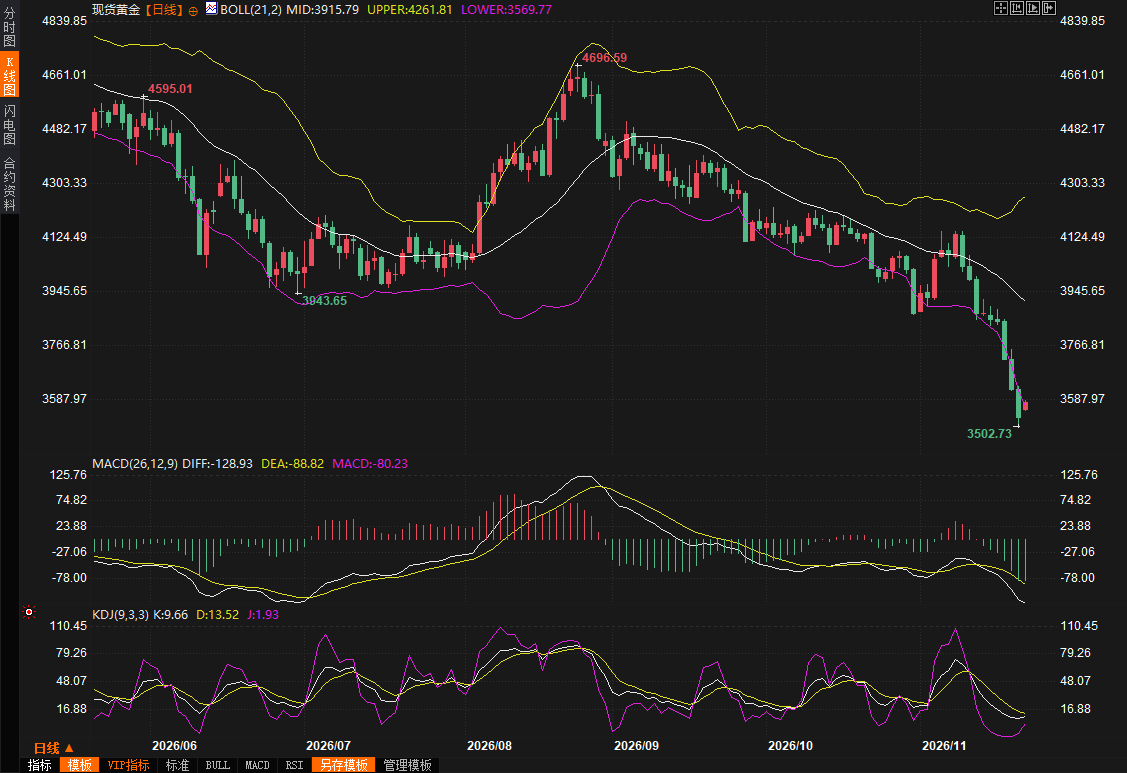 (Spot gold daily chart, source: FX678) At 07:56 Beijing time, spot gold is currently trading at $3584.40 per ounce.
Trump's weekend remarks aimed at easing tensions in the Middle East sent US stock index futures rebounding.
Last Friday, the S&P 500, a market bellwether, fell for the seventh consecutive trading day, marking its longest losing streak since February 2020, as Anthropic's IPO failed to restore investor confidence in the AI sector. The S&P 500 and Dow Jones Industrial Average recorded their largest weekly percentage declines since April 2025. The Nasdaq Composite's weekly drop was its largest since March 2020. European stocks fell 2%, marking their biggest weekly decline since late March 2025. Asian stocks recorded their worst week since 2020. Analysts said the sell-off in AI-related stocks forced some investors to liquidate their gold positions to cover losses, leading to last week's sharp drop in gold prices. However, US President Trump stated over the weekend that he preferred to take action against Iran after the New Year, provided that the two sides failed to reach an agreement. President Trump revealed that if no agreement could be reached with Iran, he would prefer to resume strikes against Iran after the New Year. Currently, indirect dialogue between the US and Iran continues. However, Trump described the Iranian people as "professional tap dancers," adding that they were currently only talking and not taking any concrete action. Trump's statement eased market concerns about the deteriorating situation in the Middle East and expectations of further interest rate hikes by the Federal Reserve. U.S. stock index futures rebounded sharply on Monday, with S&P 500 futures rising as much as 1.1%, Nasdaq 100 futures gaining 1.8%, and tech-heavy Nasdaq futures rising as much as 1.9%. This reduced the demand from investors to close out their gold positions. According to CME's "FedWatch," the probability of the Fed keeping interest rates unchanged in December is 8.6% (0% for most of last week), the probability of a 25 basis point rate hike is 91.4%, and the probability of a 50 basis point rate hike is 0% (0% at one point last week). The cooling of expectations for a December rate hike by the Fed also attracted bargain hunters, supporting gold prices.Tehran seeks diplomatic resolution, Washington finds terms unacceptable: the war of words between the US and Iran continues.
Regarding how to end the war with the United States, Iran has indicated its willingness to continue pursuing a diplomatic path. Iranian Foreign Minister Araqchi stated that Tehran still hopes to end the conflict through negotiations rather than military means, and revealed that the two sides are maintaining communication through mediators. According to Araqchi's explanation to state media, Iran is seeking "an agreement that ensures the war will not be repeated." Based on this, he proposed that before formally advancing negotiations, Iran needs assurances from the US that it is taking the dialogue seriously, and stated that Iran has already discussed the form and nature of confidence-building measures with the mediators. On the core point of contention regarding nuclear materials, Araqchi drew a clear line: keeping highly enriched uranium within its territory is a "red line" for Iran. However, he also expressed some optimism, believing that a fair solution to the nuclear materials issue is still possible. The US attitude, however, seems inconsistent. US President Trump said at a press conference on Friday that Iran does want an agreement, but "doesn't want an agreement I can accept," effectively shifting the focus back to the negotiating conditions themselves. Mediation efforts are ongoing. A spokesperson for the Qatari Foreign Ministry said that Qatari and Iranian officials held talks on Tuesday with the aim of "bridging differences and narrowing the gap between the actual proposals put forward by both sides." This statement suggests that there is still a considerable gap between the two proposals.Oil tanker hits mine and catches fire east of the Strait of Hormuz: Iran accuses vessel of violating navigation ban.
Iran reported on Sunday that two oil tankers struck mines and caught fire in the Strait of Hormuz, one of the most critical waterways in the global oil shipping chain. The Iranian Navy stated that the two ships entered the restricted waters early that morning despite prior warnings. According to the Iranian Navy, the vessels received clear warnings before entering the restricted area, but their detection and navigation equipment was switched off, ultimately leading to the collision with a mine and subsequent fire without warning. Iranian authorities determined that the ship operators violated established local maritime restrictions and must bear responsibility for the consequences. They further warned that any ship owner, operator, or pilot of a vessel that ignores warnings and enters a restricted area or disables its navigation system will be directly liable for any resulting losses. This incident occurred against the backdrop of Iran's control over transit through the strait. In February, following a joint military operation by the United States and Israel, Tehran announced the closure of the strait and insisted that only passage through channels permitted by its armed forces was safe. Washington, however, does not accept the claim that the strait has been effectively blocked. The US claims to maintain a military presence around the Strait of Hormuz and to ensure the continued operation of Middle Eastern energy exports by escorting merchant ships. The two sides offer conflicting accounts of the actual situation in the Strait.This week, market focus shifts to PCE: Can consumer spending support US stocks swayed by AI concerns?
In the coming week, investors will shift their focus from artificial intelligence to the strength of consumer spending. The market anticipates generally robust economic data to act as a stabilizing force, alleviating the recent volatility in US stocks caused by doubts surrounding the AI trading logic. The holiday shopping season officially kicks off with Black Friday, and retailers' discount wars have already begun. Investors are concerned about how consumers cope with inflationary pressures, including rising energy and borrowing costs. Consumer spending accounts for about two-thirds of the US economy, and Jim Baird, chief investment officer at Plante Moran Financial Advisors, believes that strong consumption will directly boost corporate revenue and profits, providing investors with catalysts beyond just AI. Meanwhile, the market is still digesting a deep correction in tech stocks and AI leaders. Last week, the highly anticipated IPO of Claude developer Anthropic and the solid quarterly earnings report from AI chipmaker Nvidia (NVDA.O) failed to drive the stock index higher. Against the backdrop of massive financing needs and concerns about political obstacles, the market is beginning to question the massive investments in data centers and other AI infrastructure—a key engine supporting the four-year bull market in US stocks. Murphy & Sylvest Wealth Management market strategist Nolte acknowledged that the market has many questions about the technology sector. Furthermore, recent technical glitches in banking, travel, and email services, coupled with shortened trading hours due to the Thanksgiving holiday, have made investors more cautious this week. This week will also see the release of inflation data (PCE), the consumer confidence report, and the revised third-quarter GDP figures. The quarterly reports from Dell Technologies (DELL.N) and semiconductor company Analog Devices (ADI.O) could also influence market sentiment towards AI-related stocks and the technology industry. Nationwide's chief market strategist, Mark Hackett, aptly summarized the current dilemma: "The market fundamentals have a lot to offer, but when sentiment is so strong, bottom-fishing becomes extremely difficult."Summarize
Spot gold is currently in a phase of "oversold rebound but the overall trend remains unchanged." Last week's sharp drop stemmed from hawkish interest rate expectations and passive liquidation following the AI stock market sell-off, with a weekly decline of 8.9% highlighting the fragility of the bulls. Monday's gap-up opening was largely due to a marginal easing of geopolitical risks, the fading expectation of a significant 50 basis point rate hike in December, and bargain hunting, but it is not yet sufficient to confirm a reversal. The next key data point is the US October PCE: if inflation remains stubbornly strong and reinforces the expectation of rate hikes, gold prices may retest lower levels; if the data is moderate and US-Iran diplomacy continues, gold prices are expected to stabilize. Thanksgiving's thin liquidity and month-end portfolio adjustments will amplify volatility; investors should pay attention to the support level around $3500 and the sustainability of the rebound. (Spot gold daily chart, source: FX678) At 07:56 Beijing time, spot gold is currently trading at $3584.40 per ounce.- Risk Warning and Disclaimer
- The market involves risk, and trading may not be suitable for all investors. This article is for reference only and does not constitute personal investment advice, nor does it take into account certain users’ specific investment objectives, financial situation, or other needs. Any investment decisions made based on this information are at your own risk.