Crude Oil Weekly Review: War Shadows vs. Oversupply – Oil Prices Fall for Three Consecutive Weeks; Rebound Just a Flash in the Pan?
2026-11-21 14:22:31
The international crude oil market experienced significant volatility this week, driven by both geopolitical risks and a fundamental oversupply. Brent crude fell nearly 4% this week, while West Texas Intermediate (WTI) crude dropped almost 6%, marking their third consecutive week of declines. Although prices rebounded on Friday due to concerns about attacks in Iran and short covering ahead of Thanksgiving, the market as a whole remains overshadowed by the oversupply resulting from the recovery of Middle Eastern exports. 
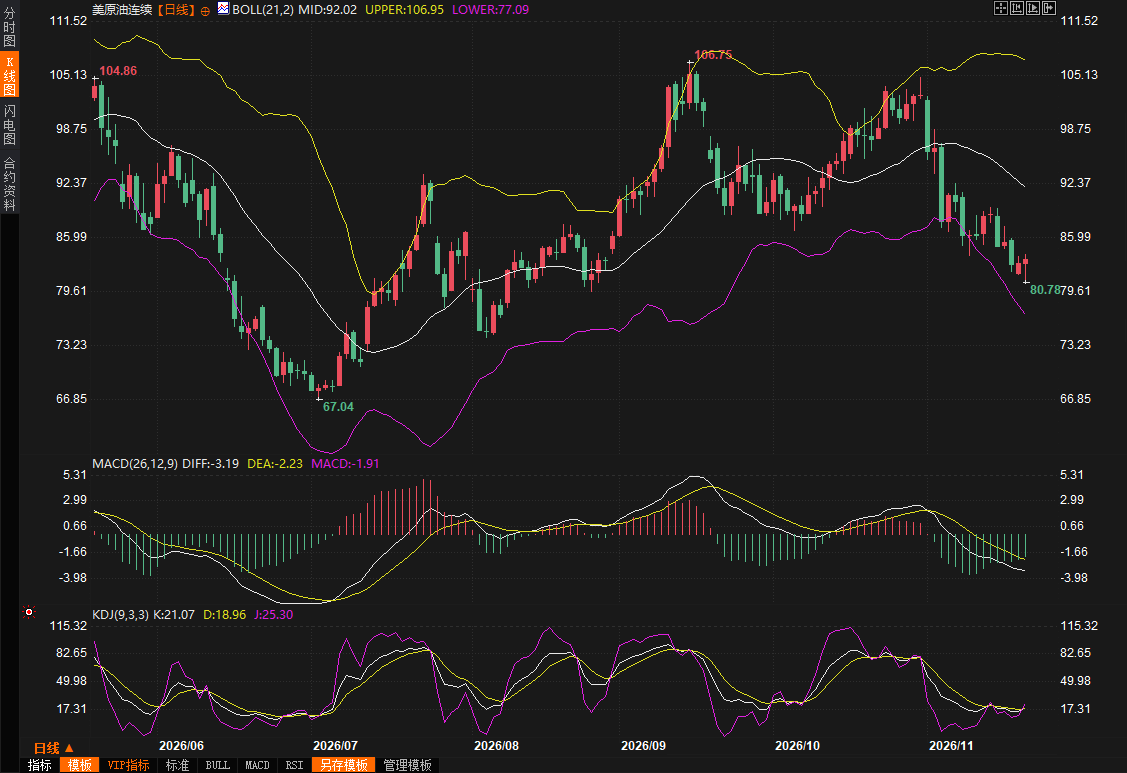 (US crude oil futures daily chart, source: FX678)
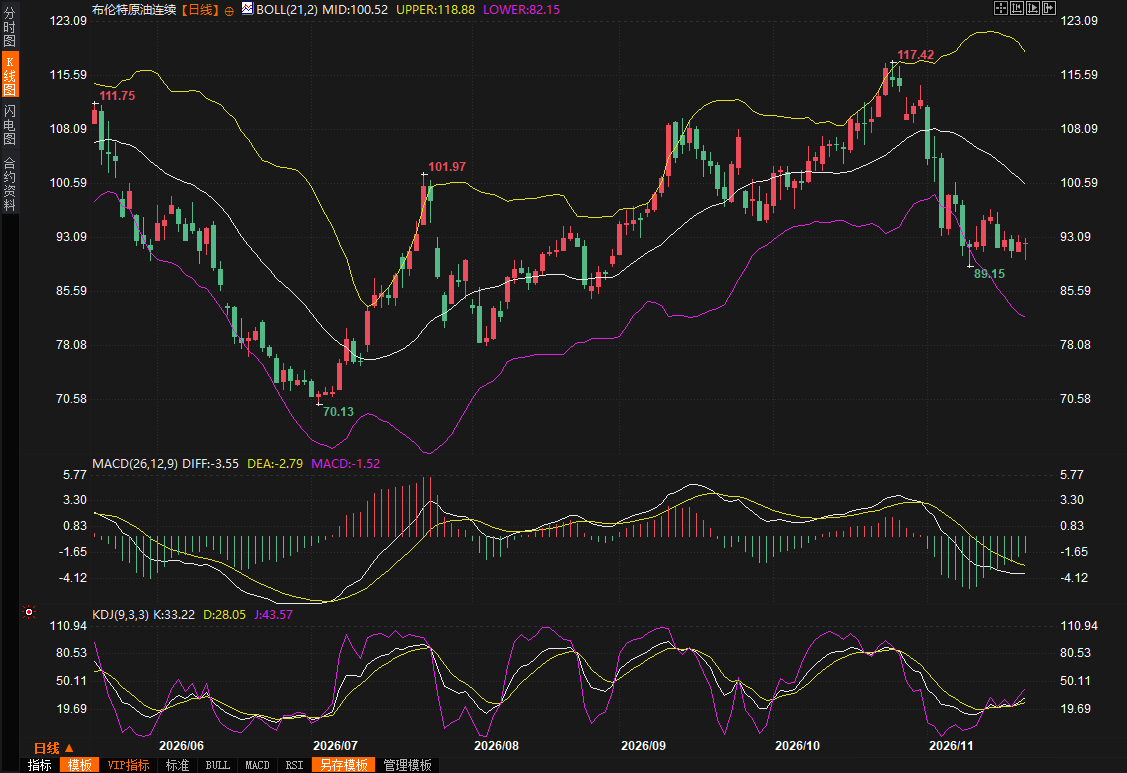 (Brent crude oil weekly chart, source: FX678) The unexpected increase in US inventories further reinforces this logic. Not only did crude oil inventories rise, but the comprehensive accumulation of refined product inventories also indicates that there are no significant bright spots on the demand side. Meanwhile, the ongoing attacks by Ukraine on Russian refineries and export infrastructure, while leading to a roughly 45% decrease in Russian crude oil processing, have not resulted in an overall ample global supply. OPEC+ will hold a ministerial meeting on November 29 to discuss 2027 production policy, and the market is closely watching whether it will adjust the supply pace. Analysts generally believe that there are two opposing forces in the market: on one hand, the recovery of Middle Eastern supply and expectations of a global surplus; on the other hand, the risk of war-related supply disruptions. Brent crude oil is therefore fluctuating within a range, and a sudden strengthening of either force could disrupt the balance.
Oil prices initially rose, then fell, and finally stabilized, with geopolitical factors and inventory data alternating influencing market sentiment.
At the start of the week, oil prices rose slightly on news of attacks on tankers in the Strait of Hormuz. Traders were concerned about continued shipping risks in the Strait, while market expectations of a decline in U.S. crude oil inventories provided support for prices. Brent crude briefly rose above $96 per barrel, and WTI approached the $90 mark. However, expectations that Middle Eastern exports would recover faster than global demand growth consistently capped gains. The International Energy Agency had previously stated that the global oil market would return to a state of oversupply in the fourth quarter. This assessment was confirmed by a sharp drop in transportation costs, a significant reduction in maritime risk premiums, and the recovery of Gulf exports to pre-February conflict levels. Subsequently, oil prices weakened. Wednesday's inventory data further pressured prices. Data released by the U.S. Energy Information Administration showed that U.S. crude oil inventories increased sharply by 3.4 million barrels in the week ending November 13, far exceeding market expectations of only an increase of 58,000 barrels; gasoline inventories surged by 5.2 million barrels, and distillate fuel inventories also increased by 1.6 million barrels. Unexpected inventory buildup immediately triggered a sell-off, with Brent crude falling by more than $2 at one point during the session, and December WTI crude falling by more than $4, ultimately settling at $83.26, a new low since the end of August. The increase in inventories further widened the Brent-WTI price spread, reflecting increased inventory pressure along the US Gulf Coast and temporarily closing the arbitrage window. The market was largely flat on Thursday amid mixed signals. Iranian state media reported that two oil tankers exploded after hitting mines in the Strait of Hormuz, and Houthi rebels launched missiles at Riyadh and warned residents near Saudi Red Sea ports to evacuate, reigniting concerns about supply disruptions. The International Energy Agency updated its data on the same day, stating that the Middle East conflict had resulted in a cumulative loss of 2.8 billion barrels of crude oil and 60 billion cubic meters of natural gas. These developments effectively offset inventory pressure and oversupply expectations, stabilizing oil prices. A pre-holiday corrective rebound occurred on Friday. Market concerns about a potential escalation of the US-Iran conflict, coupled with short covering by traders ahead of the Thanksgiving holiday, pushed Brent crude oil to settle at $92.57 and WTI December futures to settle at $83.98. John Kilduff, a partner at Again Capital, noted that while pre-holiday buying contributed to the strong and highly alert US military presence, concerns about the Iranian situation were the primary driving factor. (US crude oil futures daily chart, source: FX678)With geopolitical tensions still looming, risks in the Hormuz and the Red Sea continue to escalate.
Geopolitics remained the core variable for oil prices this week. Iranian drone attacks on a US military radar system in Bahrain prompted a retaliatory airstrike on a missile launch site on Qeshm Island. Iran also attacked a US base in Kuwait, its first such attack on the Gulf state since September. Frequent attacks on oil tankers and landmine incidents in the Strait of Hormuz, along with reports of missing crew members, directly pushed up shipping risk premiums. Meanwhile, the Houthi rebels in Yemen were very active. They launched drones at pumping stations along Saudi East-West oil pipelines and missiles at Riyadh's tallest skyscraper, causing damage. The Houthis further warned residents near Saudi ports along the Red Sea coast to evacuate and threatened to strike ports like Jeddah if the coalition attacked Hodeidah. Western officials revealed that Saudi Arabia is prepared for the conflict with the Houthis to continue into next year. These actions not only threaten the Strait of Hormuz, the world's most important oil route, but also directly impact alternative pipeline transport bypassing the strait. Despite mediation efforts by Oman and Qatar between the US and Iran, market vigilance regarding escalation remains high. UBS analysts point out that increasingly frequent attacks by Iran are putting pressure on Middle Eastern exports, leading to reduced maritime crude oil supplies. Against the backdrop of increased imports by major Asian countries, the market is actually tightening. BNP Paribas strategists, however, state that current prices are only reasonable if geopolitical risks are considered to have ended, but they disagree with this assessment, suggesting a potential rebound in oil prices.Oversupply expectations are rising, with the recovery of Middle Eastern exports becoming the biggest drag on supply.
In stark contrast to the geopolitical premium are easing signals from the fundamentals. Gulf exporters have increased exports to pre-war levels, and crude oil transportation costs have fallen sharply, clearly indicating that the risk premium is receding. The International Energy Agency's assessment that the fourth quarter will see a return to oversupply has become a key anchor for market pricing. Since the beginning of this month, Brent crude has fallen by about 20%, and WTI by about 16%, fully reflecting the dominance of oversupply expectations. (Brent crude oil weekly chart, source: FX678) The unexpected increase in US inventories further reinforces this logic. Not only did crude oil inventories rise, but the comprehensive accumulation of refined product inventories also indicates that there are no significant bright spots on the demand side. Meanwhile, the ongoing attacks by Ukraine on Russian refineries and export infrastructure, while leading to a roughly 45% decrease in Russian crude oil processing, have not resulted in an overall ample global supply. OPEC+ will hold a ministerial meeting on November 29 to discuss 2027 production policy, and the market is closely watching whether it will adjust the supply pace. Analysts generally believe that there are two opposing forces in the market: on one hand, the recovery of Middle Eastern supply and expectations of a global surplus; on the other hand, the risk of war-related supply disruptions. Brent crude oil is therefore fluctuating within a range, and a sudden strengthening of either force could disrupt the balance.A short-term rebound is unlikely to change the weak overall trend; geopolitical tensions and the struggle over oversupply will continue to dominate the market outlook.
In summary, the core contradictions in the crude oil market remained unresolved this week. Geopolitical risks did provide a floor for oil prices, particularly the uncertainty surrounding shipping in the Strait of Hormuz and the Red Sea, making a sustained sharp decline unlikely. However, the rapid recovery of Middle Eastern exports, the accumulation of US inventories, and the International Energy Agency's clear assessment of oversupply constituted significant downward pressure. Three consecutive weeks of declines have demonstrated that the boosting effect of geopolitical premiums, driven by oversupply expectations, is diminishing. Looking ahead to next week, the Thanksgiving holiday will reduce market liquidity, potentially amplifying price volatility. Traders need to closely monitor the actual developments in the US-Iran conflict, whether shipping in the Strait of Hormuz will be further disrupted, and policy signals ahead of the OPEC+ meeting. If geopolitical risks escalate again, oil prices could see a stronger rebound; however, if Middle Eastern exports remain strong and inventory pressure persists, the weak trend will be difficult to reverse. At current price levels, the market seems to be waiting for the next "black swan" or "white swan" event to break the deadlock. For investors, amid the tug-of-war between oversupply and the looming threat of war, carefully managing positions and closely monitoring shipping data and inventory changes may be more important than blindly betting on the direction.- Risk Warning and Disclaimer
- The market involves risk, and trading may not be suitable for all investors. This article is for reference only and does not constitute personal investment advice, nor does it take into account certain users’ specific investment objectives, financial situation, or other needs. Any investment decisions made based on this information are at your own risk.