Geopolitical premiums failing? IEA warns of a 2 million barrel oversupply, WTI crude oil faces slight downward pressure.
2026-11-23 11:32:34
On Monday (November 23), during Asian trading hours, US WTI crude oil prices came under downward pressure, currently trading around $83.20 per barrel, down about 0.2%. Traders weighed signals of stronger crude oil exports against the risk of escalating conflict in the Middle East, with expectations of a global crude oil oversupply prevailing over safe-haven buying driven by geopolitical tensions. 
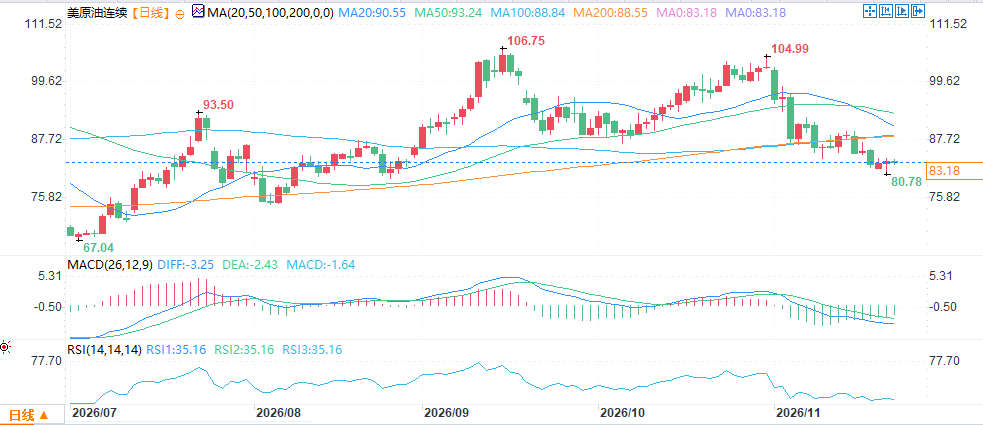 (US crude oil futures daily chart, source: FX678) At 11:31 Beijing time, US crude oil futures were trading at $83.21 per barrel.
Supply and demand drive pricing: IEA warns of significant crude oil surplus in Q4
The International Energy Agency (IEA) recently forecasts that the global crude oil supply surplus will reach approximately 2 million barrels per day in the fourth quarter of this year. The rapid recovery of crude oil exports from the Middle East, with increases significantly exceeding the decline in global crude oil demand, has become the core force suppressing oil prices. Goldman Sachs has also issued a warning, believing that the oil market will also face the risk of oversupply next year, with ample supply continuing to suppress WTI oil prices in the short term. Traders generally believe that the expectation of a global crude oil oversupply has gained the upper hand, overshadowing safe-haven buying driven by geopolitical conflicts. As Gulf oil-producing countries accelerate supply recovery through methods such as bypassing pipelines and ship-to-ship transshipment, market concerns about the oversupply have further intensified, significantly compressing the upside potential for oil prices.The ongoing geopolitical risks in the Middle East are only providing a lower support level for oil prices.
The ongoing tensions in the Middle East may limit the downside for oil prices, but currently only provide lower-level support, not a dominant factor driving a significant rebound. According to media reports over the weekend, Iran again attacked Bahrain; the Houthi rebels, supported by Iran, continued their attacks on targets within Saudi Arabia, with the attacks now reaching the Saudi capital, Riyadh. The UK's Office for Maritime Trade Operations (UKMTO) reported that two oil tankers were attacked by unidentified projectiles near Oman on Saturday. US President Trump posted on Truth Social that Iran launched a record number of missiles and drones last week, the highest in over a year, and indicated his willingness to resume strikes against Iran after the New Year if negotiations fail to reach an agreement. Despite the continued risk of escalation, the market is more focused on the actual recovery of supply, and geopolitical premiums are unlikely to offset expectations of oversupply.The ripple effects of loose supply: alleviating inflation and anchoring long-term bond yields.
Brown Brothers Harriman (BBH) strategists point out that the recent joint statement on peace between the US, Russia, and China has a core market impact in terms of commitments to expand refined petroleum product production and supply. Oil shipments through the Strait of Hormuz have recovered to approximately 80% of pre-war levels, effectively capping upside potential for crude oil prices and leaving gasoline and diesel prices with the possibility of further declines. BBH believes this combined effect will help alleviate inflationary pressures and constrain the rise in US long-term Treasury yields. The easing of supply not only directly lowers energy prices but also indirectly alleviates overall inflation expectations by reducing industrial and transportation costs. For the fixed-income market, falling energy costs help anchor long-term interest rates and reduce the risk of a sharp rise in yields. This transmission path is becoming a key focus in current macroeconomic trading. (US crude oil futures daily chart, source: FX678) At 11:31 Beijing time, US crude oil futures were trading at $83.21 per barrel.
- Risk Warning and Disclaimer
- The market involves risk, and trading may not be suitable for all investors. This article is for reference only and does not constitute personal investment advice, nor does it take into account certain users’ specific investment objectives, financial situation, or other needs. Any investment decisions made based on this information are at your own risk.