Gold has gone from being the king of safe havens to a "cash cow"—has the logic changed?
2026-11-23 11:36:33
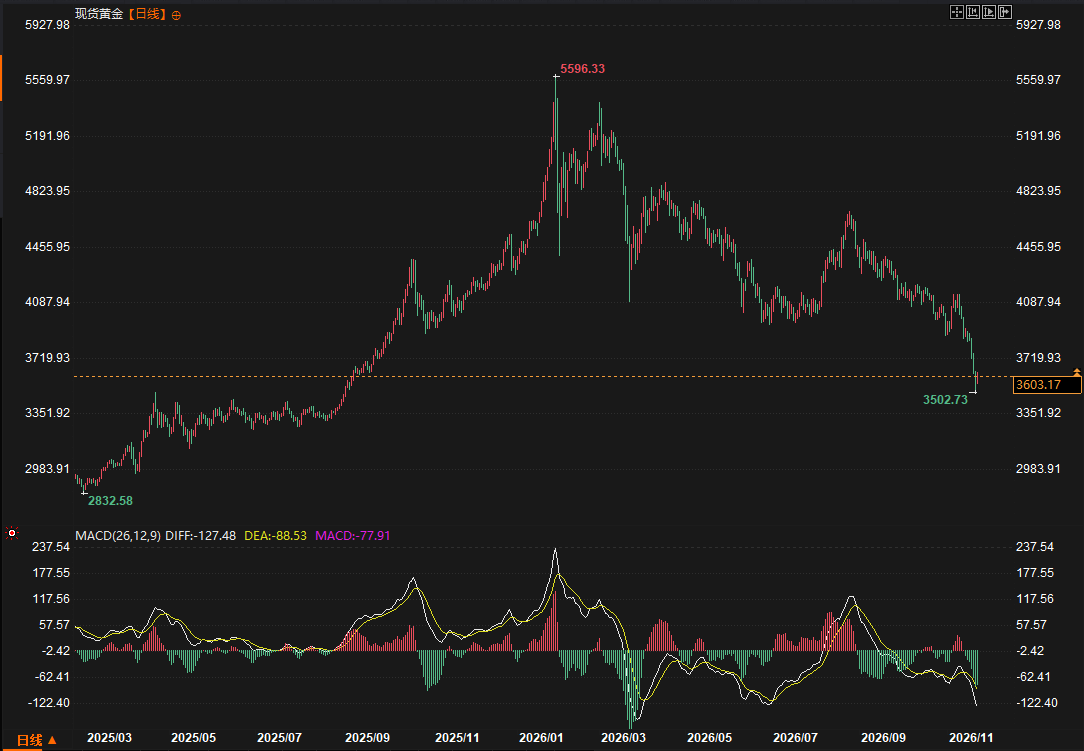
Spot gold has recently experienced a period of significant volatility. Last week, gold prices fell by approximately 9%, briefly dipping to around $3,520, a 14-month low and the worst week in nearly eight months. The market rebounded at the beginning of this week, with prices currently above $3,600, a daily gain of nearly 2%. However, considering the broader context of the decline from the January 2026 high (over $5,500), it remains in a clear correction phase. For traders who have long followed gold, the real significance of this decline lies not in the "amount" of the drop, but in how it reveals the changing role of gold in the market. 
Forced selling becomes the core driver
In the past, gold was often bought as a safe-haven asset during risk events, but in this round of correction, the situation has reversed. Several institutional analysts pointed out that the sharp pullback in AI and related technology stocks triggered margin pressure on leveraged accounts. When there are consecutive losses on the stock market, investors need to quickly raise cash, and gold, with its deep market and low liquidity, naturally becomes one of the assets prioritized for sale. ING commodity strategist Ewa Manthey mentioned that higher interest rate expectations and a stronger dollar have reduced the attractiveness of gold, while the stock market sell-off may also prompt some investors to sell gold for cash. Commerzbank's Carsten Fritsch directly pointed out "renewed forced selling." Under this mechanism, gold is temporarily more like a "liquidity tool" than a pure safe haven—its near-term direction depends more on stock volatility and the speed of deleveraging, rather than traditional geopolitical or inflation hedging needs. The even larger drop in silver prices during the same period (approximately 14%) also confirms that this is a release of liquidity pressure across assets, rather than a problem specific to gold.The combined pressure from interest rate expectations and the dollar environment
Parallel to the forced selling is a shift in monetary policy expectations. The market's pricing in a December rate hike by the Federal Reserve is nearly certain, and higher interest rates increase the opportunity cost of holding non-yielding assets. A temporary strengthening of the US dollar and rising real interest rates further weaken gold's relative attractiveness. Goldman Sachs has lowered its gold forecast twice this month, now expecting gold prices to be around $4,150 by the end of 2026 and $4,650 by the end of 2027. Institutions generally believe that further downside potential from interest rates in the short term may be limited (because rate hike expectations are already fully priced in), but if AI-related stocks continue to correct sharply, it could still trigger a new wave of liquidation. Conversely, if the stock market stabilizes, the selling pressure on gold is more likely to ease. It is worth noting that even during the sharp decline in gold prices, some analysts still emphasize that medium- to long-term central bank gold purchases and investor allocation demand have not disappeared, but have only been temporarily suppressed by short-term liquidity forces.Role Shift: From "Safe Haven" to "Linked Asset"
The most noteworthy aspect of this market trend is the rapid increase in the correlation between gold and risk assets under specific circumstances. When the market enters a deleveraging phase, gold no longer operates independently but becomes part of the entire risk asset chain. Its high liquidity becomes a double-edged sword—easy to enter and exit in normal times, but easily sold off during crises. Current gold prices are significantly lower than most banks' year-end targets, and further downward revisions to forecasts are possible, which will also put downward pressure on sentiment. However, the real turning point is more likely to come from a contraction in stock market volatility or signs of easing in Federal Reserve policy communication (such as rising concerns about excessively rapid tightening). Recently, some market voices, including Bill Ackman, have begun to publicly discuss whether inflation targets should be more realistic and the risks of further interest rate hikes; these discussions themselves may also influence market expectations for the future policy path.
- Risk Warning and Disclaimer
- The market involves risk, and trading may not be suitable for all investors. This article is for reference only and does not constitute personal investment advice, nor does it take into account certain users’ specific investment objectives, financial situation, or other needs. Any investment decisions made based on this information are at your own risk.